Eligibility Age Raised to Eight This Year, Increasing Annually
Passed Welfare Committee Through Bipartisan Agreement
Awaiting Review by Legislation and Judiciary Committee Before Plenary Vote
The National Assembly’s Health and Welfare Committee has passed a revision to the Child Allowance Act, which will raise the eligibility age for child allowance payments by one year each year from the current age of seven, reaching age twelve by 2030.
On January 7, the Welfare Committee held consecutive meetings of the Bill Review Subcommittee No. 1 and the full committee to process the amendment to the Child Allowance Act. According to the amendment, starting this year, the child allowance will be paid to children up to age eight, and the eligibility age will increase annually, expanding to cover children up to age twelve by 2030. In addition, for this year only, children living outside the Seoul metropolitan area and in regions with declining populations will receive an additional monthly allowance of 5,000 to 20,000 won.
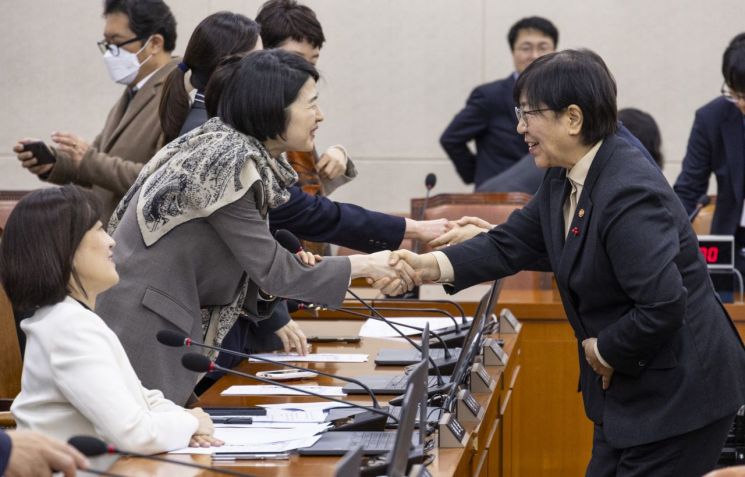
The People Power Party has opposed the child allowance on the grounds of universal provision. However, through bipartisan compromise, an agreement was reached to include districts classified as population-declining areas within metropolitan cities, such as Dong-gu, Seo-gu, and Yeongdo-gu in Busan, and Nam-gu and Seo-gu in Daegu. Kim Mi-ae, the People Power Party’s secretary for the Welfare Committee, stated, "The child allowance is a universal welfare system that guarantees children’s basic rights, and the People Power Party maintains that it should be provided to all children without discrimination. Regional differentiation in payments undermines the principle of the system and constitutes reverse discrimination against children in the metropolitan area." She added, "Differences in childcare infrastructure and conditions, as argued by the ruling party, should be addressed through separate policies, not through the child allowance. Since we cannot undermine policy trust, we have reluctantly accepted the temporary additional payments. Next year’s budget must include provisions to increase the amount for all children, as advocated by the People Power Party."
Lee Sujin, the Democratic Party’s secretary for the Welfare Committee, commented, "There should be preferential treatment for population-declining areas, and the additional payments should be linked to revitalizing local communities. I hope consensus can be reached on providing additional payments either through regional preference or local currency." The Democratic Party initially sought to provide extra child allowance payments in the form of local currency, but this provision was excluded from the amendment due to opposition from the People Power Party.
A Welfare Committee official explained, "The bill will undergo a review of its structure and wording by the Legislation and Judiciary Committee before being put to a vote at the plenary session."
© The Asia Business Daily(www.asiae.co.kr). All rights reserved.

















