Gwangju City Announces 2026 Administrative Vision at New Year's Press Conference
Welfare Budget Set at 583.7 Billion Won... Welfare Administration Town to Be Completed in February
Accelerating Success of 2026 Gyeonggi Sports Games and Construction of Five Major Rail Networks
"From Livelihoods to Railways... Gwangju Will Open a Sustainable Future"
Gwangju City in Gyeonggi Province has unveiled its administrative blueprint for the Year of the Fire Horse (Byeongo) in 2026, focusing on the recovery of the local economy and the establishment of a rail-centered transportation system.
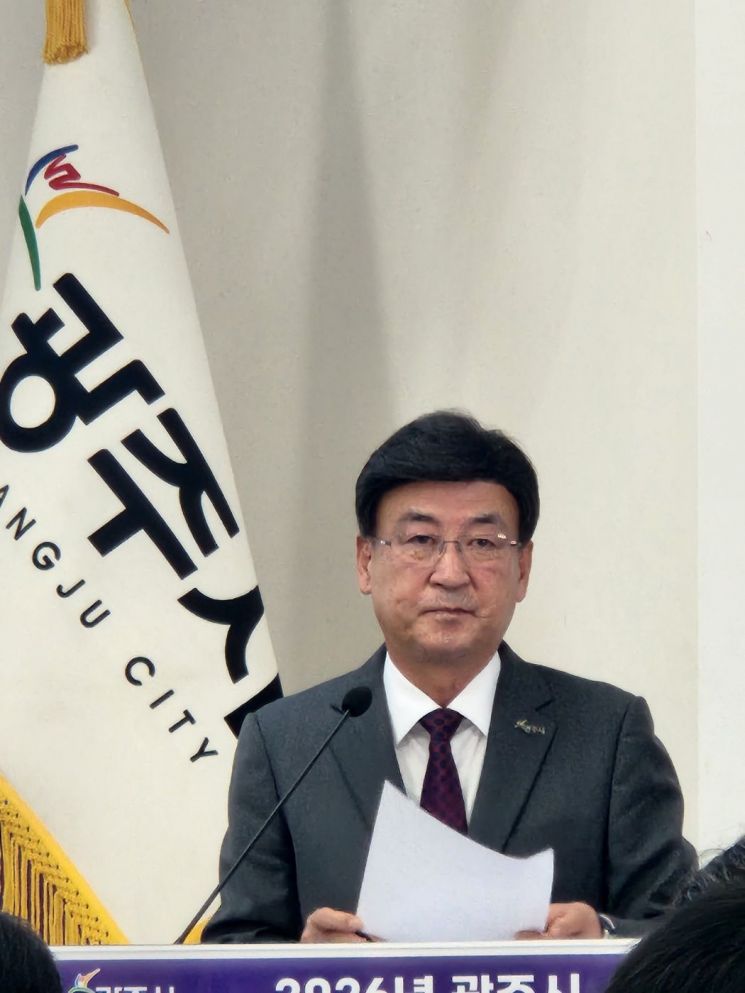 Gwangju Mayor Bang Se-hwan presented the five core administrative goals at a New Year's press briefing held at City Hall on the 7th, stating, "Based on the foundation of change established since the launch of the 8th elected administration, this year we will achieve tangible results that citizens can directly experience in improving their quality of life." Photo by Lee Jong-gu
At a New Year's press conference held at City Hall on the 7th, Mayor Bang Sehwan presented five core administrative goals, stating, "Based on the foundation of change built since the launch of the 8th elected administration, this year we will achieve tangible results that citizens can directly feel in the improvement of their quality of life."
This year, Gwangju City has identified "protecting the local economy" as its most urgent task. The city plans to expand financial support for small business owners and SMEs, and to strengthen the preferential purchase system for local products, creating a virtuous cycle of funds within the region. In addition, through the "Gwangju-style Job Policy," the city will establish a stable employment base for both young people and seniors.
In the agricultural sector, the city will foster the Jayeonchae Food Farm Center as a key infrastructure facility to expand local food consumption, and will pursue a development model for urban-rural coexistence by restructuring rural spaces.
In the welfare sector, the city's welfare budget for this year has been set at 583.7 billion won, an increase from the previous year, accounting for 46.1% of the total budget.
In particular, the Gwangju Welfare Administration Town, scheduled for completion in February 2026, will establish an integrated welfare support system encompassing all generations and social groups. The city also plans to operate its first-ever Welfare Center for the Disabled and a Lifelong Learning Center for the Disabled, aiming to significantly improve the quality of welfare services for people with disabilities.
Tailored policies for children, youth, and seniors will also be strengthened. The city will create a child-friendly environment by attracting the Aibarun Growth Center and the Gyeonggi Eastern Region Early Childhood Experience Education Center, while expanding employment and housing support for young people. With the construction of the Eastern Region Senior Welfare Town and an increase in the monthly honorarium for national merit veterans to 180,000 won, the city has enhanced recognition for their service.
The successful hosting of the 2026 Gyeonggi-do Comprehensive Sports Games has also been identified as a major task.
Gwangju City has completed construction on 11 sports facilities, including the Bandabi Sports Center for the Disabled. The Gwangju G-Stadium, equipped with a certified 50-meter swimming pool, and the tennis dome stadium are also nearing completion. The city plans to host all events except shooting within Gwangju, further establishing its reputation as a sports city.
This sports event will be operated as an ESG practice event reflecting the value of carbon neutrality and is expected to attract more than 20,000 visitors, thereby revitalizing the local economy. At the opening ceremony, the "Dalhangari Seongsudae" performance will symbolize the unity of all 31 cities and counties in Gyeonggi Province by merging their waters into one.
To strengthen urban competitiveness, the city will promote the "2030 Urban Management Plan Revision," accelerate the second phase of urban development around Gwangju and Gonjiam stations, as well as the development of Samdong and Chowol. The city will create a pleasant industrial environment by renovating factory-concentrated areas and will expand leisure and tourism infrastructure for citizens, including the Jungang Park glamping site, pet playground, Songjeong Sports Park, Paldang Mulangae Park, and Gyeongan Stream Ecological and Cultural Riverside Park.
In the transportation sector, the city will accelerate its transition to a rail-centered urban system.
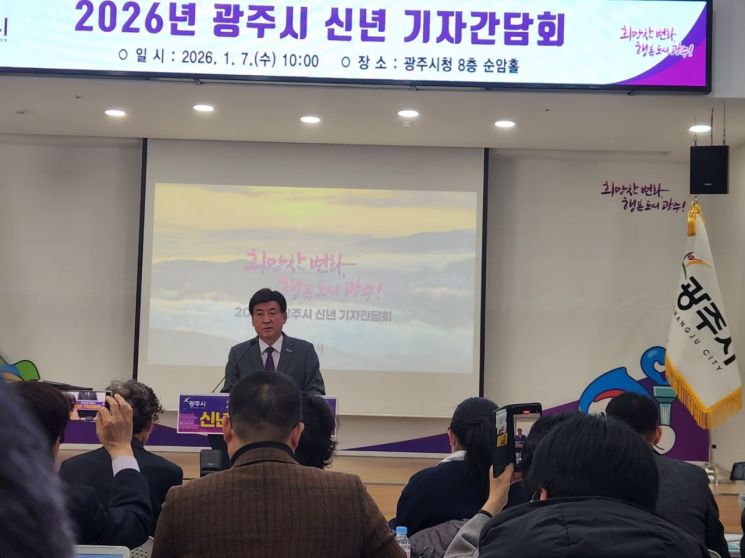 Mayor Bang Se-hwan of Gwangju is holding a New Year's press conference at the city hall on the 7th. Photo by Lee Jonggu
The city will actively ensure the smooth progress of five major rail network projects: the Suseo-Gwangju double-track railway, the Gyeonggang Line extension, the Wirye-Samdong Line, GTX-D, and the Pangyo-Opo Line. By 2028, all regular buses will be converted to eco-friendly low-floor buses, and the city will address chronic congestion by constructing ramps on the Seongnam-Janghowon Expressway and expanding and paving national highways.
For environmental policy, the city will pursue energy production through an integrated biogas facility and establish a "Gwangju-style Comprehensive Forest Welfare Plan." The construction of the Neoreungol Natural Recreation Forest and the Timber Education Center will further accelerate the creation of an ecological city where people and nature coexist.
Mayor Bang stated, "We will complete an urban structure that harmonizes residential environment improvements with industry, tourism, and leisure, and leap forward as a sustainable, self-sufficient city of 500,000 people. Together with more than 1,600 public officials, I will fulfill my responsibility to the end to make Gwangju a city where citizens are truly happy."
© The Asia Business Daily(www.asiae.co.kr). All rights reserved.
![Clutching a Stolen Dior Bag, Saying "I Hate Being Poor but Real"... The Grotesque Con of a "Human Knockoff" [Slate]](https://cwcontent.asiae.co.kr/asiaresize/183/2026021902243444107_1771435474.jpg)
















