"Emphasizing Integration by the Residents, for the Residents Through a Referendum"
Calls for Guaranteeing Legislative, Organizational, Fiscal, and Autonomous Authority and Status
According to a public opinion poll conducted by the Busan-Gyeongnam Administrative Integration Public Deliberation Committee, 53.65% of Busan and Gyeongnam residents responded in favor of administrative integration, while 29.20% expressed opposition.
In previous surveys conducted in June 2023 and September 2025, the approval rate had remained in the 30% range, but this time it has surpassed the halfway mark.
On January 6, at the 2026 New Year's press conference held in the provincial government conference room, Park Wansu, Governor of Gyeongnam Province, emphasized, "Administrative integration must be by the residents and for the residents, and this integration is meaningless unless the status and autonomy of local governments are guaranteed."
Governor Park stated, "Administrative integration was the very first initiative I advocated when I took office as governor four years ago," adding, "At that time, I explained to Busan City the necessity and process of administrative integration and presented four conditions."
He explained, "The first condition was that integration must be by the residents and for the residents, and the second key prerequisite was that integration is meaningless unless the status and autonomy of local governments are guaranteed."
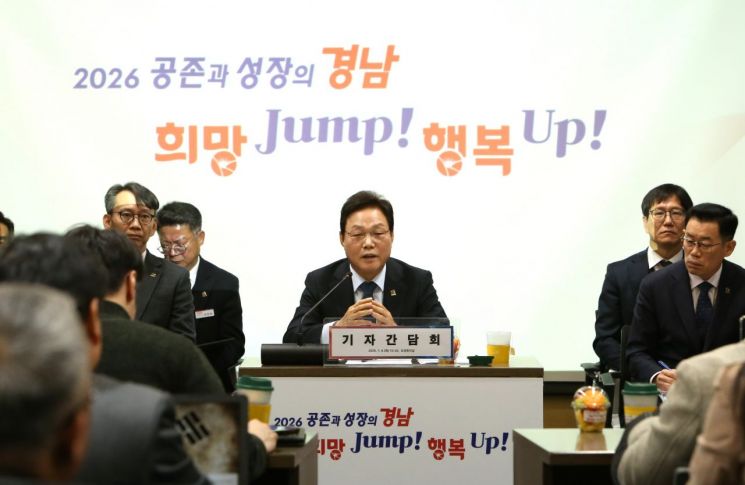 Gyeongnam Province Governor Park Wansu is speaking about the promotion of administrative integration with Busan at the 2026 New Year's press conference. Photo by Lee Seryeong
He then proposed a 'resident referendum' as a way to achieve 'integration by the residents, for the residents.'
Governor Park stated, "If administrative integration is pursued through political discussions by political circles, it will inevitably lead to trial and error and side effects," and continued, "As someone who has experienced the integration of Changwon, Masan, and Jinhae, I believe that in order to secure the identity and legitimacy of Korea's first metropolitan local government integration, reduce trial and error, and minimize conflict, a resident referendum must be held."
He added, "Integration for the sake of integration is meaningless," and stressed, "For integration to have a real effect, it is important what kind of status and autonomy the integrated local government will have."
He further stated, "Integration must be achieved by residents through a referendum, and the central government must provide an answer as to what extent the status and autonomy of the integrated local government will be guaranteed."
Governor Park also said, "Physical time is needed to determine the criteria for the authority of the integrated local government, the location of the integrated government office, and the name of the region after integration," adding, "The only way to resolve all these issues at once is through a resident referendum."
Under the Public Official Election Act, a resident referendum cannot be held within 60 days of an election. Therefore, in order to achieve integration by June 30 this year, the referendum must be held before April 3. He explained that prior to this, the status and autonomy of the integrated local government must be reflected in a special law, and the referendum must be held based on that.
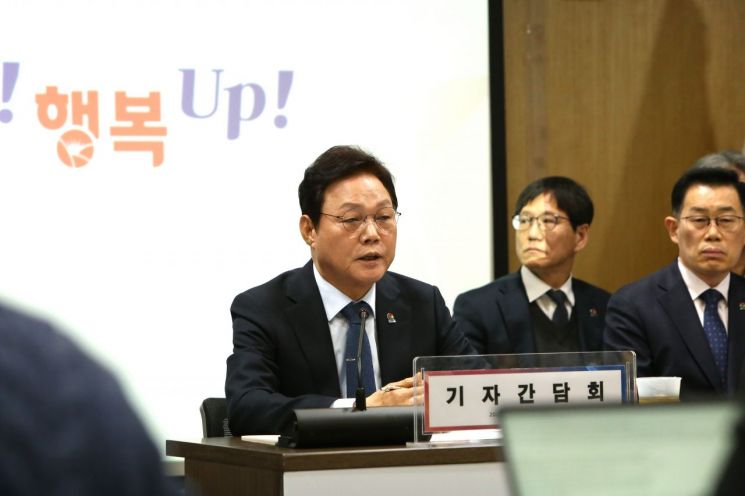 Governor Park Wansu of Gyeongnam Province is answering reporters' questions at the 2026 New Year's press conference. Photo by Lee Seryung
Regarding the status and authority of local governments, Governor Park pointed out, "Local autonomy in Korea is only at 5%."
He said, "When preparing the budget for Gyeongnam Province and submitting it to the provincial council, I found that, excluding statutory and mandatory expenses, only 5% of the total budget is available for the province to allocate for projects for the residents. The rest is determined unilaterally by the central government, including the purpose and size, and then sent to the region."
He continued, "President Lee Jaemyung has said that local governments will henceforth be called local administrations, but they must be given the status and authority befitting a true local administration, not just in words. Only when legislative, organizational, autonomous, and fiscal authority and status are granted will integration be beneficial and will there be a willingness to pursue it."
Governor Park also emphasized, "I don't think there is any other country like Korea where national functions such as administration, healthcare, education, welfare, culture, finance, and the economy are so concentrated in the capital region," and called for the decentralization of national functions to the provinces.
He pointed out, "If national functions are not dispersed to the provinces, only the capital region will continue to grow, and balanced national development policies cannot be achieved. Seoul and Gyeonggi Province are responsible for more than half of the national functions, and now even the Chungcheong region is being included, but Gyeongnam and Jeonnam, which are far from the capital region, are left out in the cold."
He lamented, "In regions far from the capital, even to build a single railway or road, a preliminary feasibility study must be passed, which is measured based on demand. The capital region has high demand, but as the population in the provinces declines, demand decreases, making it impossible to build even a single road or railway under the current system."
He continued, "The preliminary feasibility study system must be revised to consider non-capital regions, and government support policies should include tax reforms and grant tax authority to local governments that are far from the capital. If administrative integration proceeds without these long-standing proposals to the central government being reflected, it could lead to significant conflict."
Governor Park stated, "Administrative integration is being pursued to ensure that metropolitan administration is properly aligned with living areas and to respond to the capital-centric system. Local governments need to scale up, but only when they have the corresponding authority and finances for self-development will they be able to respond effectively to the capital region."
He added, "Integration is like marriage; it cannot happen just because one party wants it. We will discuss the next steps with Busan City based on the results of the public opinion survey conducted by the Public Deliberation Committee."
Regarding whether he will run for re-election in the local elections this June, he said, "I have not decided yet. I will listen to public opinion and make a decision. There are many provincial issues to address and many things to take care of at the beginning of the new year, so I will take my time to clarify my position and announce it when the time comes."
© The Asia Business Daily(www.asiae.co.kr). All rights reserved.
![Clutching a Stolen Dior Bag, Saying "I Hate Being Poor but Real"... The Grotesque Con of a "Human Knockoff" [Slate]](https://cwcontent.asiae.co.kr/asiaresize/183/2026021902243444107_1771435474.jpg)
















