Economic Delegation Brings Together Leaders of Entertainment and Content Industries
Consensus on Gradual Restoration of Cultural Exchanges
Korea: "Step-by-Step Exchange" vs. China: "Orderly Progress"
 President Lee Jae-myung and his spouse, along with President Xi Jinping and his spouse, are taking a commemorative photo after the state banquet at the Great Hall of the People in Beijing, China, on the 5th. Photo by Joint Press Coverage
There are signs that China’s “Korean Wave Ban” (Hallyu Restriction Order), which was triggered by the deployment of the Terminal High Altitude Area Defense (THAAD) system in 2016, may be lifted after nearly a decade. This comes as President Lee Jaemyung’s state visit to China is accompanied by a large delegation of leaders from Korea’s culture and content industries. The industry is now closely watching to see whether the pipeline of Korea-China cultural industries, which has been severed for ten years, will be reconnected, moving beyond simple human exchanges.
According to the business and entertainment industries on January 7, this economic delegation to China includes not only the heads of Korea’s four major conglomerates, such as Lee Jae-yong, Chairman of Samsung Electronics, but also CEOs from cultural content companies and entertainment agencies. These include Sohn Kyungshik, Chairman of CJ Group; Jang Cheolhyuk, CEO of SM Entertainment; Kim Changhan, CEO of Krafton; and Choi Yongho, CEO of Galaxy Corporation.
CJ and SM are traditional powerhouses that enjoyed their heyday in the Chinese market prior to the Hallyu Restriction Order. Krafton has established a massive user base in China with its game “Battlegrounds.” The addition of Galaxy Corporation, an emerging powerhouse, has further strengthened the delegation. This reflects the current administration’s policy of making “realizing a cultural powerhouse” a key national agenda.
A senior figure in the music industry commented, “In the past, economic delegations were centered on manufacturing, but this time, the proportion of content companies has noticeably increased. This is a result of China’s need for high-quality Korean content to stimulate its domestic market, aligning the interests of both countries.”
Particular attention is being paid to Choi Yongho, CEO of Galaxy Corporation, who was born in 1989 (age 37). As the youngest CEO in the delegation, he presented a differentiated strategy for this visit to China. Instead of simply putting affiliated artists on Chinese stages, he introduced an “Enter-tech” model that combines artificial intelligence (AI) and metaverse technologies. The plan is to merge China’s nationally promoted AI robot industry with Korea’s creative intellectual property (IP).
Last October, Galaxy Corporation achieved tangible results by signing a Greater China world tour contract for singer G-Dragon with China’s largest music platform, Tencent Music Entertainment. It is reported that CEO Choi discussed partnerships for AI avatar technology and other collaborations with local Chinese partners at the Korea-China Business Forum held in Beijing the previous day.
Government-level support is also continuing. Wi Sunglak, Director of the National Security Office, stated at a briefing on the Korea-China summit on January 2 that “the leaders of both countries agreed to gradually and step-by-step restore cultural content exchanges.” It is unusual for the restoration of cultural exchanges to be formalized at the summit level.
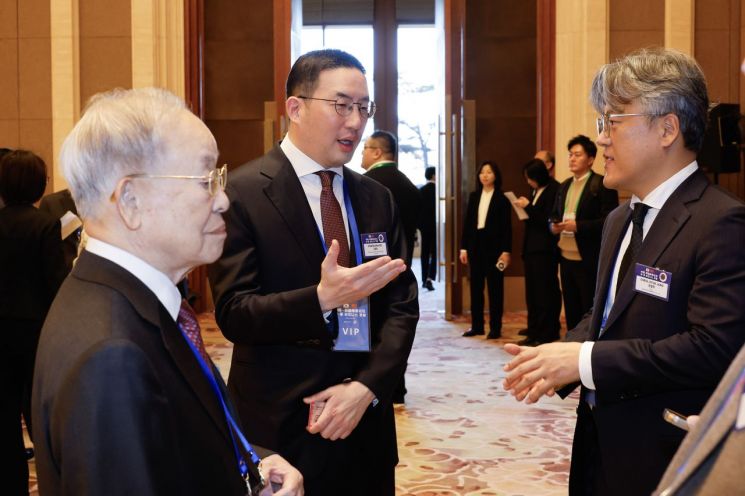 Koo Kwangmo, Chairman of LG Group (center), and Chang Chulhyuk, CEO of SM Entertainment, are conversing at the Korea-China Business Forum held on the 5th at the Beijing Diaoyutai State Guesthouse. On the left is Sohn Kyungshik, Chairman of CJ Group. Photo by Yonhap News Agency
 Jang Cheolhyuk, CEO of SM Entertainment (left), Choi Yongho, CEO of Galaxy Corporation. Provided by each agency.
The Chinese government has also responded in principle. At a regular briefing on January 6, Mao Ning, spokesperson for the Chinese Ministry of Foreign Affairs, answered a question from reporters about expanding imports of Korean cultural content by saying, “Both Korea and China agree to carry out healthy and beneficial cultural exchanges in an orderly manner.” Rather than a rapid opening, both countries appear to be emphasizing order and gradual progress, adjusting the pace accordingly.
However, it is premature to be optimistic. The Chinese government maintains that “there is no such thing as the Hallyu Restriction Order,” but in reality, invisible barriers such as delays in permits for K-pop concerts persist.
Kang Hoonshik, Chief Presidential Secretary, drew a line on a radio program on January 5 when asked whether the Hallyu Restriction Order would be immediately lifted as a result of this visit, saying, “I think it will take a little time.” He added, “The process of building trust with the Chinese side must come first. This visit will be the first step in building that trust, and as trust deepens, the doors will fully open in the long term.” This is interpreted as placing more weight on a gradual recovery through private exchanges rather than an immediate, full-scale opening.
Experts advise that, in light of this visit to China, Korea should fundamentally reconsider its content strategy for the Chinese market. They point out that the previous model of simply exporting Korean content to generate profits is no longer effective.
Jang Cheolhyuk, CEO of SM Entertainment, also explored the possibility of establishing a local joint venture in China during this visit, for similar reasons. Krafton is also strengthening technological cooperation with Tencent in China to respond more flexibly to local regulations.
The results of this economic delegation’s visit to China are expected to become visible in the coming months. Whether Chinese authorities will permit stadium tours for major Korean artists and significantly expand the issuance of licenses (banhao) for Korean games will serve as indicators for the lifting of the Hallyu Restriction Order.
A representative from a major entertainment agency commented, “Over the past ten years, the Chinese entertainment market has developed its own idol training system. Rather than simply sending Korean singers to perform, a sophisticated cooperation model mediated by technology could be the key to overcoming the Hallyu Restriction Order.”
© The Asia Business Daily(www.asiae.co.kr). All rights reserved.
![Clutching a Stolen Dior Bag, Saying "I Hate Being Poor but Real"... The Grotesque Con of a "Human Knockoff" [Slate]](https://cwcontent.asiae.co.kr/asiaresize/183/2026021902243444107_1771435474.jpg)













