Consensus Reached on "Special City" Status Over "Special Province" for Integration
Name Adjustment Planned During Special Act Revision and Resubmission
Assemblyman Jeong Junho: "Goal Is to Consider Integration and Reorganization at the Basic Level"
It has been reported that Gwangju City and Jeollanam-do Province have reached a consensus to designate the status of the integrated local government, which will be established after administrative integration, as a "Special City" rather than a "Special Province."
According to Gwangju City and Jeollanam-do Province on January 6, the two local governments have formed a consensus during the administrative integration discussions to set the legal status of the integrated local government as a "Special City." This decision is interpreted as an effort to integrate only the metropolitan governments while maintaining the current system for basic local governments.
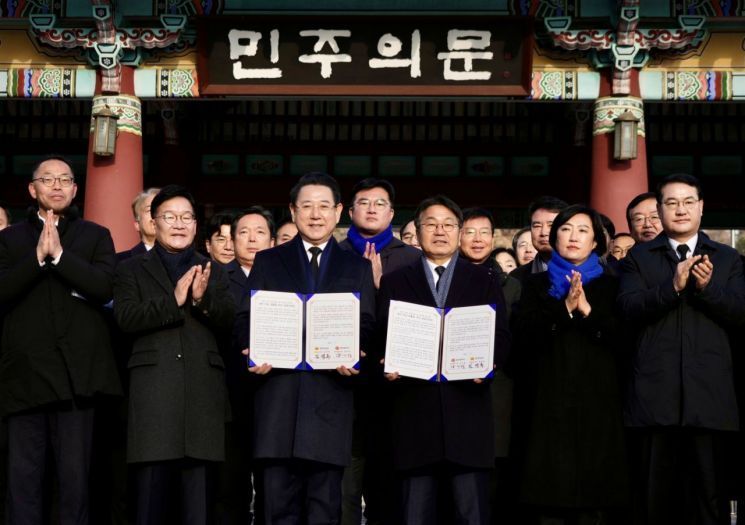 Gwangju Mayor Kang Gijeong and Jeollanam-do Governor Kim Youngrok are announcing the "Joint Declaration for Promoting Integrated Local Government" after paying a joint tribute at the National May 18 Democratic Cemetery on the 2nd. Provided by Gwangju City
Currently, the Gwangju-Jeonnam Integration Special Act, sponsored by Assemblyman Jeong Junho of the Democratic Party, specifies the name of the integrated local government as "Gwangju-Jeonnam Ultra-Wide Special Autonomous Province." However, both Gwangju City and Jeollanam-do Province are considering amending this to "Special City" during the process of supplementing or resubmitting the special act in the future.
Gwangju City and Jeollanam-do Province believe that the name "Special City" is appropriate, given the central government's position to grant the integrated local government a status and authority equivalent to that of Seoul Special City. In particular, they have carefully considered the possibility of changes to the status of basic local governments after the integration.
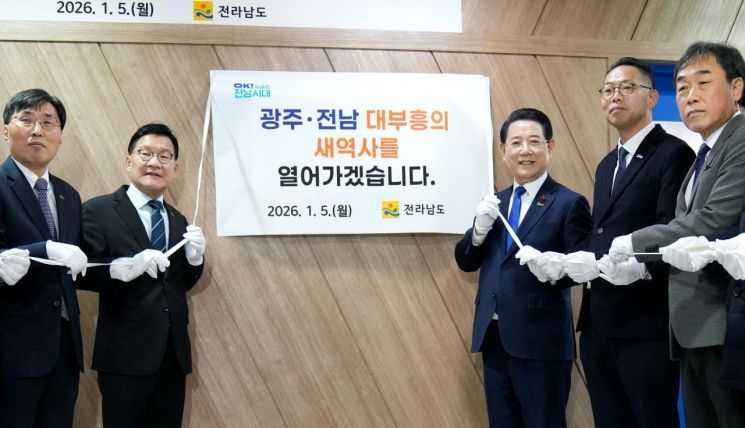 Kim Youngrok, Governor of Jeollanam-do, is unveiling the plaque of the "Gwangju-Jeonnam Administrative Integration Promotion Planning Group" with attendees at the provincial office on the 5th. Provided by Jeonnam Province
If the integration proceeds as a "Special Province," Gwangju, which is currently a metropolitan city, would be converted into a special city under the jurisdiction of the special province. In this case, the five districts of Gwangju would not meet the requirements for autonomous districts under the current Local Autonomy Act, resulting in the loss of their autonomy, with district heads becoming appointed positions and district councils potentially being abolished.
Accordingly, the two local governments have decided to set the status of the integrated local government as a "Special City," based on the principle of integrating only the metropolitan governments first while maintaining the basic local governments, a "metropolitan first, basic later" approach.
If Gwangju and Jeonnam are integrated as a special city, the positions of Gwangju Mayor and Jeonnam Governor will be abolished, and the head of the integrated local government will be elected. Meanwhile, the five autonomous districts of Gwangju and the 22 cities and counties of Jeonnam will retain their current status, maintaining their respective heads and councils.
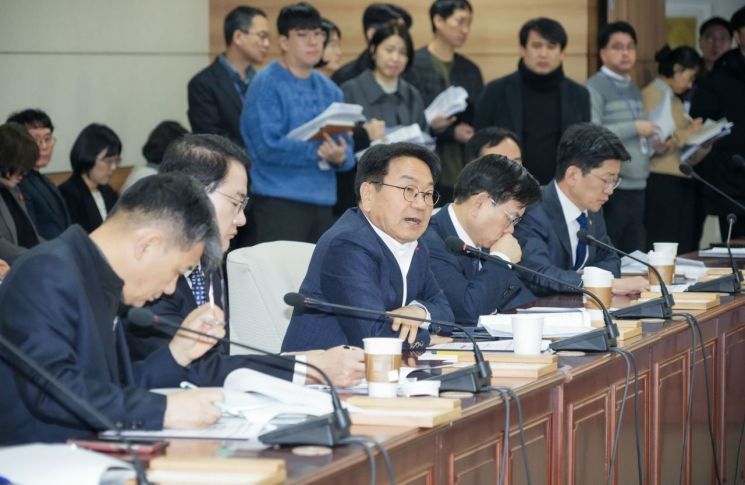 Kang Gijeong, Mayor of Gwangju Metropolitan City, held a meeting with city council members on the morning of the 6th at the Gwangju City Council's main conference room to discuss the progress of administrative integration between Gwangju and Jeonnam. Provided by Gwangju Metropolitan City
At a meeting with city council members on this day, Kang Gijeong, Mayor of Gwangju, reportedly explained, "We have reached a consensus with Jeonnam Province to set the status of the integrated local government as a 'Special City.' The metropolitan government head will be elected through integration, but basic governments such as Gwangju's district offices will maintain the current system."
The draft of the special act includes provisions to abolish the existing Gwangju City and Jeonnam Province, and to establish a new integrated local government under direct central government control with a status and authority equivalent to Seoul Special City. The integrated local government will be guaranteed a high degree of autonomy in organization, personnel, and finance, and aims to implement an autonomous police system and educational autonomy.
The government has prepared grounds to provide administrative and financial special provisions, such as supporting costs for the launch of the integrated local government, local allocation tax, establishment of administrative organizations, and allocation of administrative authority. The name of the integrated local government will be finalized during the legislative process in the National Assembly, and there are plans to utilize the existing government office buildings of Gwangju City and Jeonnam Province as the new government offices.
Special provisions will also apply to the election system. According to the special act, the head of the integrated metropolitan government will be elected in the local elections in June this year, and separate elections for Gwangju Mayor and Jeonnam Governor will not be held. The integrated metropolitan council will also be elected in the June local elections, with the current number of council members and electoral districts maintained.
Incumbent public officials wishing to run for the head of the integrated metropolitan government must resign within 10 days from the enforcement date of the law. However, if the current Gwangju Mayor, Jeonnam Governor, or city and provincial council members run for the head of the integrated local government or the integrated metropolitan council, they will be allowed to run while retaining their positions.
Even after the launch of the integrated local government, the existing laws, ordinances, and rules of the former city and province will remain effective until new regulations for the integrated local government are enacted. The status of existing public officials will also be succeeded to the integrated local government.
Assemblyman Jeong Junho stated, "In this local election, we will conduct integrated elections at the metropolitan level, and after the launch of the integrated local government in July, the long-term goal is to consider integration and reorganization at the basic local government level as well."
© The Asia Business Daily(www.asiae.co.kr). All rights reserved.
![Clutching a Stolen Dior Bag, Saying "I Hate Being Poor but Real"... The Grotesque Con of a "Human Knockoff" [Slate]](https://cwcontent.asiae.co.kr/asiaresize/183/2026021902243444107_1771435474.jpg)

















