Kang Ki-jung and Kim Young-rok Confirm Election of Integrated Leader
Integration Talks Gain Momentum Ahead of June 3 Local Elections
Concerns Raised in Local Political Circles Over Election-Driven Motives
Outcome Should Be Reached Through City and Provincial Processes
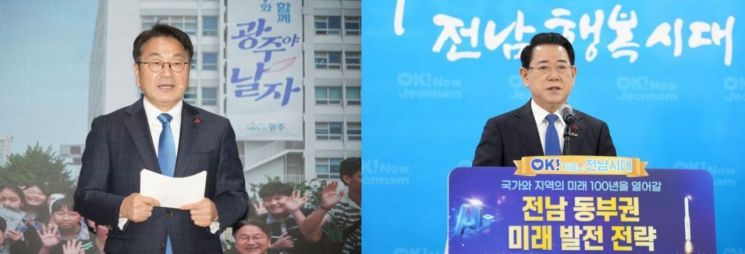
With the upcoming local elections on June 3, the push for administrative integration between Gwangju and Jeollanam-do has rapidly emerged as the most significant political variable that could sway the election landscape. On the surface, the initiative is being promoted under the banners of 'super-regional administration' and 'future competitiveness,' but within political circles, there is an interpretation that this discussion is, in fact, a highly strategic political move aimed at reshaping the election structure.
This is because, if administrative integration becomes a reality, even the fundamental premise of the election will change.
The existing system of separately electing the Mayor of Gwangju Metropolitan City and the Governor of Jeollanam-do would be abolished and replaced with an election for a single 'integrated metropolitan leader.' This would not merely be an administrative experiment, but could completely reset the pool of candidates and the dynamics of the race.
On January 5, Mayor Kang Ki-jung of Gwangju and Governor Kim Young-rok of Jeollanam-do both made statements treating the election of an integrated leader as a fait accompli.
Mayor Kang stated, "The integrated leader will be elected in the June 3 local elections," while Governor Kim declared, "Through the June 3 election, we will elect the integrated leader and launch a unified metropolitan government for 3.2 million people on July 1."
By precisely aligning the election schedule with the timing of integration, they have effectively presented a rationale for the initiative.
Within local political circles, there are voices saying, "Administrative integration is not a variable in the election; rather, the election itself is becoming the driving force behind administrative integration." This is because the acceleration of integration discussions coincides exactly with the election season.
In particular, many observers are interpreting this move in light of the current political situations of the incumbent leaders.
Mayor Kang's approval ratings have remained in the low to mid-10% range in various polls, signaling a warning for his reelection prospects. Governor Kim, while maintaining the lead, has been unable to break out of the approximately 28% range and has not clearly outpaced multiple challengers.
Moreover, both leaders share the experience of having received a 'negative image' from local residents during President Lee Jaemyung's town hall meeting held last year.
For Mayor Kang, who is seeking a second term, and Governor Kim, who is aiming for a third, the 'integrated leader' card serves as a hidden advantage that, under the pretext of administrative integration, could shake up the electoral framework.
The nature of the election would shift from a routine evaluation of local administration to a 'competition for leadership of a super-regional government.' The focus would move away from performance assessments and toward vision and symbolism.
Furthermore, the options for rival candidates would become even more limited. If they are critical of administrative integration, they risk being labeled as 'anti-integration,' 'defenders of vested interests,' or 'out of step with the times.'
In fact, among potential candidates, rather than open opposition, there is a tendency to use indirect expressions such as 'adjusting the pace' or 'procedural supplementation.'
National Assembly members such as Min Hyungbae (candidate for Mayor of Gwangju) and Joo Cheolhyeon (candidate for Governor of Jeollanam-do), who are considered practical rivals to Mayor Kang and Governor Kim, have also expressed principled support for administrative integration, while suggesting the need for integration around 2030, which is in line with this trend.
Regarding this, Oh Seungyong, Director at Metavoice, emphasized, "Approaching the current administrative integration and the election of an integrated leader as if there are no political interests involved is actually ignoring the fundamental perspective. Mayors and governors are politicians, and their statements will inevitably be interpreted politically. Rather than restricting this, we need to focus on the essence of the current Gwangju-Jeonnam administrative integration initiative. Although discussions about Gwangju-Jeonnam integration have been ongoing since 1995, each time vested interests have raised issues about the pace, and after 30 years, nothing has changed."
He added, "Depending on the various interests involved, there can be different approaches to regional integration. Nevertheless, over time, there has been sufficient gathering of opinions on this matter. If the cities and province reach an agreement, the integration process can proceed systematically."
© The Asia Business Daily(www.asiae.co.kr). All rights reserved.

















