Opening the Door to Personalized Infertility Treatment for Patients
The research team led by Professor Ahn Jungho of the Department of Biophysics at Sungkyunkwan University and Professor Kang Yoonjung of CHA University has developed the world's first patient-derived endometrium-on-a-chip (EoC), which quantitatively assesses implantation suitability and even predicts personalized treatment responses by recreating patient uterine tissue on a chip.
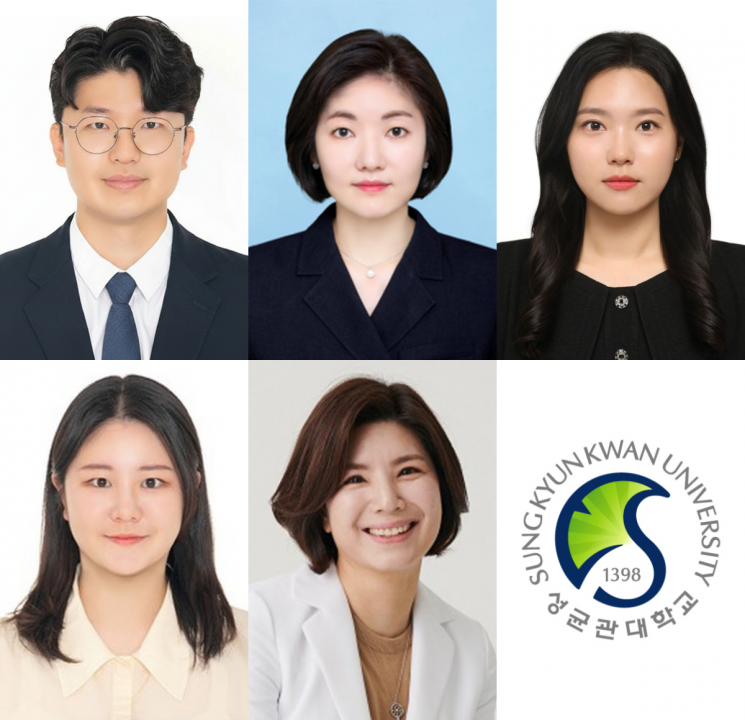 (From left) Professor Ahn Jungho of Sungkyunkwan University, Professor Kang Yoonjung of CHA University, Ga Eun Lee, PhD student at Sungkyunkwan University, Yukyung Lee, PhD student at CHA University, and Hwaseon Koo, Chief Director of Best of Me Women's Clinic for infertility. Sungkyunkwan University
This breakthrough opens the door to personalized treatment for patients experiencing infertility and recurrent implantation failure, raising significant expectations for clinical application.
The research team created a microchip that mimics the actual endometrial microenvironment by reconstructing endometrial cells collected from patients in three dimensions.
The chip incorporates the ERS2 index, which quantifies the implantation receptivity of embryos, enabling medical professionals to quantitatively assess a patient's "current implantation suitability" and determine any necessary supplementary treatments.
Traditional diagnostics relied on limited indicators such as endometrial thickness or blood flow, making it difficult to reflect individual differences. This new platform directly incorporates patient-specific tissue characteristics, thereby improving the accuracy of predicting implantation success and reducing unnecessary procedures.
In particular, the team compared various drug responses on the chip and confirmed that CXCL12 treatment effectively promotes angiogenesis and restores receptivity in patients with intrauterine adhesions.
When tracking pre- and post-treatment conditions on the chip for actual patients, the implantation success score increased significantly, demonstrating the platform's effectiveness.
Professor Ahn Jungho stated, "This is the first case of implementing a personalized predictive tool based on patient tissue that can be directly applied in clinical practice," adding, "We will accelerate the clinical application of infertility treatment through multicenter validation and standardization processes in the future."
By using patient-derived endometrial chips, the team analyzed endometrial receptivity for each patient based on a scoring system that evaluates receptivity and angiogenesis.
This research was published in Nature Communications on November 25, 2025, and was supported by the National Research Foundation of Korea and the Ministry of Health and Welfare.
© The Asia Business Daily(www.asiae.co.kr). All rights reserved.
![Clutching a Stolen Dior Bag, Saying "I Hate Being Poor but Real"... The Grotesque Con of a "Human Knockoff" [Slate]](https://cwcontent.asiae.co.kr/asiaresize/183/2026021902243444107_1771435474.jpg)















