Weekly Meetings Scheduled This Month Based on Medical Workforce Estimation Committee Results
Discussions to finalize the 2027 medical school enrollment quota are officially beginning. The government plans to determine the scale of the increase before the Lunar New Year holiday, taking into account the university entrance schedule and other factors. However, as the medical community is already showing signs of opposition, concerns are being raised that conflicts between the government and medical professionals over the expansion of medical school enrollment may be repeated.
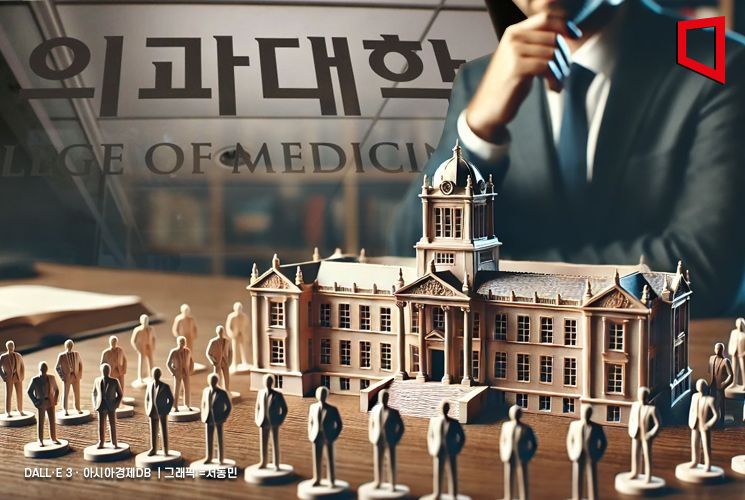
On the afternoon of January 6, the Ministry of Health and Welfare will hold the second meeting of the Health and Medical Policy Deliberation Committee (HMPDC) in Seoul, with the report from the Medical Workforce Supply and Demand Estimation Committee (Estimation Committee), which was released at the end of last month, on the agenda for discussion.
Previously, the Estimation Committee projected that, based on the number of days Koreans visit or are admitted to medical facilities, medical service utilization, and demographic changes, there will be a shortage of 1,535 to 4,923 doctors in 2035 (ten years from now), and a shortage of 5,704 to 11,136 doctors in 2040 (fifteen years from now).
Accordingly, a simple calculation suggests that, as of 2035, there is a need to increase the number of doctors by 153 to 492 each year, and as of 2040, by 380 to 742 each year. If the government’s planned regional doctor system or public medical schools are implemented, the scale of the increase may become even larger.
Since the Estimation Committee presented the doctor shortage as a range rather than a single figure, the HMPDC will make the final decision on the scale of medical school enrollment expansion. Based on these results, the Ministry of Health and Welfare plans to hold weekly HMPDC meetings throughout January to discuss the scale of the increase and reach a conclusion before the Lunar New Year holiday.
The HMPDC is a deliberative body under the Ministry of Health and Welfare, formed to review major policies such as the health and medical development plan. The Minister of Health and Welfare serves as chair, and a total of 25 members participate, including vice ministers from related ministries, representatives of both consumers and providers, and experts. Since the committee is usually convened irregularly only when there are agenda items, holding weekly meetings is somewhat unusual.
However, given the need to finalize not only the scale of the increase but also the allocation of quotas to 40 medical schools and the revision of university regulations for changing medical school quotas by April, it is considered inevitable that intensive meetings will be held.
There are concerns, however, that due to the practical necessity of conducting an "ultra-fast" review in a short period of time, in-depth discussions on the scale of the increase may be difficult within the HMPDC. The medical community also points out that the composition of expert members in the HMPDC is biased in favor of the government, raising the likelihood that any conclusion to increase medical school enrollment will simply follow the government’s policy direction.
The Korean Medical Association criticized, "This estimation result was produced solely to verify the political debate that 'there is a shortage of doctors,' without any consideration of the realities and conditions of medical education," and added, "Doctor supply policy should not be decided solely with the goal of 'producing a certain number of doctors.' In-depth discussions with medical school professors are needed."
The National Council of Medical School Professors also stated in a position paper released on January 2, "It is realistically impossible to increase medical school enrollment before the end of the current 'doubling' situation, where the 2024 and 2025 classes are taking classes together," and argued, "A gradual increase or decrease in enrollment is desirable, within the scope that allows students and residents to receive quality education at medical schools and training hospitals."
One member who participated in the Estimation Committee said, "There was controversy over the composition of the committee, and even until the end, there were internal opinions pointing out problems with the estimation model. Deciding the estimation method by a vote was not reasonable," and added, "Whatever the outcome of the HMPDC discussions, it will not be easy to quell opposition from the medical community."
© The Asia Business Daily(www.asiae.co.kr). All rights reserved.
![Clutching a Stolen Dior Bag, Saying "I Hate Being Poor but Real"... The Grotesque Con of a "Human Knockoff" [Slate]](https://cwcontent.asiae.co.kr/asiaresize/183/2026021902243444107_1771435474.jpg)
















