Significant Lead Beyond Margin of Error Five Months Before Local Elections
Clear Consolidation Among Young Voters and Women
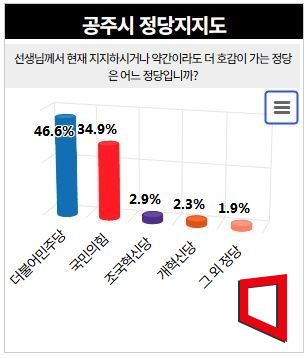
On January 5, a public opinion poll revealed that, ahead of the 9th nationwide simultaneous local elections scheduled for June 3, the Democratic Party of Korea is leading the People Power Party by a significant margin outside the margin of error in the political landscape of Gongju, South Chungcheong Province.
In particular, support for the Democratic Party was found to be strong among people in their 20s and 30s and among women.
According to a party support survey conducted by Vision Korea at the request of the Gongju Journalists Association, 524 men and women aged 18 and older residing in Gongju were surveyed over two days from January 1 to 2. The results showed that the Democratic Party of Korea received 46.6% support, while the People Power Party received 34.9%, resulting in a gap of 11.7 percentage points between the two parties. This figure is well above the margin of error (±4.1 percentage points).
The Cho Kuk Innovation Party followed with 2.9%, the Reform New Party with 2.3%, and the Progressive Party with 0.4%. Respondents who had no party preference or answered "don't know" accounted for 11.1%, while other parties received 1.9%.
By ideological orientation, 81.4% of progressive respondents supported the Democratic Party, showing overwhelming dominance. The Democratic Party also showed strong support among students (74.1%), those aged 18-29 (64.3%), those in their 40s (63.5%), and those in their 50s (55.8%).
Notably, among women aged 18-29, support for the Democratic Party exceeded 80%, indicating the highest level of consolidation.
The People Power Party received 69.3% support among conservative respondents and recorded relatively high support among those in their 60s (44.5%), those aged 70 and older (45.4%), and workers in agriculture, forestry, livestock, and fisheries (40.8%).
By gender, among men, the Democratic Party received 43.3% and the People Power Party 39.1%, indicating a close race within the margin of error. Among women, the Democratic Party led significantly with 49.8% compared to the People Power Party's 30.8%.
By age group, in their 30s, the Democratic Party received 40.4% and the People Power Party 36.2%, indicating a tight race. In their 50s, the Democratic Party led with 55.8%, while the People Power Party trailed with 25.3%, showing a wide gap. In contrast, the People Power Party held an advantage among those in their 60s and those aged 70 and older.
By region, in the 1st electoral district, the Democratic Party led with 49.5% compared to the People Power Party's 30.7%. However, in the 2nd electoral district, the Democratic Party received 42.0% and the People Power Party 41.5%, indicating a virtual dead heat.
Vision Korea analyzed, "Depending on the competitiveness of the candidates and major issues in the final stages of the election, the outcome could be overturned."
By basic council district, the Democratic Party was dominant in the Na and Ra districts, while the People Power Party received higher support in the Ga and Da districts.
This survey was conducted using 100% ARS (Automated Response System) method, utilizing 84.9% mobile virtual numbers and 15.1% landline RDD (Random Digit Dialing).
The response rate was 7.1%, and the sampling error was ±4.1 percentage points at a 95% confidence level. Weighting was applied by gender, age, and region based on the Ministry of the Interior and Safety's resident registration population statistics as of the end of November 2024.
For more detailed information about the poll, please refer to the website of the National Election Survey Deliberation Commission.
© The Asia Business Daily(www.asiae.co.kr). All rights reserved.
![Clutching a Stolen Dior Bag, Saying "I Hate Being Poor but Real"... The Grotesque Con of a "Human Knockoff" [Slate]](https://cwcontent.asiae.co.kr/asiaresize/183/2026021902243444107_1771435474.jpg)
















