At January 5 Press Conference, Lee Delivers Sharp Criticism of Coupang and Financial Holding Company Management
"Currently Checking Whether There Has Been Any Customer Data Leak at Coupang's Payment Affiliate, 'Pay'"
Strong Remarks on Chairman Reapp
On January 5, Lee Chanjin, Commissioner of the Financial Supervisory Service, stated, "Coupang Financial is applying its interest rate calculation criteria in a highly arbitrary manner and making excessive profits as a result. We are closely monitoring the situation and moving towards a full inspection."
Regarding the practice of reappointing financial holding group chairmen, he strongly criticized it, saying, "Instead of fostering next-generation leadership, it is turning them into 'antiques.'"
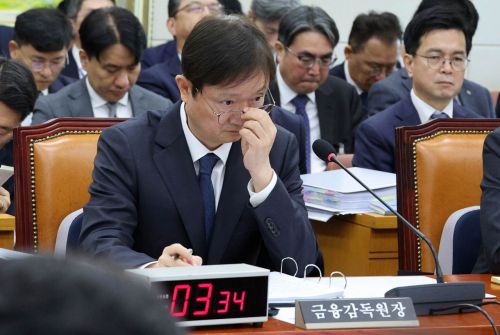 Lee Chanjin, Financial Supervisory Service Commissioner, listens to lawmakers' questions during the comprehensive audit of the Financial Services Commission and the Financial Supervisory Service at the National Assembly's Political Affairs Committee held in Yeouido, Seoul on October 27, 2025. Photo by Kim Hyunmin
At a New Year's press conference held at the Financial Supervisory Service headquarters in Yeouido, Seoul, Lee said, "There are fundamental questions as to whether Coupang has made proper investments in cybersecurity," making the above remarks.
Lee left open the possibility of converting the Coupang Financial case into an inspection and also addressed the potential risk of customer payment information leakage at Coupang Pay. He stated that the joint government response team’s investigation into Coupang’s headquarters is still underway and that no concrete results have been produced yet.
Lee said, "Unlike other retail platforms engaged in payment services, Coupang Financial has an unusually long payment cycle, often exceeding one month," and added, "It appears they are making excessive profits by applying interest rate calculation criteria in a manner that is difficult to understand and highly arbitrary."
He further commented, "Frankly, from an ethical standpoint, it seems they are engaging in what is commonly referred to as 'gapjil' (abuse of power)."
Regarding Coupang Pay, he explained, "Coupang headquarters and Coupang Pay operate under a 'one ID, one click' system, and we are currently verifying whether, as the company claims, there has been no leakage of payment information." He added, "We are cross-checking information moving from Coupang to Coupang Pay and from Coupang Pay back to Coupang."
He reiterated, "The joint investigation into Coupang headquarters has not yet produced any specific results."
Lee raised concerns about the dual regulatory framework governing Coupang's financial subsidiaries and its e-commerce operations.
He stated, "When the regulatory framework is split, it becomes difficult to impose discipline on higher-level platforms or predators that go beyond the financial sector," and added, "Given that many people experience repeated difficulties trying to withdraw from Coupang, I believe the regulatory standards should be on par with those applied to the financial sector. We plan to work towards improving the relevant systems."
Lee also strongly criticized the practice of reappointing financial holding group chairmen. He pointed out that, rather than fostering next-generation leadership, the entrenched practice of so-called 'trench building' has become commonplace, resulting in a management system where the CEO faces no real checks or balances.
He said, "The practice of 'trench building,' where board members share the same mindset as the CEO, leads to uniform decision-making by the board. Looking at the succession process, if the holding group chairman continues to be reappointed for six-year terms, they will eventually become antiques themselves."
Lee stated that he would decide whether to expand inspections to all financial holding companies after reviewing the results of the inspection of BNK Financial Group.
He said, "We will review the results of the (BNK) spot inspection to determine if there are additional areas that require attention," and added, "Whether to expand inspections to all financial holding companies will be determined based on the outcome of the BNK inspection."
Lee also argued that representative shareholders should join the board of directors to strengthen its independence. He judged that the current board, which is mainly composed of professors, is not effective in checking the power of the financial holding group chairman and CEO.
He said, "To enhance board independence, I believe that representative shareholder groups should join the board to objectively and fairly represent the interests of all shareholders," and added, "Considering that financial companies operate as service businesses for the general public without so-called 'ownership,' the shareholder-oriented board structure is far removed from the so-called 'pension socialism' debate."
Lee expressed opposition to the conversion of the Financial Supervisory Service into a public institution. He said he is persuading the government on the grounds that financial independence and autonomy would be too low.
He stated, "Even now, the situation is far worse than that of the Bank of Korea," and added, "The Financial Services Commission decides the budget and organization of the Financial Supervisory Service, and the Ministry of Economy and Finance, through the Public Institution Management Committee, acts as an additional layer of oversight. I cannot understand what they are trying to achieve."
He continued, "Globally, independence, neutrality, and autonomy for financial supervisory agencies are considered essential values and have become a 'global standard.' Since the current situation does not meet international standards, I do not expect the Financial Supervisory Service to be designated as a public institution."
© The Asia Business Daily(www.asiae.co.kr). All rights reserved.
![Clutching a Stolen Dior Bag, Saying "I Hate Being Poor but Real"... The Grotesque Con of a "Human Knockoff" [Slate]](https://cwcontent.asiae.co.kr/asiaresize/183/2026021902243444107_1771435474.jpg)















