Deadline Approaching for Repurchase of Russian Plant Stake
Buyback Option Expires This Month
Uncertainty Persists Despite Ceasefire Talks
Korean Companies: "We Cannot Easily Give Up on the Russian Market"
As the Russia-Ukraine war enters its fourth year, Hyundai Motor Company faces increasing concerns with the deadline approaching this month for the repurchase of its Russian factory stake. Even in the midst of ceasefire negotiations, uncertainties persist, making it difficult for Korean companies to give up on re-entering the Russian market, and they continue to engage in complex calculations behind the scenes.
According to the industry on January 6, Hyundai Motor must decide this month whether to re-enter the Russian market. This is because the expiration of the two-year buyback option, set in January 2024, is approaching this month. Some foreign media outlets have predicted that repurchasing the stake will not be easy while the war is ongoing.
However, Hyundai Motor Group maintains a cautious stance, stating, "No decision has been made yet." The company explained that since an extension of the deadline is still possible, it is reviewing a range of options.
The reason Hyundai Motor is reluctant to give up on the Russian market is its previously strong market dominance. Just before the war in 2021, Hyundai Motor and Kia held a combined 24% market share in the Russian automobile market, ranking first in the industry. Among major global automakers, Hyundai was also the last to announce its withdrawal from Russia and set the buyback period at only two years, the shortest among its peers.
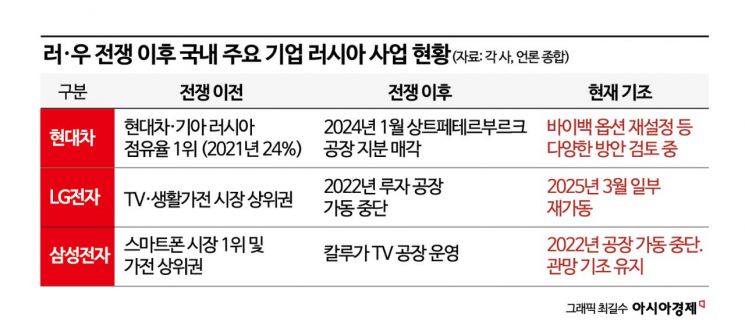
The electronics industry has also remained in the market without officially announcing a withdrawal. Although shipments and factory operations have stopped since the war, companies have maintained their business base through facility maintenance, partial restarts, and parallel imports.
LG Electronics partially resumed operations at its Luga plant near Moscow in March last year, about two years and seven months after suspending production. The company explained that this was a minimum measure to prevent equipment deterioration. Samsung Electronics had produced TVs at its Kaluga plant in Russia but suspended operations in 2022. Until just before the war, Samsung Electronics held the top market share in the Russian smartphone market, while LG Electronics was also a leading player in the large home appliance market, including TVs, washing machines, and refrigerators.
An industry insider in the home appliance sector commented, "If our companies can regain a foothold in the Russian market, which is now dominated by China, it could be a significant opportunity. However, since the war is still ongoing, companies are refraining from making direct statements and are closely monitoring the situation."
The defense industry, which benefited from the wartime boom, plans to maintain its growth momentum after the war by focusing on maintenance, repair, and operations (MRO) business. However, it is expected that the end of the war will inevitably have some impact on the defense sector as well. A defense industry official said, "We are preparing mid- to long-term strategies, such as continuously improving equipment performance and diversifying our business models."
© The Asia Business Daily(www.asiae.co.kr). All rights reserved.
![Clutching a Stolen Dior Bag, Saying "I Hate Being Poor but Real"... The Grotesque Con of a "Human Knockoff" [Slate]](https://cwcontent.asiae.co.kr/asiaresize/183/2026021902243444107_1771435474.jpg)











