A Problem Posed in 1966 Remained Unsolved for Over Half a Century
Seven Years of Research Lead to a Solution Proven by Pure Reasoning, Without Computers
The research of a Korean mathematician who solved the "Moving Sofa Problem," a mathematical conundrum that has remained unsolved for nearly 60 years, has been recognized as a global achievement.
On January 4, Yonhap News Agency reported that the American science magazine Scientific American selected the research of Jin-Eon Baek (31), PhD at the Heo Jun Lee Mathematical Problems Research Institute, Institute for Advanced Study (Heo Jun Lee Fellow), as one of "The Top 10 Math Discoveries of 2025."
The Moving Sofa Problem seeks the planar shape with the largest possible area that can pass through a right-angled corridor of width one. First posed in 1966 by Canadian mathematician Leo Moser, the problem is intuitively easy to understand but extremely difficult to solve, and it remained unsolved for more than half a century due to the challenge of proving a solution.
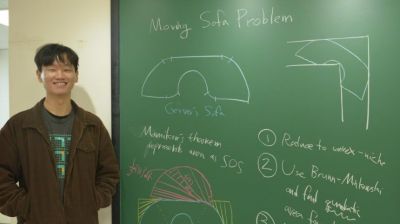 Jin-Eon Baek, PhD at Heo Jun Lee Mathematical Problems Research Institute, Institute for Basic Science. Yonhap News Agency
Over the years, mathematicians have proposed various shapes. In 1992, American mathematician Joseph Gerver suggested "Gerver's Sofa," a shape with an area of 2.2195 composed of 18 curves. However, no theoretical proof was provided that this shape was indeed optimal.
After seven years of research, Dr. Baek mathematically proved at the end of 2024 that "no shape larger than Gerver's Sofa can exist." He published a 119-page paper on the preprint site arXiv, and unlike previous studies that relied on computer simulations, he proved his result using purely logical reasoning.
The paper is currently under peer review at the Annals of Mathematics, one of the most prestigious journals in the field. Scientific American commented, "Although a rigorous verification process remains, the initial response from mathematicians in the field has been generally optimistic."
Dr. Baek encountered the problem while serving as a research specialist at the National Institute for Mathematical Sciences for his mandatory military service. He continued his research during his doctoral studies at the University of Michigan and as a postdoctoral researcher at Yonsei University, reportedly solving the problem at the age of 29.
In August last year, he was selected as a "Heo Jun Lee Fellow," a program that provides long-term support to young mathematicians under the age of 39. He is currently continuing his research on optimization problems and mathematical challenges in the field of combinatorial geometry.
© The Asia Business Daily(www.asiae.co.kr). All rights reserved.
![Clutching a Stolen Dior Bag, Saying "I Hate Being Poor but Real"... The Grotesque Con of a "Human Knockoff" [Slate]](https://cwcontent.asiae.co.kr/asiaresize/183/2026021902243444107_1771435474.jpg)















