Private Education Spending Surpasses 29 Trillion Won...
87.7% Participation Rate Among Elementary Students
Preemptive Learning and Childcare Substitution on the Rise
Intensive Focus on Private Education for Elementary Students
Despite the decline in the school-age population, the total amount spent on private education has surged by more than 60% over the past decade. In particular, as private education becomes increasingly prevalent among younger children, the growth rate of private education spending among elementary school students has far outpaced that of middle and high school students.
According to the National Statistical Portal (KOSIS) of the National Data Office on January 4, 2024, the total amount spent on private education reached 29.1919 trillion won in 2024. This represents a 60.1% increase compared to 18.2297 trillion won in 2014.
The total amount spent on private education decreased to 17.8346 trillion won in 2015, but rebounded to 18.0606 trillion won in 2016. By 2019, it surpassed 20 trillion won again, reaching 20.9970 trillion won. In 2020, when the impact of COVID-19 was significant, it dipped to 19.3532 trillion won, but has continued to rise for four consecutive years since 2021.
Although the number of students has declined due to low birth rates, rising prices for educational services and increased household income have expanded the capacity for educational spending, which are cited as the main factors behind the increase in private education expenses. The rise in dual-income households has led private academies to partially take on childcare functions, while the growing prevalence of single-child families has intensified the tendency to invest heavily in education. These factors have also contributed to the increase.
By school level, the increase in private education spending was most pronounced in elementary schools. In 2024, total private education spending for elementary schools amounted to 13.2256 trillion won, a 74.1% increase compared to 7.5949 trillion won in 2014. During the same period, middle schools saw a 40.7% increase-the lowest growth rate-while high schools experienced a 60.5% rise. In terms of total volume, private education spending for elementary schools was 1.7 times that of middle schools (7.8338 trillion won) and 1.6 times that of high schools (8.1324 trillion won).
By subject, general academic subjects accounted for 8.3274 trillion won, or 63.0% of elementary school private education spending, while arts, physical education, hobbies, and liberal arts made up 4.8797 trillion won, or 37.0%.
The burden per student has also increased significantly. In 2024, the average monthly private education spending per elementary school student reached a record high of 442,000 won, up 210,000 won from ten years ago, marking a 90.5% increase. Of this, 278,000 won was spent on general academic subjects, and 163,000 won on arts, physical education, hobbies, and liberal arts.
During the same period, private education spending per middle school student rose from 270,000 won to 490,000 won, an 81.5% increase. For high school students, it jumped from 230,000 won to 520,000 won, a 126.1% surge, representing the steepest rise. Although the total amount increased was limited by the decline in the number of high school students, the individual burden rose sharply.
Participation rates in private education were also highest among elementary school students. In 2024, the participation rate for elementary school students in private education was 87.7%, up 6.6 percentage points from ten years ago. This is significantly higher than the rates for middle school (78.0%) and high school (67.3%) students.
For elementary schools, the participation rate in general academic private education was 67.1%, while the rate for arts, physical education, hobbies, and liberal arts was 71.2%. The increase in dual-income households, with arts academies serving as after-school childcare, is seen as a contributing factor.
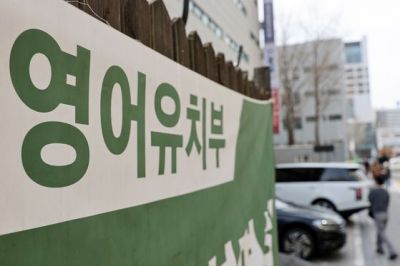
Experts point to the spread of advanced learning as the key background for the surge in elementary private education. There is a growing perception that preparing only in high school is too late, and that English and coding education should be completed during elementary school. The so-called "age 4 exam" and "age 7 exam" phenomena are also linked to this trend.
The government and the National Assembly have also begun to address the trend of private education targeting younger children. An amendment to the Private Academy Act, which bans level tests at English academies for preschoolers, passed the National Assembly's Legislation and Judiciary Committee on December 18 last month with bipartisan agreement. However, some point out that even if the bill passes the plenary session, effective administrative measures against violating academies will be necessary for it to be effective.
© The Asia Business Daily(www.asiae.co.kr). All rights reserved.
![Clutching a Stolen Dior Bag, Saying "I Hate Being Poor but Real"... The Grotesque Con of a "Human Knockoff" [Slate]](https://cwcontent.asiae.co.kr/asiaresize/183/2026021902243444107_1771435474.jpg)
















