Lowest Number of Applicants Since Undergraduate System Introduction
Direct Cause: Reduction in Medical School Enrollment Quota
This year, the number of applicants for regular admissions to medical schools reached its lowest point in the past five years. The direct cause was the reduction in the medical school enrollment quota this year.
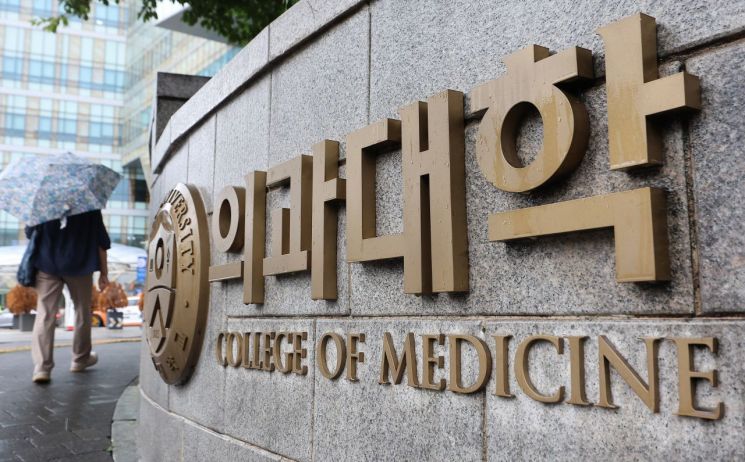
According to Jongro Academy on January 4, the number of applicants for regular admissions at 39 medical schools nationwide for the 2026 academic year was 7,125, a decrease of 32.3% compared to last year.
The number of applicants was 9,233 for the 2022 academic year, 8,044 for 2023, 8,098 for 2024, and 10,518 for 2025.
The regular admission quota for the 2026 academic year is 1,078, a decrease of 32.6% (521 students) from the previous year's 1,599. The significant increase in the medical school quota last year followed by a reduction this year led to a decrease in applicants.
The average competition rate for medical schools nationwide rose slightly from 6.58:1 last year to 6.61:1 this year.
By region, the competition rate for eight universities in Seoul fell from 4.19:1 to 3.80:1, while the rate for four universities in the Gyeongin area rose from 4.65:1 to 7.04:1, and for 27 universities outside the capital region, it increased from 7.77:1 to 8.17:1.
Kosin University recorded the highest competition rate nationwide at 24.65:1, while Ewha Womans University had the lowest at 2.94:1.
Lim Seongho, CEO of Jongro Academy, said, "The number of applicants for regular admissions to medical schools has reached its lowest point since the undergraduate system was introduced, mainly due to the reduction in the enrollment quota. However, it can also be interpreted as a sign that the medical school craze has somewhat subsided. We need to observe the additional admissions for this year's regular process and next year's medical school admissions to determine whether this is a temporary phenomenon caused by changes in the quota."
Despite the reduction in the medical school quota and the so-called "difficult CSAT," it was analyzed that top-tier students tended to apply to medical schools based on their own convictions.
Among medical schools affiliated with the so-called "Big 5" hospitals, all universities except Seoul National University (which saw a decrease from 3.50:1 to 3.20:1) experienced an increase in competition rates compared to last year, including Yonsei University, Sungkyunkwan University, Catholic University, and Korea University.
Sungkyunkwan University Medical School recorded 4.87:1 (up from 3.80:1 last year), Yonsei University 4.38:1 (up from 3.84:1), Korea University 4.33:1 (up from 4.04:1), Ulsan University 4.33:1 (up from 3.75:1), and Catholic University 3.57:1 (up from 3.27:1).
© The Asia Business Daily(www.asiae.co.kr). All rights reserved.
![Clutching a Stolen Dior Bag, Saying "I Hate Being Poor but Real"... The Grotesque Con of a "Human Knockoff" [Slate]](https://cwcontent.asiae.co.kr/asiaresize/183/2026021902243444107_1771435474.jpg)
















