Interview with China’s CCTV Ahead of State Visit
Proposal to Establish New Partnership in AI and Advanced Industries
Over 10 MOUs to Be Signed
On Taiwan Issue: “Respect for One China... Peace in Northeast Asia Is Extremely Important”
“
President Lee Jaemyung stated that, ahead of his state visit to China from January 4 to 7, it is necessary to newly establish a horizontal and equal cooperative relationship in fields such as artificial intelligence (AI) and advanced industries. Given China's rapid economic growth, he emphasized the need to identify areas for collaboration so that both countries can enhance their respective capabilities. Regarding the cross-strait issue between China and Taiwan, which China has been increasingly vocal about, President Lee expressed respect for the "One China" principle and proposed that the two sides create an opportunity to meet at least once a year for mutual coexistence and cooperation.
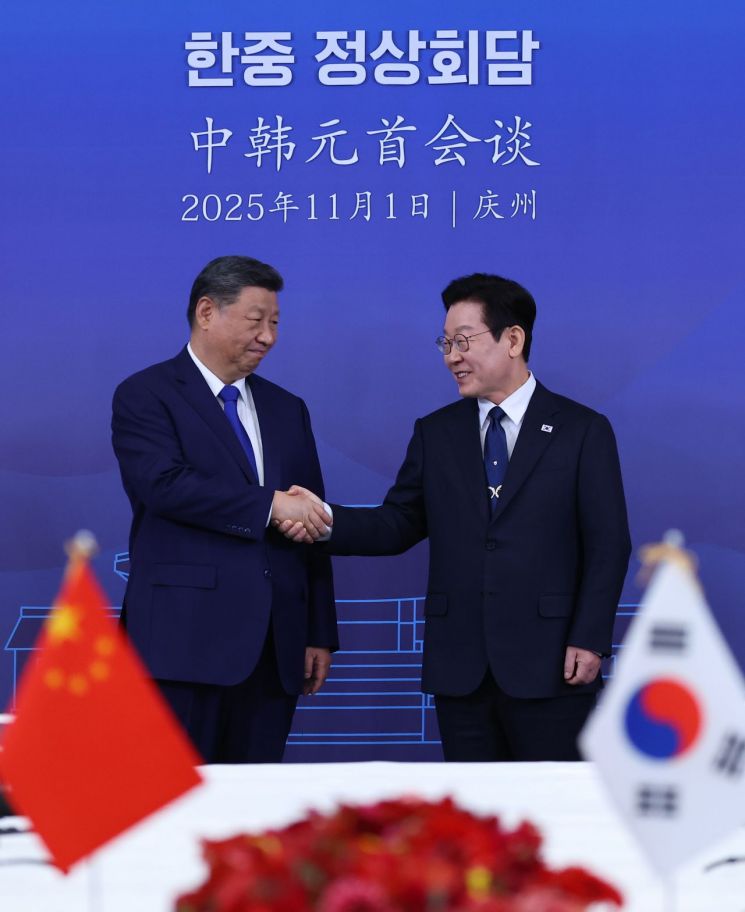
In an interview with China's state-run CCTV released on January 2, President Lee said, "If the existing economic cooperation between Korea and China was somewhat vertical-combining Korea's advanced technology and capital with China's labor force-recently, thanks to President Xi Jinping's outstanding leadership, there are many areas where China has caught up with or even surpassed Korea." He added that a delegation of about 200 economic and trade representatives will accompany him on this visit. The key event of this visit, the summit meeting with President Xi, will be held on January 5. After the summit, more than ten memorandums of understanding (MOUs) covering various fields such as public welfare and the economy are scheduled to be signed.
President Lee also highlighted the commonalities in the Korea-China economic growth strategies, which focus on advanced technology. China's 15th Five-Year Plan outlines a growth strategy centered on AI and advanced technologies. He said, "The economic growth strategies of Korea and China have similar aspects. While we are competitors, there is also significant potential for collaboration. By strengthening our respective capabilities through cooperation, we can create a relationship that benefits each country's growth strategy."
As an example of China's advancement in high technology, President Lee cited the transition to renewable energy. He has visited several Chinese cities such as Chongqing and Dalian multiple times during his tenure as mayor of Seongnam and governor of Gyeonggi Province. He said, "China is now dominating the global renewable energy industry, especially in the solar sector. The country has demonstrated truly exceptional capabilities in developing new technologies and driving industrial advancement." He added, "This trend is likely to continue for some time, and I expect it to open significant opportunities for Korea as well."
He also expressed hope that the Korea-China relationship will make a clear leap forward, spurred by President Xi's visit to Korea last year and his own visit to China this time. Regarding President Xi, Lee said, "I think he is an outstanding and broad-minded leader. During the Korea-China summit at the APEC meeting in Gyeongju, President Xi unexpectedly showed a good sense of humor and responded warmly even when I joked with my phone, which left the Korean people with a very positive impression of his character." Lee continued, "Although there are many apparent challenges, I believe President Xi has a deep understanding of the importance of building a mutually beneficial relationship between the two countries."
"I also respect 'One China'... Korea's strategic autonomy is very important... The leaders of Korea and China should meet at least once a year"
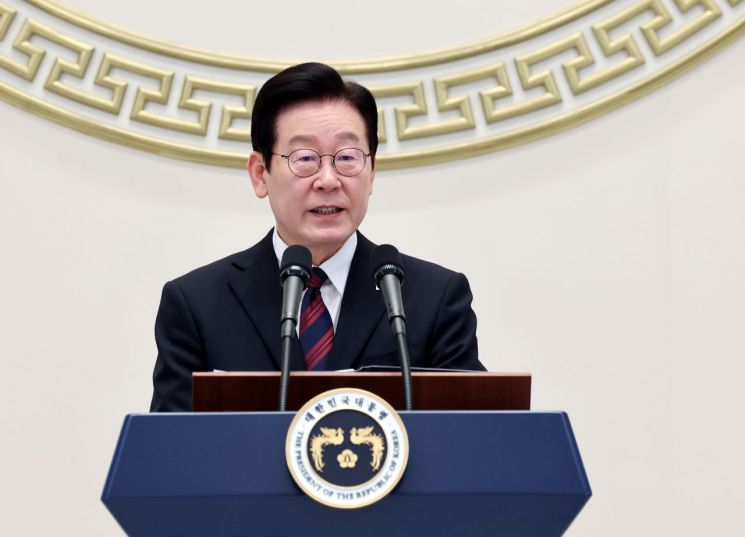
President Lee stated that he also respects the "One China" principle, which has long been a focus of the Chinese government, emphasizing mutual respect for each country's national interests. He reaffirmed the Korean government's position since the establishment of diplomatic relations in 1992, which is to respect China's stance that "there is only one China and Taiwan is part of China." He said, "The core principle that defined Korea-China relations at the time of diplomatic normalization remains valid. I want to make it clear that we respect 'One China' and that peace and stability in Northeast Asia, including the cross-strait issue with Taiwan, are extremely important."
He also mentioned that cooperation should be pursued in a way that maximizes each country's national interests, based on a "pragmatic diplomacy centered on national interest." He dismissed some concerns about Korea-China relations, emphasizing the need to continually seek mutual national interests through coexistence and cooperation.
President Lee began by saying, "I heard that in China, there is a term 'seeking truth from facts.' If each side diligently pursues its own national interest while considering the other's position and making appropriate adjustments, coexistence is always possible. In the past, there was a notion of 'security with the US, economy with China,' but now I believe Korea's strategic autonomy is extremely important." He added, "While cooperation with the US on security is unavoidable, a confrontational or conflictual Korea-China relationship is of no benefit to Korea's national interest."
Accordingly, President Lee stressed the need for constant dialogue to serve each country's interests and proposed that the leaders of the two countries meet frequently. He said, "It would be good if the leaders could meet at least once a year. Whether I visit China or the Chinese leadership comes to Korea, let's not be concerned about such details." He added, "Through frequent meetings, I am confident that Korea-China relations can develop to a much higher and deeper level than now."
On the subject of the shared history of anti-Japanese resistance, President Lee said that while it is a history that must never be repeated, the two countries cannot dwell solely on the past and must find ways to work together for a better future. He emphasized, "Each country should pursue its national interest to the maximum, but not at the expense of another country's national interest. The historical experience of Korea and China responding to aggression is very important. At the same time, since we cannot cling only to the past, we must constantly seek possibilities for working together for a better future for the people of both countries."
Regarding domestic politics, President Lee pledged to continue a politics of integration and inclusiveness. He said, "The most important thing is to minimize conflicts among members, recognize each other's existence, cooperate, and live together as necessary members of the community. That is the role of the state, the government, and politics. The Democratic Party of Korea, to which I belong, or the Korean government, will continue to work to minimize conflict, hatred, and animosity and to build Korea into a beautiful community."
President Lee to Depart for Beijing on the 4th... Korea-China Summit on the 5th
The Blue House cited the expected outcomes of this visit as follows: ▲Consolidation of the political and friendly sentiment base for the full restoration of Korea-China relations ▲Strengthening practical cooperation in public welfare based on horizontal and mutually beneficial cooperation between Korea and China ▲Enhancing communication between Korea and China for peace on the Korean Peninsula ▲Stable management of sensitive issues between Korea and China.
Upon arriving in Beijing on the 4th, President Lee's first official event will be attending a dinner meeting with Korean nationals residing in China. He is expected to listen to their concerns and introduce the Lee Jaemyung administration's policy direction for the new year and support measures for overseas Koreans.
On the morning of the 5th, he will attend the Korea-China Business Forum, where he will interact with business leaders from both countries and discuss ways to create new areas of economic cooperation based on the complementary strengths of the two countries' industries in manufacturing, consumer goods, services, and other sectors.
In the afternoon, he will participate in an official welcome ceremony, summit meeting, MOU signing ceremony, and state banquet with President Xi. At the APEC summit in Gyeongju, the two leaders agreed to fully restore Korea-China relations. They plan to hold in-depth discussions on practical solutions to issues of public welfare and peace faced by both countries, based on dialogue.
On the 6th, President Lee will meet Zhao Leji, Chairman of the Standing Committee of the National People's Congress (NPC), the equivalent of China's parliamentary speaker, and then have a luncheon with Premier Li Qiang, China's top economic policymaker. He is expected to discuss ways to enhance friendly sentiment between the peoples of Korea and China with Chairman Zhao and to exchange views with Premier Li on creating a new model of economic cooperation based on horizontal collaboration in line with the changing times.
After completing his schedule in Beijing, President Lee will travel to Shanghai, where he will have dinner with Chen Jining, Secretary of the Shanghai Municipal Party Committee. At the dinner, he plans to have meaningful discussions on exchanges between local governments and people-to-people exchanges between Shanghai, which has led China's economic growth, and Korea, as well as the preservation and management of sites related to the Korean independence movement.
On the last day of his visit, the 7th, President Lee will attend the Korea-China Venture Startup Summit in Shanghai, China's economic center, where he will interact with young entrepreneurs from both countries who are leading innovation using digital technology in fields such as content, healthcare, infrastructure, and energy. He will seek ways to make the venture startup sector a new axis of future-oriented cooperation between Korea and China.
As the final official event of his state visit, President Lee will visit the former Provisional Government of the Republic of Korea building in Shanghai. Marking the 80th anniversary of liberation in 2025, the 150th anniversary of Kim Gu's birth in 2026, and the 100th anniversary of the founding of the Provisional Government in Shanghai, he plans to honor the sacrifices and dedication of Korea's independence fighters and commemorate the shared historical experience of Korea and China working together to restore national sovereignty.
© The Asia Business Daily(www.asiae.co.kr). All rights reserved.
![Clutching a Stolen Dior Bag, Saying "I Hate Being Poor but Real"... The Grotesque Con of a "Human Knockoff" [Slate]](https://cwcontent.asiae.co.kr/asiaresize/183/2026021902243444107_1771435474.jpg)

















