Yeonggwang County to Remove Sika Deer from Five Islands Including Anmado
Mobile Control Team of 24 Hunters Formed... Capture Operations Begin This Month
Captured Deer Expected to Be Processed by Rendering Method
Animal Rights Group: "Efforts Need
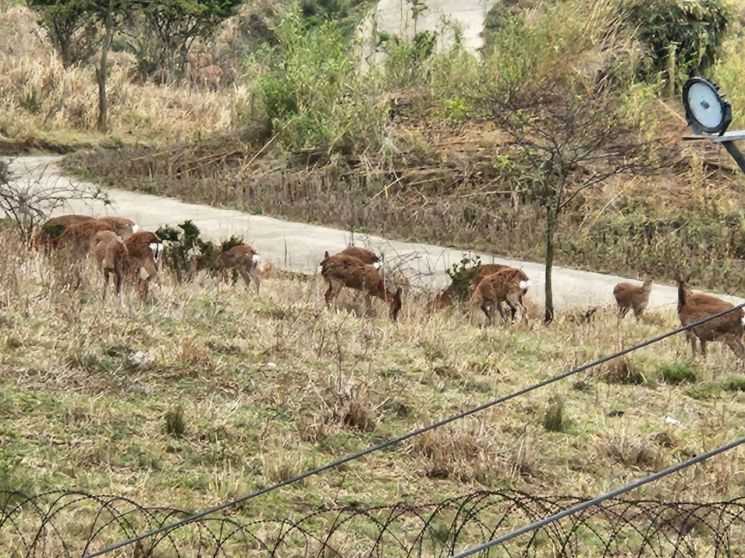 Spotted deer feeding on Anmado Island, Yeonggwang County, Jeollanam-do. Provided by Yeonggwang County
A 'population reduction operation' targeting the spotted deer inhabiting several islands in Yeonggwang County, Jeollanam-do, is expected to begin in earnest this month.
According to Yeonggwang County on January 2, it is estimated that 937 spotted deer are living on a total of five islands, including Anmado and its surrounding islands: Daeseokmando, Soseokmando, Odo, and Hoengdo.
Since this figure is based on a population analysis conducted in 2024, Yeonggwang County now believes that the number has increased by more than 50, bringing the current population to about 1,000 deer on the islands. This is about five times the total number of residents on Anmado, which is approximately 220.
As the spotted deer have been officially designated as harmful wild animals by the Ministry of Environment, Yeonggwang County has decided to begin full-scale capture operations this year. The deer will be captured in two phases: from January to April, and again from October to December.
Yeonggwang County recently completed the formation of a mobile control team consisting of 24 hunters and is now awaiting the completion of the capture permit process. The target is to capture at least 100 deer. The captured deer will be processed using a rendering method, which is an eco-friendly approach that involves crushing and sterilizing the carcasses at high temperature and pressure, then separating them into oil and solids for recycling as compost or animal feed.
This capture operation is being carried out because the increasing deer population has led to a buildup of damage suffered by island residents, making it impossible to delay the operation any further. As the number of deer has grown, both tangible and intangible damages have increased, including crop damage to sweet potatoes and other produce grown on the islands, as well as the destruction of graves. Moreover, there have been frequent cases where wild deer have directly threatened residents during breeding season.
While there is consensus that capturing the deer is a proactive measure to minimize damage to residents, some argue that human greed also played a role in the increase in the deer population, and that this is an opportunity to re-examine and improve the animal breeding system.
In fact, the proliferation of spotted deer on Anmado can be traced back to 1985, when three residents brought deer to the island to harvest antlers. At that time, they planned to raise about ten deer on the island, but for unspecified reasons, the deer were released into the surrounding mountains, and from then on, the population increased exponentially.
Anmado is a relatively small island with an area of 5.8 square kilometers, where food sources are limited. It is reported that some deer migrated to nearby islands. The side effects, such as deer coming down to inhabited areas in search of food, are believed to have started at that time. However, since spotted deer were classified as livestock under the relevant laws, residents could not arbitrarily capture them, which intensified conflicts with the local community.
Although residents' complaints were eventually addressed and relevant regulations were established, allowing for the management of the deer, the animals that were forcibly brought to the island for profit are now classified as harmful wildlife and face extermination.
Cho Heekyung, President of the Korean Animal Welfare Association, stated, "Behind the process of wildization of medium and large mammals, including spotted deer, lies the poorly managed domestic animal breeding industry, which lacks systematic oversight and control. Before focusing solely on killing animals because they inconvenience humans, we must first reflect on how much effort has been made to prevent population increases. There must also be strong legal sanctions against those who abandon or neglect animals in the wild."
© The Asia Business Daily(www.asiae.co.kr). All rights reserved.
![Clutching a Stolen Dior Bag, Saying "I Hate Being Poor but Real"... The Grotesque Con of a "Human Knockoff" [Slate]](https://cwcontent.asiae.co.kr/asiaresize/183/2026021902243444107_1771435474.jpg)















