"Fraud Charges Difficult Without Intent to Deceive"
"Buyers Aware of 'Workarounds' May Face Consequences"

Jeon, a 34-year-old office worker, recently purchased a 12-month YouTube Premium subscription for 75,000 won, equivalent to about 6,000 won per month, after hearing about the low price on an online video service (OTT) sharing platform. Jeon was initially satisfied with the deal, which was less than half the regular monthly price of 14,900 won, but after just three months, the account was suspended. "I contacted customer service, but only received automated responses. There has been no account recovery or refund at all," Jeon said with frustration.
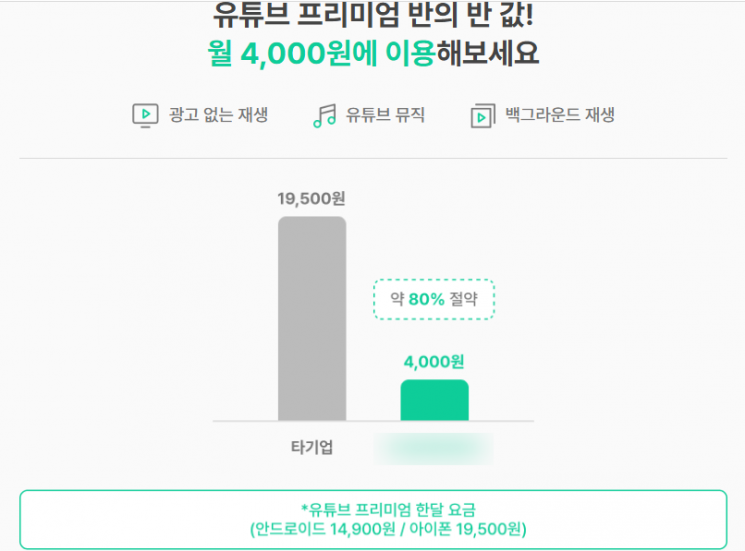 Homepage of Company A selling online video service (OTT) subscriptions such as YouTube Premium. Online capture
Recently, as Google has stepped up enforcement against YouTube Premium family sharing and overseas bypass accounts, intermediary companies that had been reselling these subscriptions at low prices have been shutting down their services one after another, resulting in a surge of consumer complaints. However, it is difficult for consumers to seek relief through police investigations, so extra caution is advised.
According to a report by The Asia Business Daily on January 5, about 170 users who suffered similar losses to Jeon have gathered in a KakaoTalk open chatroom to prepare a collective response against Company A. The amount lost per person ranges from 50,000 to 70,000 won. The company’s website is currently inaccessible, and sales of YouTube Premium subscriptions have been suspended. The Seoul Electronic Commerce Center has classified the site as a high-risk business and recommends reporting it, and complaints about other sharing companies continue to be filed.
The problem is that even when victims go to the police, it is difficult to find a clear solution. The police have stated that it is hard to apply fraud charges against the company. This is because the company did not intend to take the money without providing a service from the outset; rather, it actually provided the service for a certain period before being forced to stop due to a policy change by YouTube, making it difficult to prove intent to deceive.
Experts point out that these OTT account sharing transactions exist in a legal gray area where legal protection is limited, and that buyers may also bear some responsibility.
Kim Dowoo, a professor at Kyungnam University’s Department of Police Administration, explained, "For fraud charges to be established, the company must have accepted payment without the intention or ability to provide the service from the beginning. In this case, the service was blocked due to Google’s policy change, so criminal punishment is difficult." "Consumers are also likely aware that they are not using an official channel, meaning they knowingly engaged in a workaround. Legally, this can be seen as conditional intent, so if YouTube headquarters later suspends their accounts or imposes other penalties, it may be difficult for them to receive any relief."
© The Asia Business Daily(www.asiae.co.kr). All rights reserved.
![Clutching a Stolen Dior Bag, Saying "I Hate Being Poor but Real"... The Grotesque Con of a "Human Knockoff" [Slate]](https://cwcontent.asiae.co.kr/asiaresize/183/2026021902243444107_1771435474.jpg)

















