Nine Out of Ten Office Workers Say "A Company Cafeteria Is Essential"
"Cheap Doesn't Mean I'll Eat Anything"... The Dilemma Between Saving on Food Costs and Quality
Merits Stand Out in Terms of Cost, Time, and Convenience
In an era where the price of a single lunch exceeds 10,000 won, food expenses have become the biggest living cost burden for office workers. With high inflation continuing and dining-out costs rising steeply, workplace meal support is now seen as a core system that directly protects employees’ living expenses, going beyond a simple welfare benefit. This is why the presence of an in-house cafeteria and meal support has emerged as an important criterion when choosing a workplace.
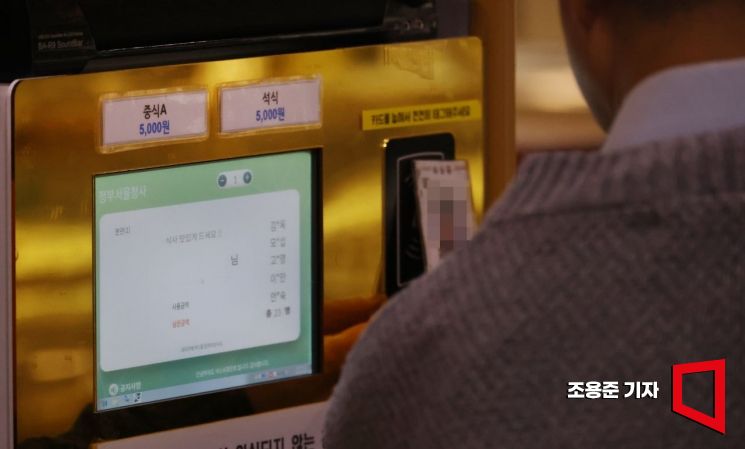
Younger and Lower-Ranked Employees Are More Sensitive to the Presence of In-House Cafeterias
According to the results of the “2025 Office Workers’ Perceptions of In-House Cafeterias” survey, conducted on January 3 by market research company Embrain Trend Monitor among 1,000 male and female office workers nationwide aged 19 to 59, 79.9% of respondents said, “I want to work at a company where I don’t have to worry about food expenses,” while 72.3% said, “I want to work at a company that provides three free meals a day.” Even if other welfare benefits are somewhat lacking, 62.6% said they feel positively about companies that generously support meals. This shows that meal support has become the most practical indicator of perceived welfare, aside from wages.
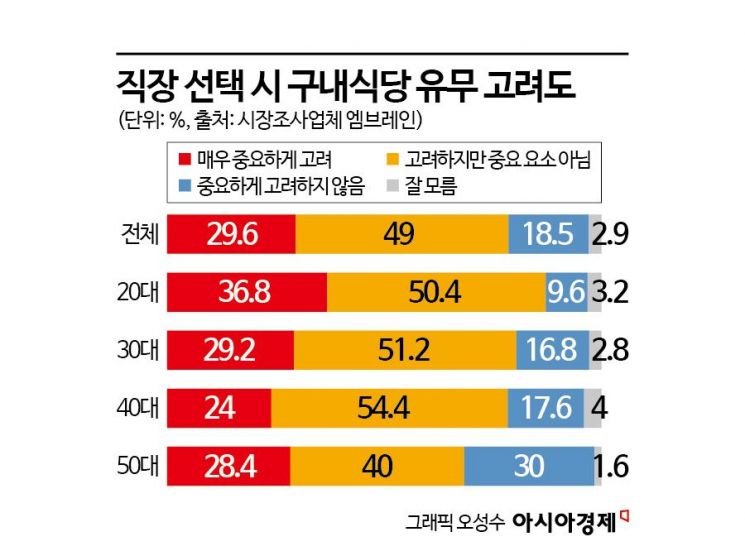
73.7% of respondents considered meal-related welfare “essential.” An even higher 90.1% agreed on the necessity of an in-house cafeteria providing meals at work, meaning that the vast majority of office workers now see in-house cafeterias as a core benefit. This trend was especially pronounced among employees in their 20s, younger age groups, and those with lower job ranks, who said they would prioritize the presence of an in-house cafeteria when choosing a future workplace. Those in relatively lower income brackets view recurring meal expenses as the most tangible burden and highly value the fact that an in-house cafeteria can save them hundreds of thousands of won in living costs each month.
Although the in-house cafeteria has become an important welfare benefit, there is a strong perception that its mere existence is not enough. 66.3% of respondents said, “If the in-house cafeteria does not guarantee a certain level of quality, it is no better than having none at all.” Additionally, 64.0% responded that if the taste and quality of the food are poor, there is no need to use the in-house cafeteria. If a cafeteria chosen to save on food expenses instead leads to dissatisfaction and stress, the welfare effect can be greatly diminished.
In fact, 72.2% of respondents said that the quality of the in-house cafeteria directly affects employee happiness, showing that a single meal at work is considered a key experience that determines one’s daily condition and work concentration. If basic standards of taste, hygiene, and menu variety are not met, the cafeteria is seen not as a “cheap meal” but as an “unbearable dining experience.”
While the burden of food expenses is a common problem for all office workers, the means to address it vary greatly depending on company size. 75.1% of respondents said, “A company needs to be of a certain size to establish an in-house cafeteria,” and 72.7% of employees at companies with fewer than 10 people agreed with this view. Additionally, 48.0% said they feel a sense of relative deprivation when hearing stories about in-house cafeterias. This indicates that the gap in welfare benefits that can reduce food expenses is widening depending on company size.
"Used Three to Four Times a Week or More"... The Most Practical Way to Save Money in an Era of High Inflation
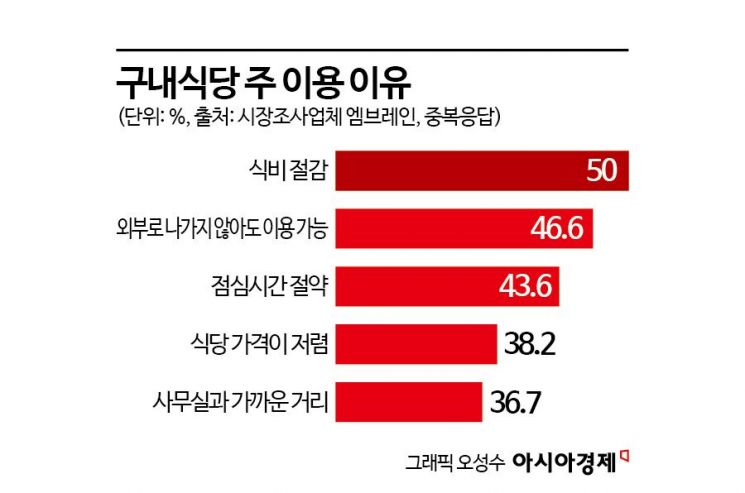
The frequency of use among office workers with access to an in-house cafeteria was very high. 34.8% said they use it “almost every day,” and 34.2% said they use it “three to four times a week,” meaning about 70% rely on the in-house cafeteria for most of their weekday meals. The main reason for using it was “to save on food expenses” (50.0%), followed by “not having to go outside” (46.6%) and “being able to save lunchtime” (43.6%).
The average price per meal at in-house cafeterias was around 5,000 to 6,000 won, making the perceived cost much lower than eating out. 80.3% of respondents said, “I feel the need for in-house cafeterias even more due to recent high inflation,” and 78.9% predicted that “the popularity of in-house cafeterias will continue to rise.”
The survey results show that in-house cafeterias are no longer an optional benefit, but have become a minimum safety net for office workers to protect their living expenses in an era of high inflation. As the burden of food expenses grows faster than wage increases, workplace meal support is becoming the central pillar of corporate welfare.
© The Asia Business Daily(www.asiae.co.kr). All rights reserved.
![Clutching a Stolen Dior Bag, Saying "I Hate Being Poor but Real"... The Grotesque Con of a "Human Knockoff" [Slate]](https://cwcontent.asiae.co.kr/asiaresize/183/2026021902243444107_1771435474.jpg)


















