Starting the New Year with Opening Ceremony and New Year’s Greeting Event
First Opening Ceremony Since Returning to the Blue House... Launching the ‘First Year of a Great Leap Forward’
A Turning Point from ‘Seven Months of Recovery’ to ‘A Year of Ac
On the morning of January 2, President Lee Jaemyung will hold the New Year’s kick-off ceremony at the Blue House State Guest House, marking the first step in his administration’s governance for the year. In the afternoon, he plans to host a New Year’s greeting event, exchanging well-wishes for the year ahead with figures from various sectors, including politics and government.
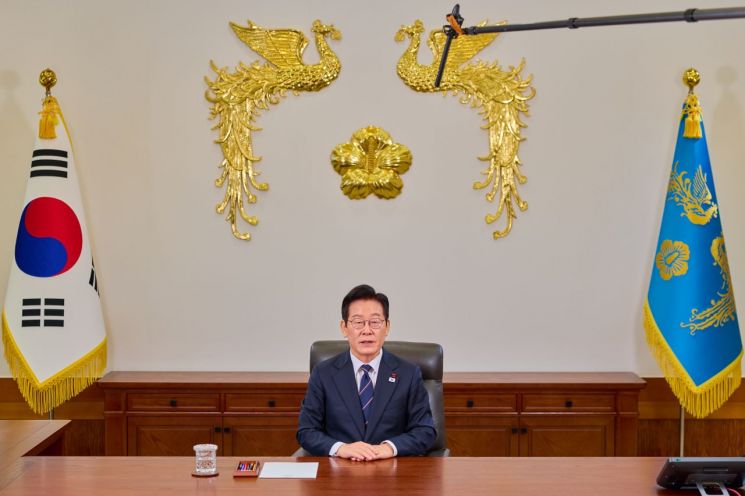
The presidential kick-off ceremony is typically an occasion to share the administration’s policy direction for the new year and to set out the year’s tasks for public officials. This year’s ceremony is especially symbolic, as it marks President Lee’s first official work event of the new year since returning to the Blue House after his inauguration on June 4 last year. Having taken office at the Yongsan Presidential Office without a transition committee, this event is expected to serve as a turning point, shifting from the “seven months of recovery” to “a year of achievement and fruition.” The first kick-off message is likely to include a blueprint for simultaneously driving growth, livelihoods, and national unity.
Last year’s government kick-off ceremony in January was held under the “Acting President” system. At the time, Acting President Choi Sangmok, during the ceremony at the Government Complex Seoul, referred to the “unprecedentedly grave situation” and urged public officials to ensure early stabilization of state affairs, unwavering economic management, public safety, and national unity. This backdrop was heavily overshadowed by the declaration and lifting of the 12·3 Martial Law, the subsequent passage of the presidential impeachment bill (December 14, 2024), and the passage of the impeachment bill against then-Acting President and Prime Minister Han Ducksoo (December 27, 2024), resulting in a significant “leadership vacuum.”
That afternoon, President Lee will host the New Year’s greeting event, presenting the direction of state affairs while exchanging greetings with key figures from various sectors, including cabinet members. With the leadership of the People Power Party, including party leader Jang Donghyeok, set to be absent, President Lee is expected to focus on the themes of the “First Year of Grand Leap Forward” and the “Five Major Transformations” presented in his New Year’s address, and actively request cooperation.
Previously, in his New Year’s address on January 1, President Lee declared “the first year of Korea’s grand leap forward” and introduced the “Five Major Transformations” aimed at fundamentally changing the nation’s growth strategy. First, he pledged to shift from the concentration in the capital region to a multi-polar system led by local governments, referred to as the “Five Poles, Three Special Zones” strategy. He promised to provide greater support the farther a region is from the capital, and to invest in education, metropolitan transportation, cultural facilities, and tourism as a package, thereby creating a structure where the development of advanced industries leads directly to regional development.
The second transformation emphasized a shift from growth centered on large corporations to “growth for all.” He stated that national achievements, such as tariff negotiations and exports in defense and nuclear power industries, should not be concentrated among a few, but should be spread to small and medium-sized enterprises, venture companies, and households. He also introduced the “National Growth Fund” as a catalyst for enabling all citizens to invest in and share the fruits of growth, and outlined plans to support the transition from an employment-centered society to a start-up-centered society, fostering a robust ecosystem for second-chance entrepreneurship.
Next, he presented “growth based on safety as a fundamental value.” He directly criticized the structural issue of industrial accident fatalities by stating, “What good is a high economic growth rate if safety is compromised?” and proposed increasing the number of labor inspectors by 2,000 and establishing a new “Workplace Guardian” system. He also mentioned promoting culture-led growth by expanding the cultural budget to 9.6 trillion won to amplify the impact of K-content and strengthen the cultural ecosystem, including the foundational arts, to create a virtuous industrial cycle.
Finally, he emphasized growth underpinned by peace. He reaffirmed his commitment to easing inter-Korean tensions and restoring trust, supporting North Korea-U.S. dialogue as a “pacemaker,” and turning the “Korea risk” into a “Korea premium.” He also unveiled plans to reduce growth uncertainties based on strong self-reliant national defense and an evolved South Korea-U.S. alliance.
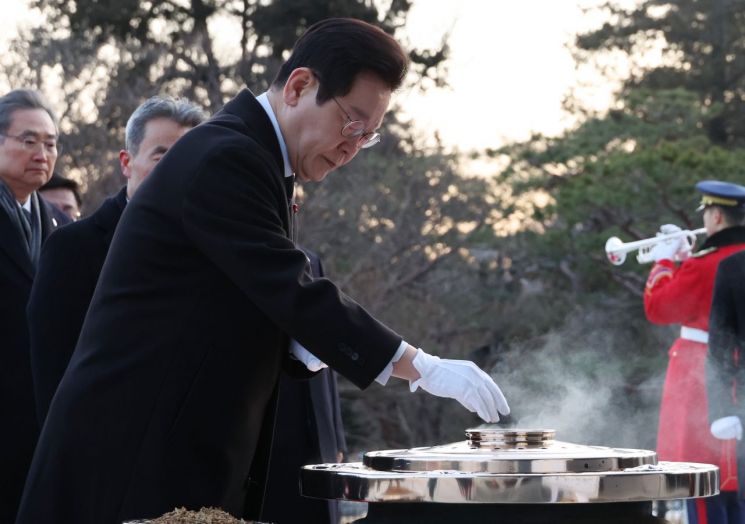
After delivering his New Year’s address, President Lee visited the Seoul National Cemetery, where he laid flowers and incense at the Memorial Tower and paid silent tribute to the fallen patriots and national heroes. In the guestbook, he wrote, “The first year of Korea’s grand leap forward-a world where we live together-I will open it together with the Korean people.” He was accompanied by Prime Minister Kim Minseok, cabinet members, ministers, and Blue House staff. After the visit, he shared a rice cake soup breakfast at the Blue House staff cafeteria, exchanging well-wishes with the attendees.
© The Asia Business Daily(www.asiae.co.kr). All rights reserved.


















