Ministry Releases "2026 Sociocultural Trends" Analysis
538 Million Pieces of Big Data Analyzed, 74,760 Keywords Identified
The Ministry of Culture, Sports and Tourism has identified artificial intelligence (AI), authenticity, wellness, restrained and practical consumption, K-culture, and communication and relationships as the key trends that will shape the sociocultural landscape of Korean society in the coming year.
On December 31, the Ministry released the results of its "2026 Sociocultural Trends" analysis, based on 538 million pieces of online big data collected from news, social networking services (SNS), online communities, and video platforms between January and November of this year. From the overall data, the Ministry extracted a total of 74,760 keywords and, after a comprehensive review of online public opinion and lifestyle changes, presented six major sociocultural trends: ▲the shift to a human-centered society after the rise of AI, ▲the era of authenticity and hyper-personalization, ▲the transition to wellness, ▲restrained and practical consumption ethics, ▲pride in K-culture and the emotional economy, and ▲coexistence fostered by emotional empathy.
Based on these findings, the Ministry expects that Korean society will move beyond a simple "recovery" phase after recent crises, entering a stage where people adapt to changed circumstances and reconstruct their ways of life.
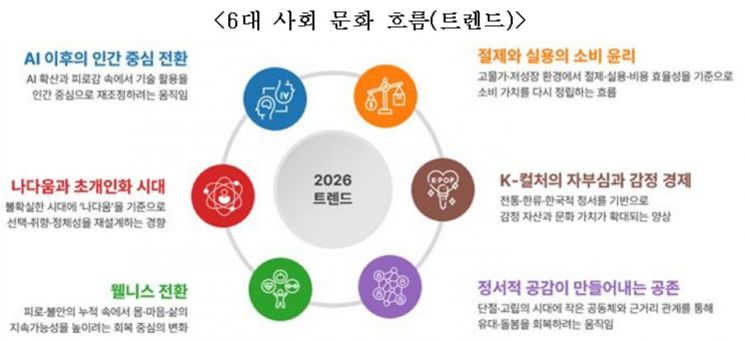
This year, online mentions related to AI increased by 44% compared to the same period last year. In particular, mentions of related terms such as policy (up 147.5%), security (up 220.4%), and regulation (up 109.1%) saw significant increases, indicating growing interest in institutional management of AI.
The Ministry interpreted these results by stating, "As generative AI becomes deeply embedded in all aspects of daily life, our society is moving beyond simply utilizing AI and is now actively debating how to redefine the roles and responsibilities of humans. This shows that while the public is embracing the convenience and potential of AI, they are also paying close attention to its impact on jobs, safety, and fairness."
The growing interest in authenticity reflects a shift toward an individual-centered society, as more people seek to design their own lives rather than conforming to social norms. Mentions of authenticity increased by 10% compared to the same period last year, with related terms including individual, identity, choice, and self-determination.
The Ministry explained, "Authenticity refers to the perception that life choices should be defined by one's own identity and values, rather than by societal standards or group expectations. This attitude, which values approaches that best suit the individual in all aspects of life-career, relationships, leisure-demonstrates that society is moving away from a single standard model toward the coexistence of diverse lifestyles."
Mentions related to wellness increased by 16% year-on-year, with sharp rises in associated terms such as daily life (up 125.2%), old age (up 677.3%), later life (up 181.1%), and slow aging (up 93.7%). This indicates a growing awareness of the need to manage health throughout daily life, rather than focusing solely on treatment.
The Ministry noted, "People are now interested in lifelong health management that goes beyond treatment to include sleep, lifestyle habits, mental health, and preparation for later life. Health is increasingly recognized not just as a matter of personal choice, but as a basic social condition for a stable life."
In terms of consumption, there is a growing trend toward restraint and practicality. Rather than expanding desires through consumption, people are increasingly prioritizing balance and efficiency in their lives. Mentions related to consumption increased by 13% compared to the same period last year, with "cost-effectiveness" being the most prominent keyword in consumption-related discussions.
The Ministry observed, "The public is not necessarily reducing consumption, but is instead managing expenditures through rational choices and alternative consumption methods. At the same time, there is sustained awareness of eco-friendly and ethical standards, so consumption is now regarded as an act that involves value judgments as well as price considerations."
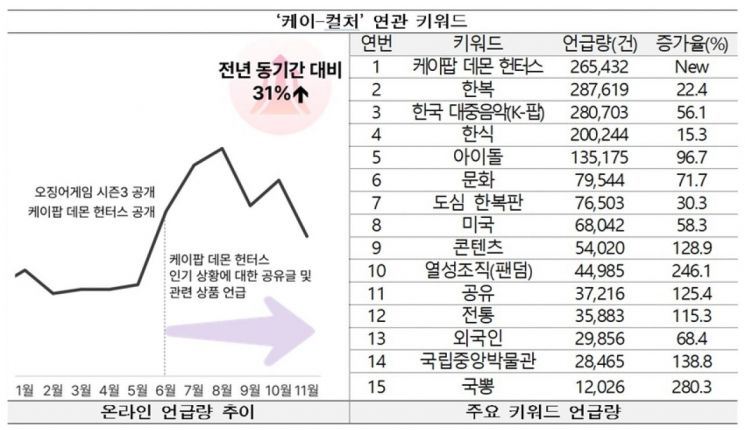
K-culture is expanding beyond simple content consumption to a domain where emotional and economic values are combined. Mentions of K-culture increased by 31% year-on-year, with a notable rise in related terms reflecting fandom and pride.
There is also a growing trend toward emotional immersion and pride in the cultural experience, leading to increased shared, participatory, and viral consumption centered around fandoms. This is translating into tangible consumption-such as exhibitions, performances, tourism, and product purchases-and shows how emotional empathy accumulated online is now driving real-world economic effects beyond cultural enjoyment.
There is a shift away from performance- and competition-oriented relationships toward those that provide emotional stability and recovery, resulting in changes in how people coexist. Mentions related to relationships and empathy increased by 20% compared to last year, with emotional keywords such as recovery (up 109.1%), emotion (up 123.2%), and communication (up 83.3%) standing out.
The Ministry analyzed, "Rather than large-scale, institutional relationships, small communities based on shared tastes, lifestyles, and interests are functioning as safety nets that provide emotional support and stability. This demonstrates a growing recognition that, more than 'successful living,' it is important to have relationship structures that enable self-recovery even in times of crisis."
Lee Jungeun, Director of Digital Communication at the Ministry of Culture, Sports and Tourism, stated, "In the rapidly changing media environment, we will use the results of the 2026 sociocultural trends analysis to anticipate public needs and further strengthen communication that resonates with the public."
© The Asia Business Daily(www.asiae.co.kr). All rights reserved.
![Clutching a Stolen Dior Bag, Saying "I Hate Being Poor but Real"... The Grotesque Con of a "Human Knockoff" [Slate]](https://cwcontent.asiae.co.kr/asiaresize/183/2026021902243444107_1771435474.jpg)
















