Medical Associations Voice Unified Criticism
Medical associations have criticized the Medical Workforce Supply and Demand Estimation Committee, stating that discussions regarding the estimated shortage of physicians are proceeding without scientific evidence or validity.
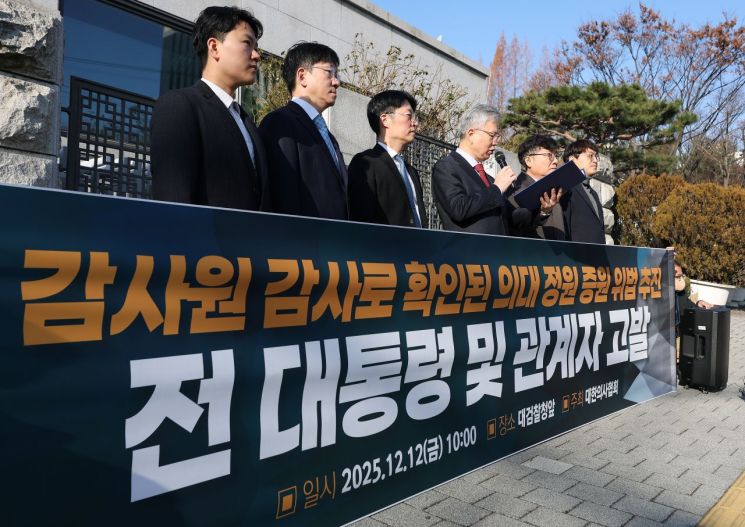 On the 12th, Kim Taekwoo, president of the Korean Medical Association (fourth from the left), is speaking at the press conference for the criminal complaint against the former president and others following the Board of Audit and Inspection's audit results on the medical school quota increase procedure, held in front of the Supreme Prosecutors' Office in Seocho-gu, Seoul. Photo by Yonhap News
On the 30th, before the committee meeting began, the Korean Medical Association released a statement saying, "The current estimation committee is conducting discussions in the same outdated manner as before, effectively excluding key variables of the future medical environment such as the introduction of artificial intelligence (AI), advancements in medical technology, and changes in productivity."
The association pointed out, "This directly contradicts the intent of the Board of Audit and Inspection's findings, which emphasized that 'the validity must be ensured as the results can vary greatly depending on assumptions that reflect structural factors.'"
They continued, "Due to the excessive increase in medical school quotas, educational sites are already at their limits, with a shortage of classrooms within medical schools," adding, "It is unreasonable to focus solely on numbers without in-depth consideration of educational conditions." They also argued, "Rushing to an immature conclusion under time pressure will only repeat a national mistake like the '2,000 quota increase incident.'"
The Korean Intern and Resident Association also stated, "Although the estimation committee claims to use scientific models, in reality, it relies on arbitrary constants while excluding essential variables from the medical field," and added, "Attempts to justify the expansion of medical school quotas based on poor data are hasty decisions lacking validity."
The association expressed concern, saying, "The committee's failure to fully reflect the actual workload and working days in the medical field, as well as its exclusion or conservative estimation of productivity improvements due to technological advances, amounts to statistical distortion," and warned, "Increasing quotas while ignoring fundamental limitations such as faculty and training environments will lead to poor-quality education."
They further asserted, "The government must stop trying to justify its decisions based on unreliable estimation results," and argued, "Estimates that distort reality and lack academic validity are no different from the unilateral policy decisions of the previous administration and cannot be accepted."
The National Intern and Resident Labor Union also released a statement, pointing out, "Throughout the twelve rounds of committee discussions, concerns have been repeatedly raised about the limitations of the data and the validity of variable settings, but these concerns have not been adequately addressed," and added, "While this estimation may serve an administrative purpose, it is unlikely to meaningfully advance discussions on physician workforce policy."
The union stated, "Policies should first address the avoidance of certain specialties and provide incentives for already qualified specialists, and it is essential to restore the collapsed medical delivery system," adding, "If the sole purpose becomes increasing the medical school quota without addressing these fundamental issues, unnecessary medical utilization and rising national healthcare costs will be inevitable, ultimately harming the quality of healthcare in the long term."
© The Asia Business Daily(www.asiae.co.kr). All rights reserved.
![Clutching a Stolen Dior Bag, Saying "I Hate Being Poor but Real"... The Grotesque Con of a "Human Knockoff" [Slate]](https://cwcontent.asiae.co.kr/asiaresize/183/2026021902243444107_1771435474.jpg)















