"Shortage Projected at Minimum 4,923 to Maximum 11,136 Doctors by 2040"
How was the estimate that South Korea may face a shortage of more than 11,000 doctors by 2040 calculated?
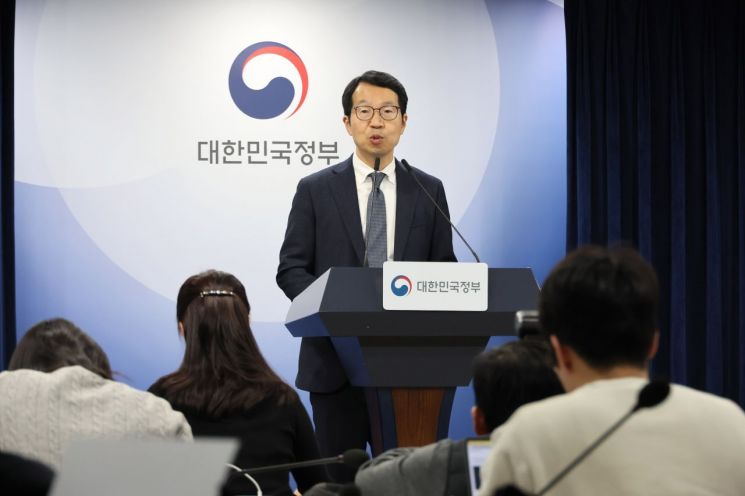 Kim Taehyun, Chairman of the Medical Workforce Supply and Demand Forecasting Committee, is announcing the results of the 12th Medical Workforce Supply and Demand Forecasting Committee meeting at the Government Seoul Office in Jongno-gu, Seoul, on the 30th. Photo by Yonhap News
The Medical Workforce Supply and Demand Forecasting Committee announced on the 30th that this projection was not merely a simple prediction, but was derived using a validated statistical model based on observable data and agreed-upon assumptions at the present time, including changes in the population structure, historical trends in medical service utilization, and the potential for future technological advancements.
To estimate the demand for doctors, the committee first calculated the 'total volume of medical services used' by the public, and then estimated the number of doctors required to meet that demand. For the time-series analysis, they analyzed long-term trends in hospital visits by using accumulated inpatient and outpatient data from various types of medical institutions (such as tertiary hospitals and clinics). The committee explained that they used the Autoregressive Integrated Moving Average (ARIMA) model, which corrects for irregular fluctuations in data, to enhance the accuracy of their predictions.
In the model reflecting demographic structure (cohort-component method), the committee accounted for South Korea's rapid aging. They assumed that current patterns of medical service utilization by gender and five-year age groups would remain unchanged, then applied Statistics Korea's future population projections to estimate total future medical demand.
For the supply side, the committee did not simply count the number of licensed doctors, but closely tracked changes in the number of 'practicing physicians' who actually see patients. Using the stock-flow approach, they added the number of new doctors entering the workforce each year-calculated from the annual medical school admission quota (3,058 students) and the national licensing exam pass rate-and subtracted those leaving due to mortality and other factors. They then multiplied this by the probability that a doctor would actually be practicing in the field to calculate the final workforce.
For supply estimates based on attrition rates, the committee tracked the physician population over a long period to determine how many retire or leave clinical practice each year. In particular, they separated out deaths to determine the number of pure retirees.
The committee also stated that this projection went beyond simple numerical calculations by reviewing various scenarios, including improvements in physician productivity due to advances in medical technology such as artificial intelligence (AI), changes in the number of working days for doctors, and changes in government healthcare policy.
Kim Taehyun, Chairman of the Medical Workforce Supply and Demand Forecasting Committee, explained, "The committee collectively recognizes that it is inherently difficult to fully predict future patterns of medical service utilization, technological advances, and changes in work patterns in medium- to long-term workforce projections. We also agree that there are practical limitations in comprehensively incorporating all factors into a single model given the constraints of available data and methodologies," adding, "Therefore, we comprehensively considered variables observable at present and applicable methodologies."
© The Asia Business Daily(www.asiae.co.kr). All rights reserved.
![Clutching a Stolen Dior Bag, Saying "I Hate Being Poor but Real"... The Grotesque Con of a "Human Knockoff" [Slate]](https://cwcontent.asiae.co.kr/asiaresize/183/2026021902243444107_1771435474.jpg)















