This year, the KOSPI ushered in the era of "Sacheonpi" (KOSPI 4,000 points) with a record-breaking rally, rising 75.6% and marking the highest increase among major countries. The government's capital market revitalization policies and efforts by listed companies to enhance corporate value are cited as the driving forces behind this unprecedented bull market.
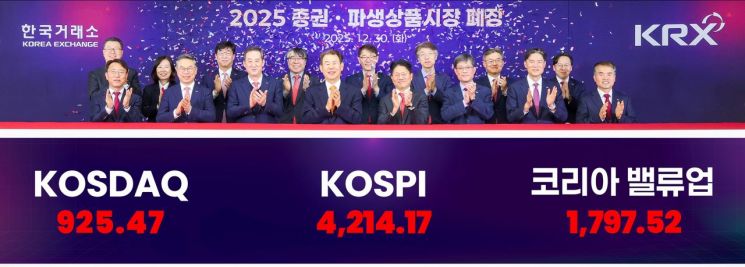 Jung Eunbo, Chairman of the Korea Exchange (center), is holding the "2025 Securities and Derivatives Market Closing Ceremony" with executives at the Korea Exchange Busan headquarters on the 30th and is taking a group commemorative photo based on the closing index.
According to the Korea Exchange on December 30, the KOSPI closed the final trading session of the year at 4,214.17, down 0.15% from the previous session. Although the index declined on the last day, it soared 75.6% compared to the end of last year, demonstrating an extraordinary bull run. The KOSDAQ finished at 925.47, down 0.76% from the previous session, but up 36.5% year-on-year.
At the beginning of the year, the KOSPI hit its lowest point due to increased domestic and international uncertainties, including political instability and concerns about US reciprocal tariffs. However, following the inauguration of the new administration, investor sentiment recovered and the index rebounded, driven by capital market revitalization policies such as enhancing shareholder value and eradicating unfair trading, as well as improvements in the semiconductor industry.
The trend of gains in odd-numbered years continued this year. The KOSPI rose 3.6% in 2021 but fell 24.9% in 2022. In 2023, it successfully rebounded with an 18.7% increase, but last year it dropped 9.6%.
The KOSPI ranked overwhelmingly first among major stock markets (G20 and OECD). While the KOSPI surged 75.6%, Chile followed with 57%, Colombia with 53%, and Israel with 51%. Japan rose 27%, ranking 21st; China gained 18%, ranking 29th; and the United States increased 17%, ranking 30th.
All sector indices rose compared to the end of last year, with machinery and equipment (133.7%), electrical and electronics (127.9%), electricity and gas (103.5%), and securities (99.9%) showing particularly strong gains.
A Korea Exchange official explained, "The main factors include improved performance in industries such as shipbuilding, defense, nuclear power, and semiconductors, as well as expectations for capital market revitalization policies amid a global trend of interest rate cuts."
The KOSPI’s market capitalization reached 3,478 trillion won, up 77.1% from the end of last year. For the first time ever, the KOSPI’s market cap surpassed 3,000 trillion won. The KOSDAQ’s market cap increased by 48.7% to 506 trillion won, also surpassing 500 trillion won for the first time.
The average daily trading volume and value in the main board increased by 6.4% and 57.1%, respectively. A Korea Exchange official analyzed, "The increase in trading value outpaced the increase in trading volume due to the expansion of trading centered on high-priced, large-cap stocks and rising share prices." In the KOSDAQ market, average daily trading volume increased by 1.0% year-on-year, and trading value rose by 10.7%.
By investor group, foreigners recorded a net sale of 9 trillion won and individuals a net sale of 19.7 trillion won in the main board, while institutions made a net purchase of 18.2 trillion won and other corporations 10.5 trillion won. Although foreigners were net sellers for the year, they drove the index higher by making large net purchases from May to October, except in August. Institutions expanded their buying, mainly through financial investment, and net purchases by other general corporations were primarily through share buybacks.
In the KOSDAQ market, only individuals were net buyers, purchasing 9.1 trillion won, while foreigners and institutions recorded net sales of 3.1 trillion won and 700 billion won, respectively.
© The Asia Business Daily(www.asiae.co.kr). All rights reserved.
![Clutching a Stolen Dior Bag, Saying "I Hate Being Poor but Real"... The Grotesque Con of a "Human Knockoff" [Slate]](https://cwcontent.asiae.co.kr/asiaresize/183/2026021902243444107_1771435474.jpg)















