"Maintaining an Uneasy Equilibrium by Suppressing Yields"
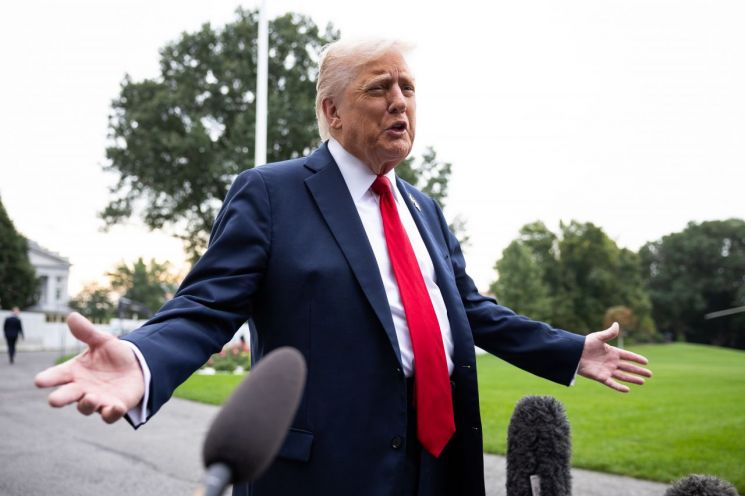
Foreign media have reported that the U.S. Treasury market and the Donald Trump administration remain in a state of "uneasy truce." While the U.S. government is making every effort to stabilize Treasury yields, persistent dissatisfaction among bond investors means that the bond yield turmoil seen last April could recur at any time.
10-Year Treasury Yield Surge Last Month
Reuters reported on the 29th (local time) that signs are emerging of renewed conflict between President Donald Trump and the $30 trillion U.S. Treasury market-a rift that was only temporarily patched up this spring.
Such signs of instability were observed on the 5th of last month, when the yield on the 10-year U.S. Treasury suddenly jumped by 6 basis points (1bp = 0.01 percentage point). This was the largest increase in recent months.
On that day, the U.S. Treasury Department signaled additional issuance of long-term Treasury bonds, and at the same time, the U.S. Supreme Court began hearings on the constitutionality of the Trump administration's reciprocal tariffs. Amid ongoing market concerns about U.S. government debt, these announcements were seen as the decisive trigger.
The "term premium" applied to U.S. Treasuries has also started to rise again in recent weeks. The term premium refers to the additional yield that investors demand as compensation for the risks associated with holding U.S. Treasuries for 10 years.
Intense 'Battle of Wills' Behind the Bond Market
According to Reuters, executives from more than 10 major banks and asset management companies have reported that, behind the seemingly calm bond market, an intense battle of wills is underway. The U.S. annual fiscal deficit now amounts to 6% of GDP. As long as the government continues to seek funding to cover this gap, the Treasury market could be in a state of "war" at any moment.
The Trump administration's biggest concern is the "bond vigilantes"-investors who drive up bond yields to check the government's loose fiscal management. Market experts note that the government is barely holding off their offensive. Sinead Colton Grant, Chief Investment Officer of BNY Wealth Management, emphasized, "Bond vigilantes never disappear. They are always present in the market, simply waiting for the right moment to act."
The apparent calm in the bond market is underpinned by confidence in the resilience of the U.S. economy. Large-scale, AI-driven investment spending is believed to have offset the growth slowdown pressures caused by tariffs. Additionally, the Federal Reserve's shift to a more accommodative monetary policy, prompted by a slowdown in the labor market, has been viewed positively.
The Trump administration has also been sending continuous signals to the market that it will act to prevent a surge in Treasury yields. In particular, the benchmark 10-year Treasury is a top management priority, as it has a significant impact on the government fiscal deficit as well as household and corporate borrowing costs. Furthermore, the Trump administration is reportedly soliciting the views of bond investors on major policy decisions in private meetings.
U.S. Treasury Secretary Scott Bessent, in a speech on the 12th of last month, described himself as "America's number one Treasury bond salesman" and reassured the market of his commitment to keeping yields on the 10-year and other bonds low. He also continued to deliver messages emphasizing the importance of Treasury yields and engaged in verbal interventions during the Treasury market turmoil last April.
U.S. Government Faces Controversy Over Setting 'Ceiling' on Long-Term Yields
However, there is considerable debate over the Trump administration's methods for managing the market. At the end of July this year, the U.S. Treasury announced an expansion of "Treasury buybacks" (early redemption of government bonds) to reduce the outstanding amount of illiquid long-term Treasuries. Since this measure primarily targets long-term bonds such as the 10-year, 20-year, and 30-year maturities, some in the market have raised concerns that the government may be trying to artificially cap long-term yields.
Jimmy Chang, CIO of Rockefeller Global Family Office, described the situation as an "uneasy equilibrium," criticizing, "We are living in an era of 'financial repression,' where the government uses various tools to artificially suppress Treasury yields."
Additionally, the Trump administration is increasing the supply of short-term Treasuries to raise funds to cover the fiscal deficit. This, too, raises concerns about potential side effects if inflation accelerates in the future. Excessive issuance of short-term debt could lead to a surge in refinancing costs when market rates rise due to inflation.
Fed Governor Stephen Miran strongly criticized the previous Biden administration last year for relying on short-term Treasuries as a solution to the fiscal deficit. When Reuters asked Governor Miran to comment on the current Trump administration pursuing the same policy, he declined to respond.
© The Asia Business Daily(www.asiae.co.kr). All rights reserved.
![Clutching a Stolen Dior Bag, Saying "I Hate Being Poor but Real"... The Grotesque Con of a "Human Knockoff" [Slate]](https://cwcontent.asiae.co.kr/asiaresize/183/2026021902243444107_1771435474.jpg)
















