SLICE Digital Business Card Service
Releases 'Report 2025' Highlighting Changes in Corporate Operations
Digital business cards, once seen primarily as personal networking tools, are now expanding into business infrastructure that encompasses operational efficiency, brand management, and global communication for companies.
On December 30, CreatorNomic, the operator of the digital business card service SLICE, announced this in its publication of the “SLICE Report 2025.”
According to the report, there are three main reasons companies are adopting digital business cards. The first is global networking without language barriers. Among companies using SLICE, 80% utilize multilingual business cards, and the automatic translation feature-which matches the recipient’s smartphone language setting-has significantly improved communication speed with overseas partners and clients.
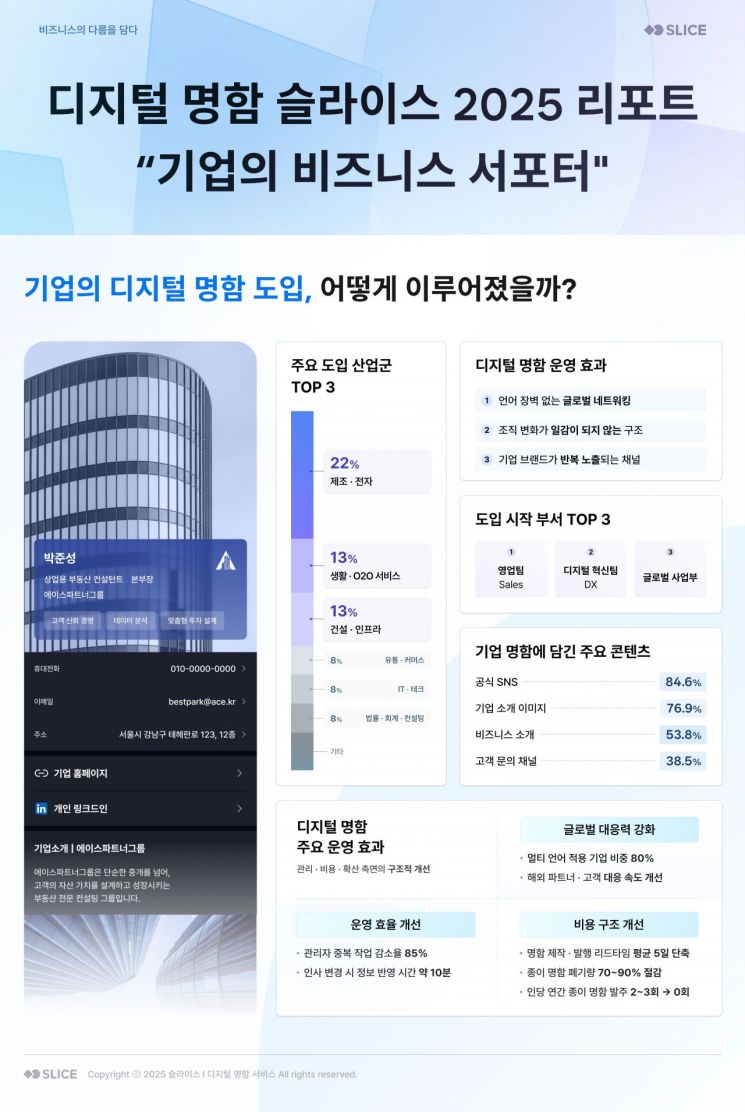
The second reason is that organizational changes no longer create extra work. With traditional paper business cards, personnel transfers or changes in job titles required large-scale reprinting and disposal. However, after adopting digital business cards, information changes are reflected instantly, on average within 10 minutes. Duplicate administrative tasks have also decreased by 85%.
The third reason is the role of digital business cards as a branding channel that repeatedly exposes the corporate brand. Companies are leveraging business cards not just as a means of contact, but as ongoing brand touchpoints that connect to company introductions, service descriptions, social networking services (SNS), press releases, and video content.
Digital business cards were first introduced in organizations with frequent external interactions and frequent information changes. Typical examples include sales teams, digital transformation (DX) departments, and global business divisions. The average scale of adoption per company is about 250 employees, with most cases involving either entire department or company-wide implementation.
Notably, by integrating the entire process of business card creation, modification, and distribution into a single system, companies have seen an average reduction of five days in business card production lead time, a 70-90% decrease in paper business card waste, and zero annual orders for paper business cards per person. These results demonstrate structural improvements in both operations and costs. Additionally, SLICE’s analysis indicates that digital business cards transform business cards from consumables into manageable digital assets by enabling centralized management, instant updates, and eliminating the need for reprinting.
An official from Lotte Rental, which adopted SLICE this year, stated, “About 40-50% of our sales staff are using digital business cards in the field. Even though digital transformation can be challenging on the ground, starting with digital business cards-a relatively low-barrier area-has led to successful adoption.”
Lee Sumin, CEO of CreatorNomic, said, “Digital business cards are infrastructure that simultaneously enhances operational efficiency, brand consistency, and global responsiveness for companies. SLICE will continue to support companies as a practical business partner in their digital transformation.” The full report is available on the SLICE website and blog.
© The Asia Business Daily(www.asiae.co.kr). All rights reserved.

















