China Expected to Sell 27 Million Units, Japan 25 Million Units
Nikkei Estimates Based on S&P Data
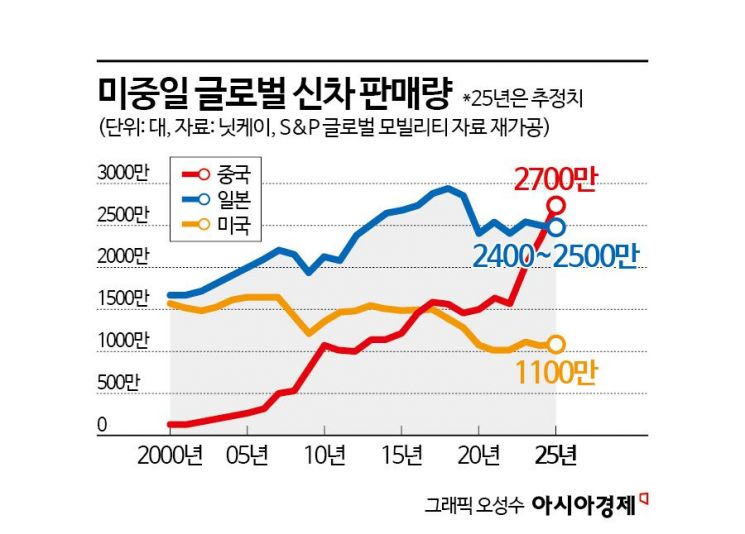
Nihon Keizai Shimbun (Nikkei) reported on December 30 that Chinese automakers are expected to rank first in global new vehicle sales (including commercial vehicles) for the first time this year.
Based on data released by automakers from January to November this year and S&P Global Mobility data, Nikkei estimated that global new vehicle sales by Chinese companies will reach approximately 27 million units this year, up 17% from the previous year.
In comparison, new vehicle sales by Japanese companies are expected to fall short of 25 million units, resulting in China overtaking Japan for the top spot it has held for more than 20 years. The United States is expected to remain at 11 million units.
Amid domestic oversupply, China has already taken the lead in exports since 2022 by flooding overseas markets, especially with electric vehicles (EVs).
This year, sales of Chinese cars in Europe are projected to increase by about 7% to around 2.3 million units, while growth rates in the ASEAN (Association of Southeast Asian Nations) and Central and South American markets are expected to reach 49% and 33%, respectively.
Nikkei noted, "Chinese companies are seeking growth through exports as price competition intensifies in their domestic market, with BYD, for example, implementing price cuts," and added, "As a result, there are concerns that protectionism may intensify as countries respond with tariffs and other measures."
However, questions remain about the sustainability of this growth in the Chinese automotive industry, as it has been driven by massive policy subsidies and tax incentives.
The South China Morning Post (SCMP) recently cited analyst analysis, noting that by 2026, more than 50 Chinese EV companies may face a critical crossroads of downsizing or withdrawal from the market.
SCMP reported, "The Chinese automotive industry is expected to see a decline in sales next year due to overproduction and weakening government support," adding, "This could mark the first negative growth since 2020."
© The Asia Business Daily(www.asiae.co.kr). All rights reserved.
![Clutching a Stolen Dior Bag, Saying "I Hate Being Poor but Real"... The Grotesque Con of a "Human Knockoff" [Slate]](https://cwcontent.asiae.co.kr/asiaresize/183/2026021902243444107_1771435474.jpg)















