The history of the Korea Customs Service’s special judicial police dates back to 1949. This predates the official establishment of the Korea Customs Service in 1970, making it no exaggeration to say that the first chapter of today’s special judicial police began with the Customs Service. This underscores how seriously the need to counter smuggling crimes at the border was regarded even at that time.
According to the Korea Customs Service on December 31, as of now, special judicial police officers are designated by the chief prosecutor of the local district prosecutor’s office, in accordance with the Act on the Duties of Judicial Police Officers, and carry out related duties. However, when the Customs Service’s special judicial police first began their activities, customs officials conducted specialized investigations into trade crimes based on investigative authority granted by the Customs Act, which was enacted in 1949.
The long-standing activities of the special judicial police have enabled the Korea Customs Service to accumulate specialized investigative experience and expertise in trade crimes.
As of this month, the Customs Service’s special judicial police consist of 37 officers in 1 bureau and 3 divisions at headquarters, and 607 officers (across 121 teams) in 5 bureaus and 55 divisions at customs offices. Their main investigative areas include customs offenses, foreign trade offenses, intellectual property (IP) offenses, foreign exchange offenses, asset flight offenses, money laundering offenses, drug offenses, offenses related to the origin of agricultural and marine products, and public health offenses.
When evidence of criminal activity is secured, an investigation (or preliminary investigation) is launched. This involves compulsory investigative procedures such as search and seizure and arrest. If the charges are substantiated through procedures such as suspect interrogation, the case is referred to the prosecution. However, the entire investigative process, including the execution of warrants, is conducted under the direction of a prosecutor.
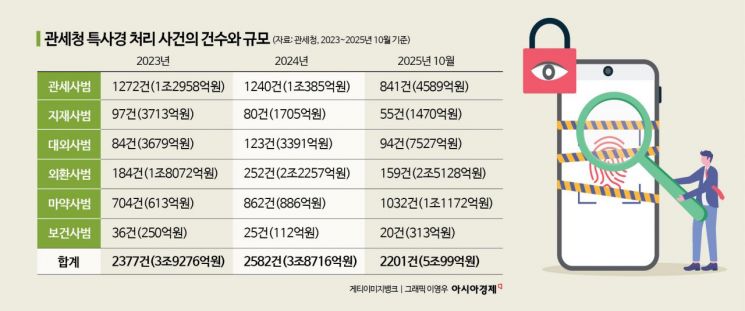
Through these efforts, from January to October of this year, the Customs Service’s special judicial police resolved a total of 2,201 cases (worth 5.0099 trillion won), including 841 customs offenses (458.9 billion won), 55 IP offenses (147 billion won), 94 foreign trade offenses (752.7 billion won), 159 foreign exchange offenses (2.5128 trillion won), 1,032 drug offenses (1.1072 trillion won), and 20 public health offenses (31.3 billion won).
Even when combining all special judicial police officers at both headquarters and customs field offices, the total number does not reach 1,000. Nevertheless, the number of cases detected annually from 2023 to October 2025 has exceeded 2,000 each year. This achievement is the result of 76 years of investigative experience and expertise, combined with the unique characteristics of the Korea Customs Service as an economic border management and oversight agency, which possesses vast information on cross-border movement of people, goods, and foreign exchange transactions, as well as export/import and tax management.
However, with the recent sharp increase in the frequency of border crimes, challenges on the ground have also intensified. For example, the number of drug offenses uncovered by the Customs Service’s special judicial police over the past three years has surged: 704 cases (61.3 billion won) in 2023, 862 cases (86.6 billion won) in 2024, and 1,032 cases (1.1072 trillion won) as of October 2025.
A Korea Customs Service official stated, “The average investigative experience of customs special judicial police is six years, and 41.5% of personnel have more than 10 years of experience, surpassing the police average of 32.2%. While it may not match the long history of the Customs Service’s special judicial police, we have deployed sufficiently experienced and knowledgeable investigators to the field, where they serve as guardians to prevent and block crimes at the border.”
He added, “However, as crimes such as drug and foreign exchange offenses have become more sophisticated and frequent, the difficulties faced on the ground have also increased. Given our long history and accumulated expertise, now is the time to consider ways for the Customs Service’s special judicial police to utilize their investigative capabilities more actively and efficiently.”
© The Asia Business Daily(www.asiae.co.kr). All rights reserved.
![Clutching a Stolen Dior Bag, Saying "I Hate Being Poor but Real"... The Grotesque Con of a "Human Knockoff" [Slate]](https://cwcontent.asiae.co.kr/asiaresize/183/2026021902243444107_1771435474.jpg)















