Eased Restrictions on Individual Import Approvals
Annual Equipment Export Quota Introduced
Instead of Revoking "Validated End-User" Status
The U.S. government has decided to partially ease export restrictions on equipment for the Chinese factories of domestic semiconductor companies such as Samsung Electronics and SK Hynix. This move has allowed them to avoid the worst-case scenario of having to obtain individual approvals for every piece of equipment brought in.
According to the industry on December 30, the Bureau of Industry and Security (BIS) of the U.S. Department of Commerce has changed its policy regarding Korean semiconductor companies’ Chinese factories. Instead of revoking their 'Validated End-User (VEU)' status, the BIS will now allow exports by approving the volume of equipment shipments on an annual basis.
With this measure, Samsung Electronics and SK Hynix will be able to significantly reduce the risk of production disruptions at their Chinese factories due to delays in equipment imports. Industry observers note that the companies have managed to avoid the worst-case scenario of requiring permits for each equipment import. This gives them some leeway to maintain stable operations of their NAND flash and DRAM production lines in China. However, restrictions remain on importing equipment for factory expansion or process upgrades, which continues to limit their medium- to long-term investment strategies.
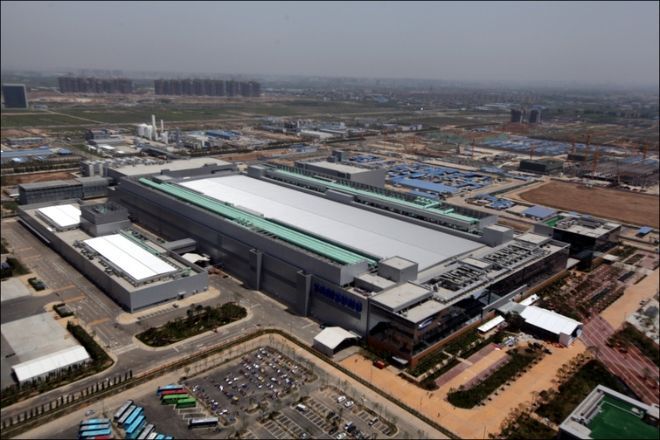 Samsung Electronics NAND flash factory exterior in Xi'an, Shanxi Province, China. Samsung Electronics
The VEU is an exceptional status that allows the supply of U.S.-made equipment without separate approval procedures or time restrictions, as long as certain security conditions are met. Until now, Samsung Electronics’ NAND factory in Xi'an, SK Hynix’s DRAM factory in Wuxi, and NAND factory in Dalian had been recognized by the U.S. government as VEUs, enabling them to import U.S. equipment without significant regulation. However, at the end of August, the BIS announced it would remove the three Chinese subsidiaries operating these factories from the VEU list.
This measure was scheduled to take effect on December 31, 120 days after its publication in the Federal Register on September 2. If implemented as planned, the Chinese factories of Korean companies would have needed to obtain individual U.S. government approvals for each import of U.S.-made equipment starting December 31.
However, with the U.S. government’s decision to ease restrictions, a new system will be introduced requiring separate annual approvals. Companies will apply in advance for the types and quantities of semiconductor equipment and parts needed each year, and the U.S. government will decide whether to approve exports after review. While this process is more stringent than being reinstated on the comprehensive VEU list, it is considered less burdensome than having to obtain individual approvals for each equipment import, thus reducing operational uncertainties.
The U.S. government estimated that, without VEU status, the annual number of required approvals for Samsung Electronics and SK Hynix’s Chinese factories would reach 1,000 cases. Even with annual equipment export approvals, the policy of not permitting equipment shipments for factory expansion or upgrades in China remains in place.
An industry official stated, “Although the set approval period is somewhat disappointing, the removal of uncertainty during the approval period is a major positive. Concerns regarding the operation and investment in Chinese factories have been largely alleviated.” However, the official added, “U.S.-China tensions are expected to intensify in the age of AI supremacy, and since NAND is produced in China, it is not a situation where we can be completely at ease.”
© The Asia Business Daily(www.asiae.co.kr). All rights reserved.
![Clutching a Stolen Dior Bag, Saying "I Hate Being Poor but Real"... The Grotesque Con of a "Human Knockoff" [Slate]](https://cwcontent.asiae.co.kr/asiaresize/183/2026021902243444107_1771435474.jpg)















