"Reducing Criminal Penalties, Strengthening Economic Sanctions"
Discussion on 331 Measures to Reform Economic Criminal Regulations
The party and government have decided to continue discussions regarding the abolition of the crime of breach of trust. For now, the Ministry of Justice is taking the lead in preparing the basic framework for alternative legislation, but it appears that it will take some time to finalize the proposal.
At the 2nd Party-Government Consultative Meeting on Rationalizing Economic Criminal and Civil Liability held by the Democratic Party on December 30, Kwon Chilseung, who heads the Democratic Party's Economic Criminal and Civil Liability Rationalization Task Force, stated, "We are aware that there is significant public interest in abolishing the crime of breach of trust, but it was not included as an official agenda item today." He added, "The Ministry of Justice is currently preparing alternative legislation, and further explanations will be provided separately in the future."
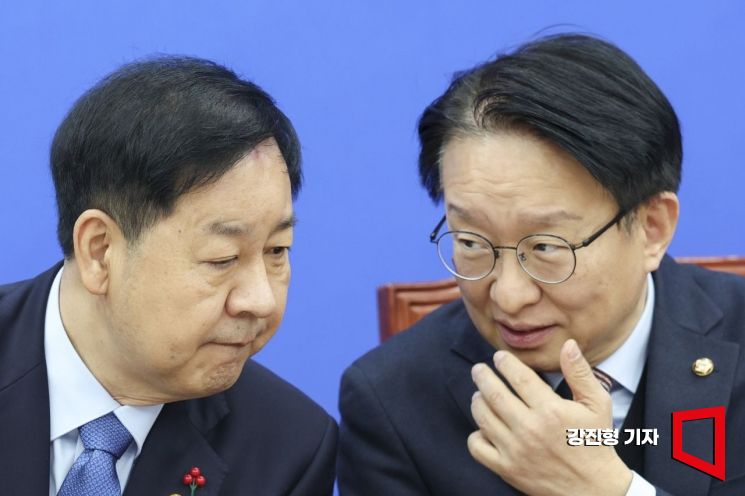 Kwon Chilseung, Head of the Economic Criminal and Civil Liability Task Force (right), and Koo Yoonchul, Deputy Prime Minister for Economy and Minister of Strategy and Finance, are attending the "2nd Party-Government Meeting on Rationalizing Economic Criminal and Civil Liability" held at the Democratic Party Floor Leader's Office in Yeouido, Seoul on the 30th, exchanging opinions. 2025.12.30 Photo by Kang Jinhyung
After the meeting, Assemblyman Kwon said, "There is no disagreement regarding the abolition of the crime of breach of trust under the Commercial Act, as the opposition has also made proposals on this matter." He continued, "Addressing the remaining breach of trust offenses is a major undertaking, so we are preparing a finalized version." When asked by reporters whether this would be discussed at the upcoming third consultative meeting, Assemblyman Kwon replied, "It's difficult to say for certain, but we are making efforts."
Oh Gihyung, who chairs the KOSPI 5000 Special Committee and is a Democratic Party lawmaker, commented on the delay in preparing alternative legislation for abolishing the crime of breach of trust, saying, "There are many provisions related to breach of trust, and since we are not at the stage of complete abolition, we need to take a comprehensive approach." He added, "A thorough professional review is required to supplement the process." Assemblyman Oh further explained, "Issues such as revolving fund problems or double sales of real estate are also matters of civil liability, but whether to apply the crime of breach of trust to corporate transactions is another issue that needs to be discussed together."
The Democratic Party emphasized that the discussion on rationalizing economic criminal and civil liability is not simply about reducing criminal penalties. Assemblyman Oh stated, "The purpose of these discussions between the party and government is to reduce excessive criminal penalties," and added, "However, this does not mean that accountability will be eased." In other words, while criminal penalties may be reduced, economic and civil liabilities will be strengthened. He said, "There is also a pattern of increasing economic sanctions in place of reducing criminal penalties." To this end, he mentioned that measures related to the discovery system and class action lawsuits are also being prepared.
At the consultative meeting held on this day, 331 regulatory reform measures for economic criminal penalties were discussed, including changes to the Large-Scale Distribution Business Act, the Subcontracting Act, the Franchise Business Act, and the Agency Business Act. Under these changes, imprisonment would only be imposed for failure to comply with corrective orders, while the maximum cap for fixed fines would be increased to up to 5 billion won.
© The Asia Business Daily(www.asiae.co.kr). All rights reserved.
![Clutching a Stolen Dior Bag, Saying "I Hate Being Poor but Real"... The Grotesque Con of a "Human Knockoff" [Slate]](https://cwcontent.asiae.co.kr/asiaresize/183/2026021902243444107_1771435474.jpg)















