Strengthening Staffing and Expertise to Secure the Golden Hour
Medical Community Sees Hope for Resolving "Emergency Room Refusal"
The government is accelerating efforts to strengthen staffing and expertise at regional emergency medical situation rooms nationwide in order to address the issue of "emergency room bouncing." The aim is to establish a centralized management system in which the state directly oversees patient transfers based on specialized knowledge, going beyond simply transporting patients.
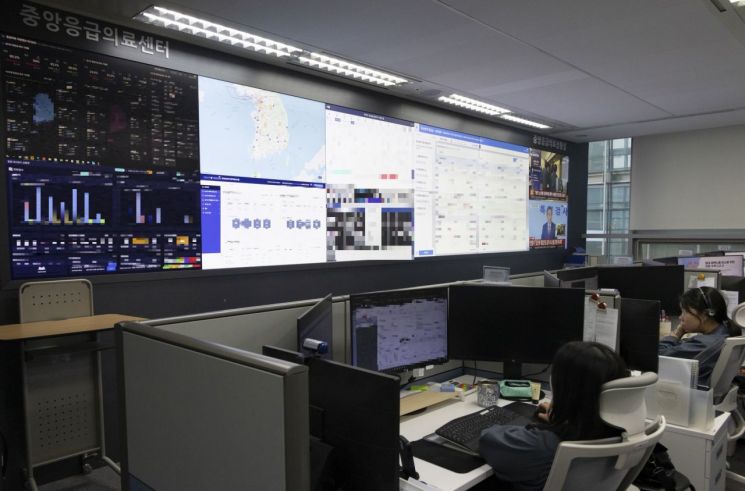 At around 11 a.m. on the 29th, at the Central Emergency Medical Center in Jung-gu, Seoul, on-duty doctors and staff who are stationed 24 hours a day are assisting the transfer of emergency patients nationwide. Ministry of Health and Welfare
On the morning of the 29th, the Ministry of Health and Welfare held a press conference at the Central Emergency Medical Center in Jung-gu, Seoul, to announce these plans. First, the number of staff at the six regional emergency medical situation rooms nationwide will be increased from 120 this year to 150 next year. In addition, the ministry plans to enhance the expertise of staff-composed of nurses and paramedics-through training, and to strengthen collaboration with related agencies such as the National Fire Agency to address the problem of emergency room refusal.
Since establishing the Central Emergency Medical Situation Room in 2014, the government has, under the fourth Basic Emergency Medical Plan, opened six additional regional emergency medical situation rooms across the country in 2024 and has begun coordinating the transfer of critically ill emergency patients. The goal is to reduce the in-hospital mortality rate for critically ill emergency patients from 6.2% in 2022 to 5.6%. To ensure rapid and appropriate transport, the government also plans to increase the rate at which critically ill emergency patients arrive at the final treatment facility within the appropriate time from 49.6% to 60% during the same period.
In the regional emergency medical situation rooms, teams of three to five staff members-nurses and paramedics-work in three shifts. Most of the on-duty doctors, who are typically emergency medicine specialists, work in two shifts, with one or two doctors on site at any given time. These teams respond jointly to select hospitals for Pre-KTAS (Korean Triage and Acuity Scale for pre-hospital emergency patients) Level 1 patients, for whom the National Fire Agency's Emergency Medical Situation Management Center and other agencies request cooperation during 24-hour 119 ambulance transport.
However, 119 ambulance teams cannot seek assistance from the regional emergency medical situation rooms from the outset. Upon arriving at the scene, if a patient is classified as Pre-KTAS Level 1, the 119 team initiates transport according to regional transport guidelines. If such guidelines do not exist or are not functioning, the Emergency Medical Situation Management Center selects the hospital for transfer. If there is a delay in patient acceptance at a medical institution, the Emergency Medical Situation Management Center can request joint response from the regional emergency medical situation room.
The Ministry of Health and Welfare explains that requests for patient transfer from the regional emergency medical situation rooms have a higher likelihood of being accepted by medical institutions than those from the 119 ambulance teams or the National Fire Agency's Emergency Medical Situation Management Center. This is because professionals with medical expertise, such as on-duty doctors, can make more informed decisions than paramedics and request admission to the most appropriate medical institutions. Furthermore, the ministry plans to further enhance the effectiveness of the regional emergency medical situation rooms by providing specialized training to staff composed of nurses and paramedics.
The medical community also believes that the government's actions offer hope for resolving the issue of emergency room refusal. However, the Korean Society of Emergency Medicine argues that overall conditions must be improved by strengthening the authority of the Central Emergency Medical Center and regional emergency medical situation rooms to recommend priority admissions, providing criminal immunity, and introducing additional compensation for overnight shifts.
Kim Jeongeon, Director of the Central Emergency Medical Situation Room, stated, "The Central Emergency Medical Center is highly trusted and has a deep understanding of the field, which is why emergency medical institutions actively cooperate with us. Our goal is to enable emergency medical professionals to focus on patient care itself, rather than spending time on phone calls to arrange patient transfers."
© The Asia Business Daily(www.asiae.co.kr). All rights reserved.
![Clutching a Stolen Dior Bag, Saying "I Hate Being Poor but Real"... The Grotesque Con of a "Human Knockoff" [Slate]](https://cwcontent.asiae.co.kr/asiaresize/183/2026021902243444107_1771435474.jpg)
















