Ministry of Employment and Labor Issues Administrative Notice
on Revision to Skip Investigation and Review for Five Occupations
Including Tire Manufacturing and Shipbuilding
KEF: "Uniform Application Without Distinguishing Physical Burden"
The Korea Employers Federation (KEF) submitted the business community's opinion opposing the revision of the notification that expands the scope of occupational diseases related to musculoskeletal disorders to the Ministry of Employment and Labor on December 30. The KEF argued that the differences in working environments between workplaces and the varying physical burdens within specific tasks of the same occupation are not reflected, which could result in unreasonable industrial accident determinations. There are concerns that, despite companies' ongoing investments in improving working environments, there may be a sharp increase in industrial accident claims.
Recently, the Ministry of Employment and Labor announced an administrative notice to add five more occupations, including tire manufacturing and shipbuilding, to the list of jobs where diseases occurring in employees who have worked for a certain period are recognized as occupational accidents without investigation or review, under the "presumption principle for musculoskeletal disorders."
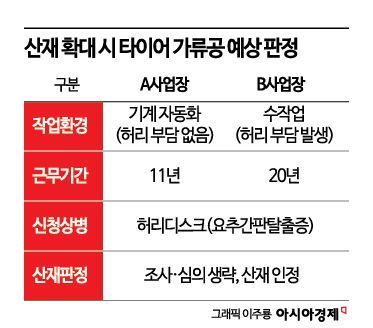
The business community maintains that it is problematic to apply occupational accident coverage to diseases unconditionally, without considering differences in working environments at each workplace. For example, in the tire vulcanization process (where semi-finished tires are subjected to heat and pressure to create finished products), there are differences between Company A, where automation eliminates physical burden, and Company B, where manual labor still causes back strain. However, the proposed revision cannot distinguish the degree of physical burden on individual workers. As a result, if workers at these companies file industrial accident claims for lumbar disc herniation (herniated disc), all claims would be approved regardless of actual working conditions.
Nexen Tire, which operates relatively modern factories, including the Changnyeong plant launched in 2012, stated, "There are no cases where employees carry products or work directly in the vulcanization process." Hankook Tire & Technology also said, "More than 90% of the vulcanization process at domestic plants is automated."
The KEF pointed out, "Even within the same occupation, the degree of physical burden varies significantly depending on the extent of workplace improvements, but the proposed revision applies the rule uniformly without distinguishing these differences."
Even a single occupation can be divided into three or four specific tasks, each with different levels of physical burden. For example, within the shipbuilding industry, electrical outfitting workers (who install cables and electrical/electronic equipment) experience varying physical demands depending on the specific task, such as cable laying, wiring, electric welding, or cable inspection. When serving as assistants, depending on their skill level, workers have little physically demanding work, but the proposed revision does not take this into account.
Cable inspectors rarely have to squat while working, and assistants mainly observe cable transport, laying, and wiring with their eyes, only helping with some tasks.
An industry official said, "If the number of industrial accident claims increases, so will the costs for companies, such as hospital and treatment expenses. We will have no choice but to reschedule work focusing on those who have not filed claims, which will also increase overtime pay, adding to the burden."

In its opinion letter, the KEF criticized the inclusion of occupations with fewer than 10 annual industrial accident claims as high-frequency cases, arguing that this is statistically inappropriate. The KEF also pointed out that the proposed revision is based solely on an analysis of musculoskeletal disorder-related industrial accident statistics for only two years (2020-2021) for research convenience.
Furthermore, the KEF argued that it is inappropriate for the Ministry of Employment and Labor to pursue an extension of the notification review period from 1.5 years to 3 years without implementing the recommendations of the Regulatory Reform Committee (RRC), and called for a prior verification of the consistency of the recognition criteria. In 2022, the RRC recommended shortening the review period for the recognition criteria for the presumption principle of musculoskeletal disorders to 1.5 years and improving the consistency verification of occupation-based recognition criteria.
Lim Wootaek, Executive Managing Director of the KEF, said, "It is regrettable that the Ministry of Employment and Labor is pushing for an expansion of the application of the presumption principle for musculoskeletal disorders without efforts to improve the recognition criteria. Excessive revision of the recognition criteria for the sake of shortening industrial accident processing times seriously undermines fairness, so the revision should be reconsidered entirely and consistency verification should be conducted first."
© The Asia Business Daily(www.asiae.co.kr). All rights reserved.
![Clutching a Stolen Dior Bag, Saying "I Hate Being Poor but Real"... The Grotesque Con of a "Human Knockoff" [Slate]](https://cwcontent.asiae.co.kr/asiaresize/183/2026021902243444107_1771435474.jpg)
















