81st Industrial Federation Forum
Subcontractor Welfare at Risk Due to Diluted Control
Industry-Specific Manuals Needed Urgently
The industrial sector has forecasted that the government's Yellow Envelope Act (amendment to Articles 2 and 3 of the Trade Union and Labor Relations Adjustment Act) guidelines could lead to negative side effects, such as the emergence of blind spots in safety management or a shift in focus toward overseas investment. In particular, the petrochemical industry, which is currently undergoing industrial restructuring, has expressed concerns that the new guidelines could delay the recovery of business conditions.
Yang Junmo, Professor of Economics at Yonsei University, stated at the "81st Industrial Union Forum: Problems and Improvement Tasks in Industrial Sites Due to Changes in Labor Policy," held at the Automobile Hall in Seocho-gu, Seoul, on the 29th, "Policies that are intended to benefit workers could actually undermine industrial competitiveness and worsen working conditions."

Professor Yang commented on the "Draft Interpretation Guidelines for the Revised Trade Union Act" recently announced by the Ministry of Employment and Labor, specifically regarding the criterion of "structural control over working conditions" for determining employer status. He said, "If the main contractor charges fees or outsources the use of its facilities, thereby diluting its control rights, the welfare of subcontracted workers could deteriorate as the subcontractor bears additional costs."
He also warned that specifying the recognition of actual control if the main contractor oversees overall safety could create blind spots in safety management. He explained, "The main contractor may only require subcontractors to comply with safety management, while itself responding passively to actual investments in safety."
He further expressed concern about a surge in demands for collective bargaining in decisions such as mergers or splits. According to the amended Trade Union Act, business management decisions aimed at organizational changes such as mergers, splits, transfers, or sales are not subject to collective bargaining. However, the new guidelines explain that if layoffs or job reassignments are "objectively anticipated" as a result of such decisions, demands for collective bargaining, such as employment guarantees, can be made.
Professor Yang stated, "Since layoffs and similar issues become subjects of labor disputes, restructuring will become more difficult," adding, "Preemptive measures, such as terminating contracts with subcontractors, may be taken."
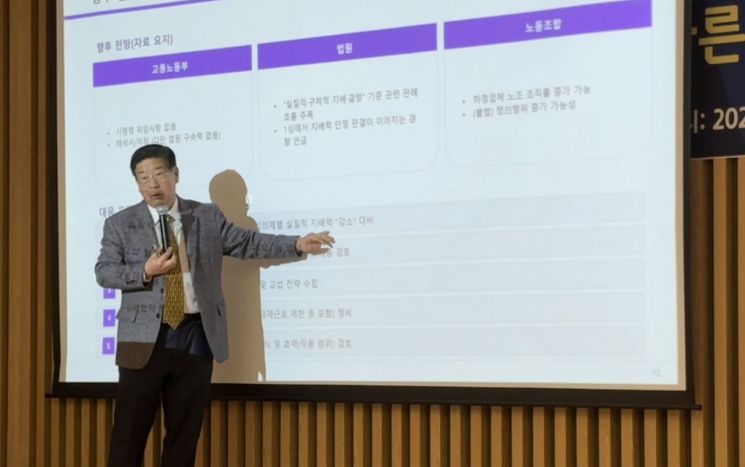 Professor Yang Junmo of Yonsei University’s Department of Economics is speaking at the 81st Industrial Union Forum held on the 29th at the Automobile Hall in Seocho-gu, Seoul. Photo by Jeon Youngju
During the forum, there were continued criticisms that the Ministry of Labor's guidelines are comprehensive yet ambiguous. Kim Juhong, Executive Director of the Korea Automobile Mobility Industry Association, said, "The structural control mentioned in the guidelines is as unclear as the previous phrase 'actual and specific control.' If the finished vehicle industry is required to negotiate individually with hundreds or thousands of partner companies due to these vague guidelines, and the associated costs become enormous, companies may abandon their partners or focus on overseas investments."
Kim Euicheol, Director of the Korea Cement Association, also emphasized the urgent need for clear implementation standards and guidelines. He stated, "Laws, enforcement ordinances, and administrative interpretations must become more precise," adding, "Detailed manuals reflecting the characteristics of each industry must be prepared as soon as possible."
The petrochemical industry, which is currently undergoing restructuring, predicted that the new guidelines could delay business reorganization. Park Janghyun, Director General of the Korea Chemical Industry Association, said, "As the industry downturn is prolonged, we are reducing production capacity, but if layoffs or job reassignments of subcontracted workers also become subjects of labor disputes, it will hinder the recovery of business conditions." He added, "Managerial decisions such as personnel rights should be separated from the subjects of labor disputes."
© The Asia Business Daily(www.asiae.co.kr). All rights reserved.
![Clutching a Stolen Dior Bag, Saying "I Hate Being Poor but Real"... The Grotesque Con of a "Human Knockoff" [Slate]](https://cwcontent.asiae.co.kr/asiaresize/183/2026021902243444107_1771435474.jpg)

















