Sales Down 30% Over 20 Years in Japan
Distrust in Winning Odds and Departure of Young Buyers to Blame
Although the top prize for Japanese lotteries has soared well beyond 9 billion yen, the number of people buying lottery tickets has actually declined. As a more sober awareness of the odds of winning spreads, analysts say that Japan's lottery market-once a national craze and dubbed a "product for buying dreams"-has now entered a prolonged stagnation phase.
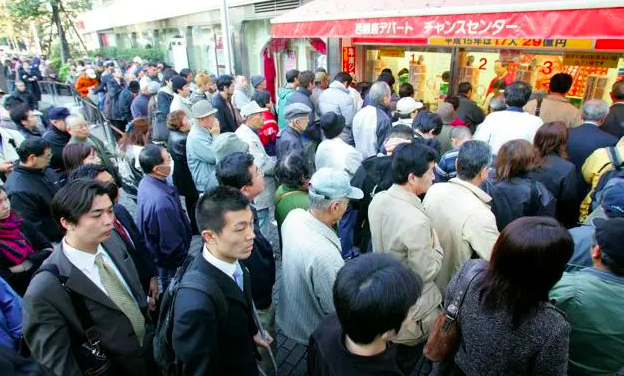 In front of the Jumbo Lottery store located in Tokyo, Japan, in 2004. People are lined up in a long queue to purchase lottery tickets. Photo by Asahi Shimbun
Raising the Jackpot Has Little Effect... Sales Drop by 30%
According to the Asahi Shimbun on December 28, Japan's lottery sales peaked at 1.1 trillion yen (approximately 10.15 trillion won) in fiscal year 2005, but have since continued to decline, falling to about 760 billion yen last year. This means the market size has shrunk by nearly 30% over the past two decades. The year-end "Jumbo Lottery," which is sold on a large scale every year, has also suffered from sluggish sales without exception.
Authorities have steadily raised the jackpot to increase the appeal of lotteries. In 2005, the combined top prize for first place and adjacent numbers was 300 million yen (about 2.77 billion won), but this was later increased to 600 million yen, then 700 million yen, and currently stands at 1 billion yen (about 9.23 billion won). However, the effect of raising the jackpot has only led to a temporary rebound and has failed to bring about a long-term recovery in sales.
"It Doesn't Feel Like I'll Win"... Japanese Youth Turn Away
Experts point to the departure of younger generations as a major reason for the lottery's slump. According to a survey conducted last year by the Japan Lottery Association, only 20% of lottery buyers were in their 30s or younger, while those in their 60s or older accounted for more than 40%. In the mid-2000s, during the peak of lottery sales, the share of buyers in their 30s or younger reached 40%, but as new demand dried up, the customer base has aged significantly.
The most common reason for buying lottery tickets was "expectation of winning a prize," but the most cited reason for not purchasing was "because the chances of winning are low." Even though the top prize exceeds 700 million yen, consumers are well aware that the odds of a single 300-yen (about 2,770 won) ticket winning first prize are only about one in 20 million. The media reported, "The 'reality check' of the odds is now outweighing the 'dream' of a huge jackpot," adding that this trend is causing sluggish sales for this year's year-end Jumbo Lottery as well."
© The Asia Business Daily(www.asiae.co.kr). All rights reserved.
![Clutching a Stolen Dior Bag, Saying "I Hate Being Poor but Real"... The Grotesque Con of a "Human Knockoff" [Slate]](https://cwcontent.asiae.co.kr/asiaresize/183/2026021902243444107_1771435474.jpg)

















