The number of subscribers to the Individual Savings Account (ISA) has surpassed 7 million, 9 years and 8 months after its launch.
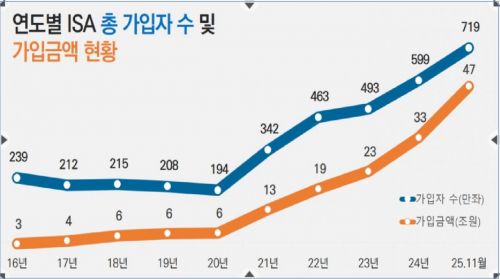
According to the Korea Financial Investment Association on December 29, as of the end of November this year, the number of ISA subscribers stood at 7.19 million, with total deposits amounting to 46.5 trillion won.
The number of subscribers exceeded 7 million just nine months after reaching 6 million at the end of February. This means that approximately 110,000 people have newly subscribed to an ISA each month this year.
The ISA was introduced by the government in 2016 to support wealth accumulation through comprehensive asset management for the public. It is a tax-advantaged account product that allows investors to manage and invest in a variety of financial products-such as domestically listed stocks, funds, exchange-traded funds (ETFs), and savings or installment deposits-all within a single account.
By account type, the "investment brokerage type," in which subscribers directly select and manage their financial products, accounted for 6.137 million subscribers, or 85.4% of the total.
In contrast, the "trust type" saw its number of subscribers decrease by 800,000 from 1.719 million at the end of 2020 to 919,000 (12.8%) at the end of November. In the trust type, a trustee (such as a bank or securities firm) manages the account with customized products according to the subscriber's instructions.
The "discretionary type," which is managed by asset management professionals based on model portfolios proposed by securities firms or banks, also declined over the same period from 220,000 to 134,000 (1.9%), a decrease of 86,000.
By financial sector, the popularity of the investment brokerage type-which can only be opened at securities firms-resulted in 6.173 million subscribers (85.9%) joining through securities firms, the highest among all sectors. In contrast, banks, which mainly handle the trust type focused on savings and installment deposits, saw their number of subscribers decrease to 1.016 million (14.1%), about half of the 1.783 million at the end of 2020.
Of the investment brokerage type funds, 45.6% are invested in ETFs and 33.4% in stocks. For the trust type, 93.0% is held in savings and installment deposits, while for the discretionary type, 98.0% is invested in funds.
The number of ISA subscribers has been increasing across all age groups. The share of subscribers in their 20s and 30s-who are relatively more familiar with financial investment products-rose from 32.8% at the end of 2020 to 40.7% at the end of November 2025, following the introduction of the investment brokerage ISA.
Across all age groups, the proportion of investment brokerage type subscribers was the highest. By age group, the proportion of investment brokerage type subscribers was 92.8% for those in their 20s and 30s, 87.4% for those in their 40s, and 76.1% for those aged 50 and above. Meanwhile, among those aged 50 and above, the share of trust type subscribers was also relatively high at 21.3%.
By gender, among those in their 20s and 30s, there were more men (1.56 million men, 1.37 million women), while among those aged 50 and above, there were more women (1.45 million women, 1.2 million men).
The greatest advantages of the ISA are the netting of investment gains and losses and tax benefits. After a certain period, profits and losses among financial products within the account are netted, and up to 2 million won (up to 4 million won for the "low-income type") in net gains are tax-exempt for the general type. Any amount exceeding this threshold is subject to a low separate tax rate of 9.9%. Additional compound interest benefits from deferred taxation can also be expected until the account is closed.
Lee Hwantae, Head of the Industry Market Division at the Korea Financial Investment Association, said, "The expansion of the investment base through ISAs shows that awareness of long-term asset building among individuals is becoming increasingly widespread," and added, "To strengthen Korea's long-term investment ecosystem and grow the capital market, incentives for ISAs-such as enhanced tax benefits and expanded eligibility-should be increased."
© The Asia Business Daily(www.asiae.co.kr). All rights reserved.
![Clutching a Stolen Dior Bag, Saying "I Hate Being Poor but Real"... The Grotesque Con of a "Human Knockoff" [Slate]](https://cwcontent.asiae.co.kr/asiaresize/183/2026021902243444107_1771435474.jpg)















