Mexico's Effective Tariff Rate at 4.7% Thanks to USMCA
Mexico's Role Grows as an Alternative to China in U.S. Trade Deficit
"Level of Integration Too High to Terminate"
An analysis has emerged that the unexpected winner in the tariff war launched this year by U.S. President Donald Trump against the world is Mexico. According to Yonhap News on December 26 (local time), citing The Wall Street Journal (WSJ), "Thanks to the United States-Mexico-Canada Agreement (USMCA), the actual tariff rate imposed on Mexican goods has remained relatively lower than that of competing countries. As Mexican products partially replaced Chinese goods targeted by high U.S. tariffs, Mexico's exports to the United States have actually increased."
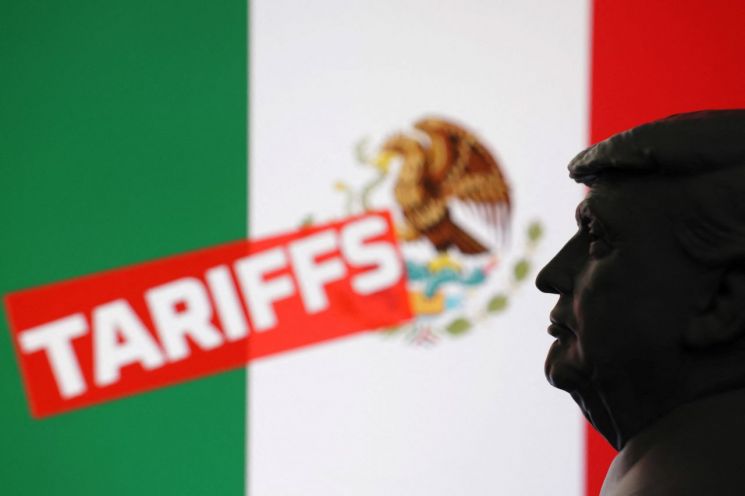 An analysis has emerged that the unexpected winner in the tariff war launched this year by U.S. President Donald Trump against the world is Mexico. Photo by Reuters Yonhap News
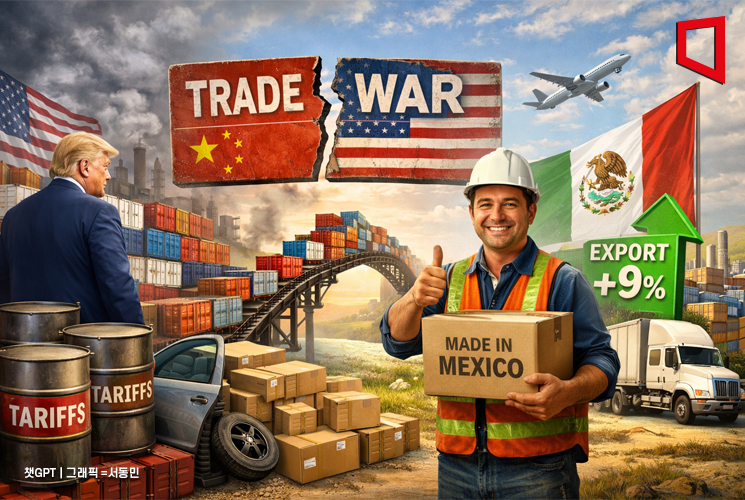
According to the Mexican government, Mexico's manufacturing exports to the United States from January to November this year increased by about 9% compared to the same period last year. During this period, Mexico's automobile exports to the U.S. decreased by about 6%, but other manufacturing exports surged by 17%. The trade volume between the United States and Mexico this year is expected to reach 900 billion dollars (approximately 1,300 trillion won), setting a new all-time high.
This year, President Trump imposed a so-called "fentanyl tariff" of 25% on all Mexican goods, citing Mexico's "passive approach to controlling drugs entering the United States." He also introduced item-specific tariffs, imposing 25% and 50% tariffs on automobiles, auto parts, steel, and aluminum products regardless of country. Despite this worsening export environment for Mexico, the USMCA, a free trade agreement within North America, is considered to have played a significant role in mitigating the impact of tariffs on the Mexican economy.
The United States, considering the potential shock to its own economy, exempts most goods imported from Mexico and Canada from tariffs if they meet USMCA requirements, given the high level of economic integration. As a result, about 85% of Mexico's total exports are still subject to zero tariffs. According to the Wharton School at the University of Pennsylvania, the effective tariff rate on Mexico's exports to the United States is 4.7%, significantly lower than that of China (37.1%), a major competitor in U.S. exports, and about half the world average effective tariff rate (10%).
WSJ analyzed, "Producers seeking access to the U.S. market say that, just as in the pre-tariff era, Mexico possesses unique advantages such as proximity to the United States, a low-cost manufacturing base, and a free trade agreement that, though somewhat weakened, still remains in effect."
Ultimately, unlike other major U.S. trade deficit countries such as South Korea, Japan, and the European Union (EU), the Trump administration did not impose country-specific reciprocal tariffs on Mexico under the International Emergency Economic Powers Act (IEEPA). Analysts point out that Mexico is regarded as a strategic partner to reduce excessive dependence on China, which is another reason why the effective tariff rate remains low.
In mid-December, Jamieson Greer, a representative of the Office of the United States Trade Representative (USTR), stated in Congress, "We are reducing the trade deficit with China by increasing imports from Mexico," adding, "Mexico is playing an important role in efforts to restore the U.S. supply chain." In other words, even if the U.S. runs a trade deficit with Mexico, it is considered preferable to running a deficit with China.
The United States is set to conduct a regular review of the USMCA in 2026. However, Luis de la Calle, a Mexican negotiator who participated in the USMCA negotiations, told WSJ, "The level of integration is so high that the cost for the U.S. to withdraw from the USMCA would be enormous."
© The Asia Business Daily(www.asiae.co.kr). All rights reserved.



















