Below Baseline (100) for 46 Consecutive Months
Both Manufacturing (91.8) and Non-Manufacturing (98.9) Sectors Sluggish
Non-Manufacturing BSI Falls Below Baseline After Just One Month
Domestic Demand, Exports, and Investment Mark 19th Straight Month of Triple Decline
Support Needed for Business Revitalization, Including Industrial Restructuring
Despite the approach of 2026-a year with potential for a new leap forward-the business outlook for Korean companies remains negative as the new year draws near.
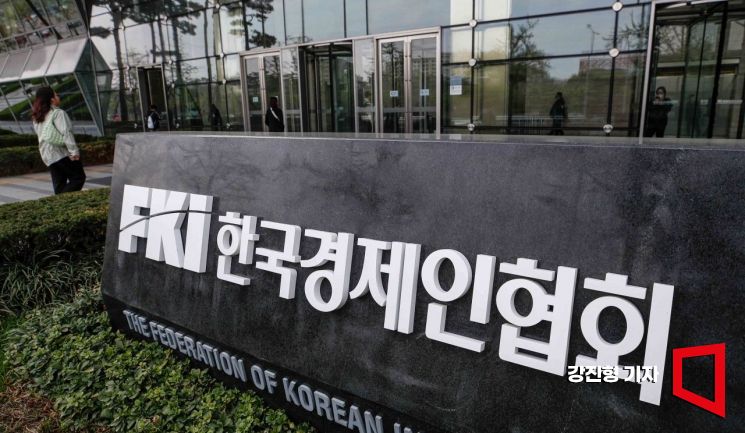 Employees of tenant companies are moving at the Korea Economic Association in Yeouido, Seoul. Photo by Jin-Hyung Kang aymsdream@
The Korea Economic Association announced on the 29th that, according to its survey of the 600 largest companies by sales, the Business Survey Index (BSI) outlook for January 2026 stands at 95.4.
With this result, the BSI outlook has remained below the baseline of 100 for 46 consecutive months since April 2022, when it recorded 99.1. A BSI above 100 indicates a more positive business outlook compared to the previous month, while a figure below 100 signals a negative outlook. The actual BSI for December also came in at 93.7, marking 47 consecutive months of sluggishness since February 2022, when it was 91.5.
By industry, both manufacturing (91.8) and non-manufacturing (98.9) sectors are expected to underperform. The manufacturing BSI (91.8) has remained below the baseline for 22 consecutive months since April 2024. The non-manufacturing BSI, which surpassed the baseline at 105.2 in December 2025, is projected to fall to 98.9 in January 2026, dropping below the baseline after just one month.
Among the 10 detailed manufacturing sectors, pharmaceuticals (125.0) and textiles, apparel, leather, and footwear (107.7) are expected to perform well. Aside from three sectors hovering around the baseline (general and precision machinery and equipment; wood, furniture, and paper; food, beverages, and tobacco), the remaining five sectors-including non-metallic materials and products (64.3)-are projected to face sluggish conditions. Specifically, non-metallic materials and products came in at 64.3, metals and metal processing at 85.2, petroleum refining and chemicals at 86.2, electronics and telecommunications equipment at 88.9, and automobiles and other transportation equipment at 94.1.
The Korea Economic Association explained that the prolonged downturn in related sectors (non-metallic materials and products; metals and metal processing) is due to deteriorating conditions in construction and steel, and that a temporary slowdown in demand for electronics and telecommunications equipment is expected as semiconductor prices rise, leading to an overall decline in manufacturing sentiment.
Among the seven detailed non-manufacturing sectors, electricity, gas, and water supply (115.8); information and communications (113.3); leisure, accommodation, and food service (107.1); and wholesale and retail distribution (103.6) are expected to perform well. In contrast, three sectors-including professional, scientific, technical, and business support services (78.6)-are projected to underperform.
Across all seven business segments-including domestic demand (95.4), exports (96.7), and investment (92.6)-the outlook remains negative. This broad-based downturn, including the three main segments (domestic demand, exports, and investment), has persisted for 19 consecutive months since the July 2024 outlook.
Lee Sangho, Head of the Economic and Industrial Division at the Korea Economic Association, stated, "Although Korea's economic growth rate in 2026 is expected to improve compared to the previous year, business sentiment has yet to recover." He emphasized, "To revitalize businesses, it is necessary to support restructuring in core industries such as petrochemicals and steel, ease the burden of energy and costs, and avoid uniform regulations-such as mandatory retirement age extensions-that increase management uncertainty."
© The Asia Business Daily(www.asiae.co.kr). All rights reserved.
![Clutching a Stolen Dior Bag, Saying "I Hate Being Poor but Real"... The Grotesque Con of a "Human Knockoff" [Slate]](https://cwcontent.asiae.co.kr/asiaresize/183/2026021902243444107_1771435474.jpg)















