Expansion Across Seoul Starting with Deungchon 2-dong
"Residents Can Reduce Heating and Cooling Costs by 30 Percent"
Seoul Energy Corporation (President Hwang Boyeon) will apply an "energy mix" design that combines renewable energy sources for the first time in Moa Town. The company announced on the 28th that it recently signed a memorandum of understanding for the expansion of renewable energy and district heating with the Integrated Cooperative Management Committee of Deungchon 2-dong Moa Town.
With this agreement, Seoul Energy Corporation aims to gradually expand energy transition cooperation projects that link district heating and renewable energy to new multi-family housing projects, including Moa Towns throughout Seoul. (Refer to The Asia Business Daily interview published on June 19, 2025: <Hwang Boyeon, President of Seoul Energy Corporation: "Geothermal-Based Renewable Energy Heating and Cooling Is the Top Priority for Moa Town Application">)
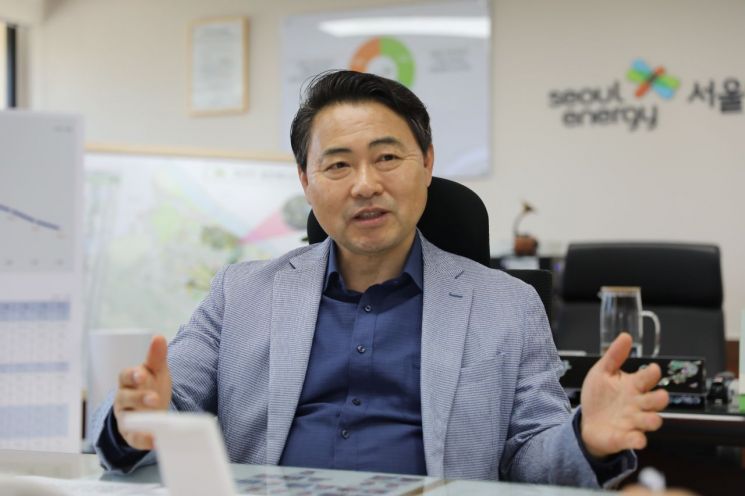 Hwang Boyeon, President of Seoul Energy Corporation, explained the energy transition cooperation project linking district heating and renewable energy in an interview with The Asia Business Daily last June. Provided by Seoul Energy Corporation.
In the mid-to-long term, the company plans to expand this initiative to large-scale redevelopment projects such as rapid integrated planning, as well as private redevelopment and reconstruction. The Deungchon 2-dong Moa Town will serve as the first case of this energy transition policy and is expected to become a leading model for expansion throughout Seoul.
This agreement was made as the government announced a policy to expand the adoption of heat pumps and released a draft amendment to the Renewable Energy Act Enforcement Decree that includes air-source heat pumps as renewable energy.
The company and the Integrated Cooperative Management Committee have agreed to apply the "energy mix" design-which combines geothermal and solar power with district heating-to the Moa Town housing project being developed at 520-3 Deungchon-dong, Gangseo-gu. Moa Town is an urban regeneration model that consolidates low-rise residential areas, where large-scale redevelopment is difficult, into block units for improvement.
Geothermal energy utilizes heat stored underground, and by installing closed-loop geothermal pipes throughout the complex, large-scale renewable energy supply-previously impossible for individual buildings-becomes feasible. According to the company, residents can reduce their annual heating and cooling costs by 25 to 30 percent, and integrating solar power can further increase energy efficiency.
Seoul Energy Corporation plans to improve energy use efficiency in multi-family housing and secure various certification incentives, such as reduced acquisition tax, by meeting the Zero Energy Building (ZEB) grade standards. As incentives-including acquisition tax reductions, increased housing and urban fund loan limits, reduced donation rates, and eased floor area ratio and building height standards-are expanded, the payback period for the initial investment has also been shortened from the previous 10 to 15 years to within 10 years.
The company plans to establish not only the optimal energy design plan for achieving ZEB grade in Deungchon 2-dong Moa Town, but also a comprehensive energy service business model that includes maintenance and management of energy facilities in the future. This is expected to become a leading example of stable and efficient energy operation at the apartment complex level, especially as electricity-based facilities such as heat pumps become more widespread.
Hwang Boyeon, President of Seoul Energy Corporation, stated, "The building sector accounts for about 68 percent of Seoul's total greenhouse gas emissions, making it a key area for reduction to achieve carbon neutrality by 2050. Solutions that combine district heating with renewable energy sources such as geothermal and solar power are a practical answer for energy transition in multi-family housing and an important starting point for implementing Seoul's carbon neutrality policy on the ground."
Meanwhile, the Moa Town at 520-3 Deungchon-dong is a small-scale housing maintenance management area with a total area of 60,417 square meters and is planned as an apartment complex with approximately 666 households. As a Moa Town project involving Seoul Housing & Communities Corporation (SH Corporation), it is being carried out in a way that a public institution supports the establishment of management plans and the formation of the cooperative.
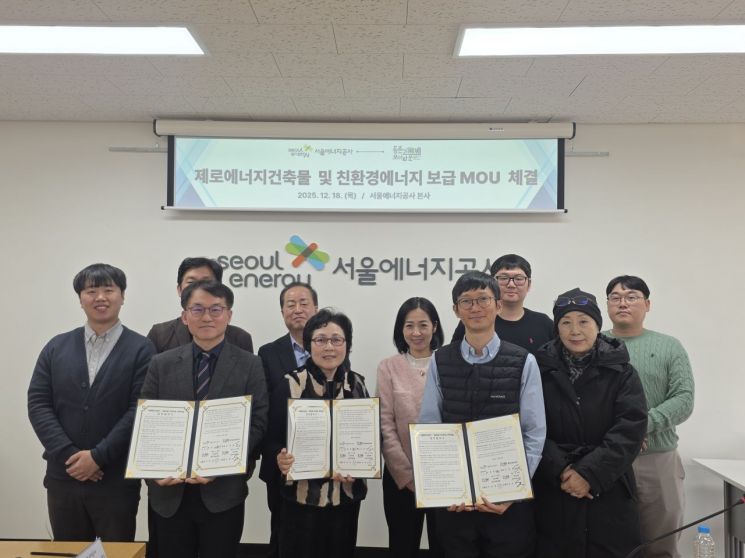 Choi Sungwoo, Head of the New Renewable Energy Division at Seoul Energy Corporation (front row, first from the left), is taking a commemorative photo with officials after signing a memorandum of understanding (MOU) for zero-energy buildings and eco-friendly energy distribution. Provided by Seoul Energy Corporation.
© The Asia Business Daily(www.asiae.co.kr). All rights reserved.
![Clutching a Stolen Dior Bag, Saying "I Hate Being Poor but Real"... The Grotesque Con of a "Human Knockoff" [Slate]](https://cwcontent.asiae.co.kr/asiaresize/183/2026021902243444107_1771435474.jpg)
















