First Successful Test in the United States
Full-Scale Testing Begins with Goal of Commercial Operation
According to science media outlet New Atlas on December 27, the sixth-generation electric vertical takeoff and landing aircraft (eVTOL) developed by Wisk Aero, a subsidiary of Boeing in the United States, achieved success in its first test flight. This is seen as a step closer to the commercialization of autonomous aircraft.
The aircraft took off just after noon (Pacific Standard Time) on December 16 at the Wisk flight test facility located in Hollister, California.
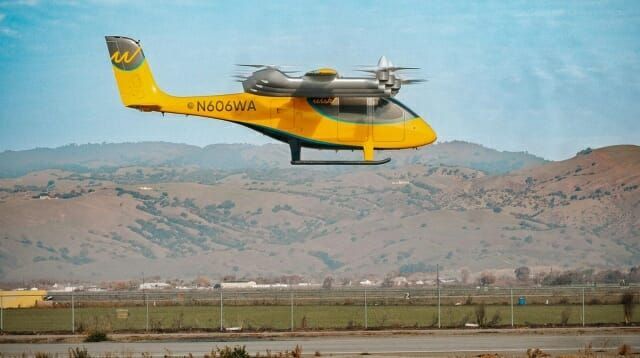 Boeing subsidiary Wisk Aero's 6th generation eVTOL has successfully completed its first test flight. (Source: Wisk Aero)
Although demonstration flights of eVTOLs and air taxis have already been conducted several times, this case is notable because it marks the first time in the United States that an eVTOL capable of fully autonomous flight has actually taken to the skies. In particular, this aircraft stands out from previous test flights as it is the sixth-generation model that has applied for FAA (Federal Aviation Administration) type certification.
Wisk has been dedicated to eVTOL development for over ten years. The previous fifth-generation models were gradually developed, ranging from proof-of-concept stages to pre-production prototypes for FAA certification.
Unlike competitors such as Joby Aviation and Archer Aviation, Wisk's eVTOL is designed around fully autonomous flight. Whereas conventional air taxis retain manual controls, Wisk's aircraft removes both the joystick and pedals, and introduces a multi-vehicle management system that allows up to three aircraft to be managed simultaneously from the ground. The company emphasized that this approach ensures safety, scalability, and cost-effectiveness at the same time.
This test flight signifies that the program has moved beyond the design and prototype phase and entered the full-scale flight testing stage. Wisk's ultimate goal is commercial operation, with plans to use Houston, Los Angeles, and Miami as operational hubs within the United States.
The sixth-generation eVTOL can reach a maximum speed of 222 km/h and a maximum altitude of 1,220 meters, and can carry four passengers along with their luggage at the same time. Transitioning from vertical to horizontal flight takes about 30 seconds. Its 15-meter wingspan and newly designed cross-tail are engineered for stability, enhanced passenger visibility, and optimized center of gravity.
The aircraft's flight control is fully autonomous, but it does not use a self-learning AI system. Instead, it combines logic-based procedural algorithms with various sensing and collision avoidance sensors and navigation systems, aiming for safety levels equivalent to those of commercial aircraft.
© The Asia Business Daily(www.asiae.co.kr). All rights reserved.
![Clutching a Stolen Dior Bag, Saying "I Hate Being Poor but Real"... The Grotesque Con of a "Human Knockoff" [Slate]](https://cwcontent.asiae.co.kr/asiaresize/183/2026021902243444107_1771435474.jpg)















