Rice Prices Up Over 30% From Early This Year
No Sign of Egg Prices Falling From Their Peak
This year, among major agricultural and livestock products, rice and eggs have seen the largest price increases. Rice prices have surged sharply in the second half of the year, while egg prices have remained high throughout the year, showing little sign of decline. As the prices of staple foods and essential proteins rise simultaneously, analysts say that consumers are feeling a heavier burden from inflation.
According to the National Data Office and related industries on the 27th, the price of rice (20kg) in Seoul started at 57,651 won in December last year and slightly decreased to 55,769 won in January this year. From February to June, prices remained relatively stable in the 56,000 to 57,000 won range. However, the situation changed after July. In July and August, rice prices surpassed 60,000 won, reaching 61,997 won, then climbed to 64,074 won in September, 71,366 won in October, and 73,527 won in November. Compared to the yearly low in January, the increase exceeds 30%.

Typically, rice prices fall during the harvest season as supply increases. However, this year, prices have remained higher than usual even during the harvest period. Industry insiders point to the government's failure in demand forecasting as the cause of this phenomenon. When rice prices plummeted in October last year and the surplus production was expected to reach 128,000 tons, the government isolated 260,000 tons from the market. However, the confirmed surplus production afterward was only 56,000 tons, less than half of the initial estimate. As a result, critics argue that the volume isolated from the market exceeded actual supply conditions.
According to the '2025 Rice Production Survey,' this year's rice production is 3,539,000 tons, down by 46,000 tons (1.3%) from last year (3,585,000 tons). Rice production has been declining for four consecutive years since 2022. The Ministry of Agriculture, Food and Rural Affairs estimates that this year's rice production exceeds the expected consumption (3,409,000 tons) by more than 130,000 tons. However, since the government estimated a surplus of 165,000 tons and isolated 100,000 tons during last October's 'rice harvest season measures,' it is expected that about 30,000 tons will actually be oversupplied to the market.
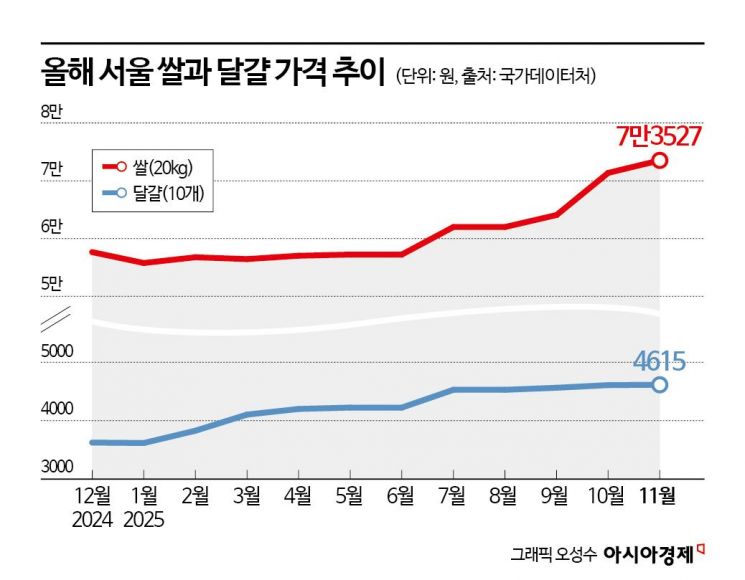
Egg prices have also shown an upward trend. The price of eggs (10 pieces) was 3,625 won in December last year and remained almost unchanged at 3,617 won in January this year, but rose to 3,828 won in February and 4,104 won in March, marking a shift to an upward trend. Subsequently, prices increased to 4,201 won in April and 4,224 won in May and June, and remained at a high level in the second half of the year, recording 4,529 won in July and August, 4,564 won in September, 4,609 won in October, and 4,615 won in November. Compared to the beginning of the year, this is an increase of about 27%.
The problem is that there are no signs of prices dropping. According to the Livestock Products Quality Assessment Service's distribution information, as of the 25th, the price of eggs (10 pieces) in Seoul is 4,298 won. The average consumer price for a tray (30 pieces) surpassed 7,000 won on the 22nd and reached 7,010 won on the 23rd. This is 8.3% higher than the average price (6,471 won). Although the price slightly fell to the 6,800 won range on the 25th, the consumer burden remains significant.
Concerns about unstable supply and demand persist. This winter, there have been 11 cases of highly pathogenic avian influenza (AI) at layer farms, five more than during the same period last year. According to the Ministry of Agriculture, Food and Rural Affairs, about 3 million laying hens have been culled due to AI this winter. Considering that the nation's daily egg production is about 50 million, this represents a reduction of 3-4% in total supply.
Meat prices, including beef, pork, and chicken, have risen more moderately. Beef (100g) prices hovered in the mid-13,000 won range throughout the year but surpassed 15,000 won in October and November. Pork (100g) rose from the high 2,000 won range to the mid-3,000 won range, while chicken (per bird) remained in the high 8,000 won range with little fluctuation.
Vegetable prices have shown significant volatility due to seasonal factors. The price of cabbage (per head) soared to the 7,000 won range early in the year, dropped to the 5,000 won range in summer, but jumped again to 8,445 won in September. Prices for radishes and potatoes also fluctuated with seasonal changes.
© The Asia Business Daily(www.asiae.co.kr). All rights reserved.
![Clutching a Stolen Dior Bag, Saying "I Hate Being Poor but Real"... The Grotesque Con of a "Human Knockoff" [Slate]](https://cwcontent.asiae.co.kr/asiaresize/183/2026021902243444107_1771435474.jpg)
















