3rd Basic Plan for Child Policy (2025?2029) by the Ministry of Health and Welfare
Overseas Adoption to Be Gradually Phased Out in the Medium to Long Term
The government is moving to gradually phase out overseas adoption for the first time in 70 years. This initiative is based on the recognition that there have been significant human rights violations in the overseas adoption process, and the state now intends to take responsibility for children. The plan prioritizes domestic protection, including domestic adoption, for children in Korea, while aiming to discontinue overseas adoption in the medium to long term.
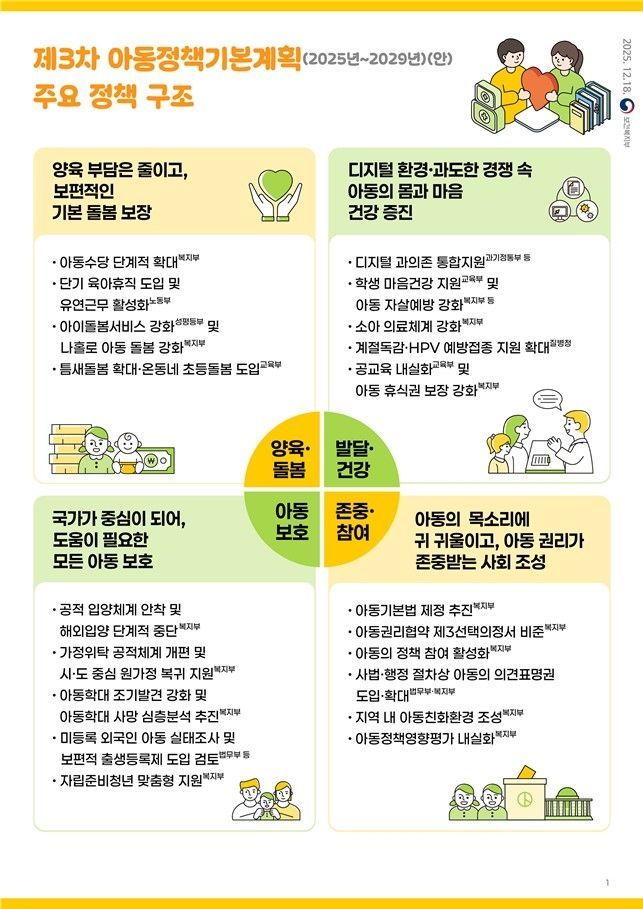
On December 26, the Ministry of Health and Welfare finalized the '3rd Basic Plan for Child Policy (2025-2029)' following deliberation and approval by the Child Policy Coordination Committee, chaired by the Prime Minister. The Basic Plan for Child Policy, established every five years in accordance with the Child Welfare Act, serves as a comprehensive government blueprint. This third plan outlines the child policy vision of the Lee Jaemyung administration. Previously, in October, President Lee Jaemyung stated, "South Korea once bore the shameful label of a 'child exporting country,'" and pledged, "The state will serve as a strong safety net for adoptees."
The Ministry of Health and Welfare has set a goal to end overseas adoption. A ministry official explained, "This year, the provisional number of children adopted overseas is expected to be 24," and added, "We are not aiming for an immediate and complete halt to overseas adoption, but will pursue a gradual phase-out." As part of the medium- to long-term plan to discontinue overseas adoption step by step, the ministry will act as the central authority and coordinate with foreign governments and relevant organizations to manage the process when overseas adoption is unavoidable.
The system of foster care, which allows children in need of protection to grow up in a family environment for a certain period, will also be restructured so that the state takes full responsibility for its management. Support for foster families will be increased, and the number of specialized foster families for children requiring special protection will be expanded. By recognizing foster families as a new family structure and strengthening the legal rights of foster parents, the government aims to reinforce the institutional foundation and accountability for child-rearing.
Additionally, to ensure children receive appropriate care from the initial protection stage, resources such as foster care, adoptive families, and child care facilities will be regularly monitored at the metropolitan level. Programs to support reunification with biological families will be provided so that children can maintain ties with their birth parents and return home when possible.
Raising the Age for Child Allowance Eligibility
With the aim of supporting the growth and development of all children, the eligibility age for child allowance will be raised by one year annually starting in January next year, reaching the target by 2030. Additional child allowance payments will be provided in non-metropolitan and depopulated areas.
To help working parents secure time to care for their children, the government will introduce a short-term parental leave system and promote flexible work arrangements. To protect children left alone, the operating hours of community child care centers will be extended to midnight, and the number of participating institutions will be increased. The government will also establish standards for 'child neglect.' The 'Ondongne Elementary Care' model, a community-driven elementary care and education program, will be introduced and expanded, along with increased support for gap care and part-time child care services. First Vice Minister of Health and Welfare Lee Seuran stated, "We will strive to realize a basic society for children, where children can enjoy their fundamental rights and live healthy lives as rights holders."
© The Asia Business Daily(www.asiae.co.kr). All rights reserved.
![Clutching a Stolen Dior Bag, Saying "I Hate Being Poor but Real"... The Grotesque Con of a "Human Knockoff" [Slate]](https://cwcontent.asiae.co.kr/asiaresize/183/2026021902243444107_1771435474.jpg)















