Chonnam National University Yeosu Campus Presents Final Report on Marine Tourism Development
Need to Foster Stay-Type Wellness Tourism and Develop the MICE Industry
Talent Development Through Fieldwork and Data-Driven Education
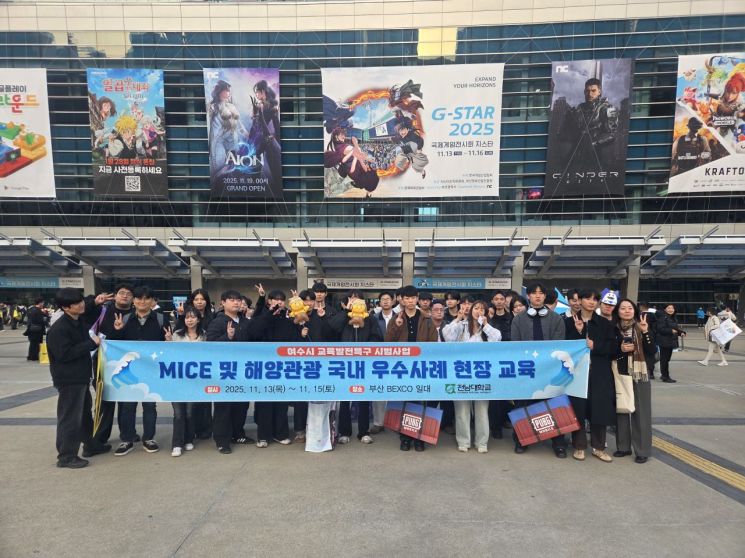 Chonnam National University Yeosu Campus recently held the final report meeting for the "MICE and Marine Tourism Regional Talent Development" project, conducted as part of the Yeosu City Education Special Zone initiative. Provided by Chonnam National University Yeosu Campus
A recent study has found that in order to enhance the sustainability of Yeosu, a city that attracts 10 million marine tourism visitors annually, it is necessary to foster "stay-type wellness tourism" and develop the MICE industry. The study emphasized that, to achieve this transformation in the tourism industry, universities should be established as the base camps for tourism.
On December 26, Chonnam National University Yeosu Campus announced that it recently held the final report meeting for the "MICE and Marine Tourism Regional Talent Development" project, conducted as part of the Yeosu City Education Special Zone initiative.
First, through the "Marine Tourism Revitalization Study," it was evaluated that Yeosu needs to shift from "sightseeing tourism" to a high value-added industry where tourists stay longer and spend more, by actively utilizing Yeosu's natural scenery to promote "stay-type wellness tourism."
In the subsequent "MICE Industry Revitalization Study," Yeosu was defined as a "bleisure city" where work and leisure coexist, and it was stressed that hosting various MICE events should create a trickle-down effect for the local economy. The research team analyzed, "If tourism is 'culture,' then MICE is the 'industry' that supports it. When tourism and MICE operate in tandem, Yeosu's economy can experience dramatic growth."
The study determined that the "role of the university" is crucial to realizing these goals. The "Yeosu MICE and Marine Tourism Education Program Service" report emphasized that university education must shift away from a theory-centered approach and be thoroughly reorganized to focus on fieldwork and data-driven learning.
Specifically, there is a need to foster analyst-type talent by strengthening "smart capabilities" that involve analyzing tourism big data and utilizing digital tools to identify trends. The report also called for bold academic policies, such as recognizing hands-on experience at actual sites-including events like the 2026 Yeosu World Island Expo-as credits toward graduation.
Kang Jihoon, Director of Planning and Research at Chonnam National University, stated, "Universities can no longer remain ivory towers; they must become 'R&D centers' and 'talent academies' that lead innovation in local industries. Based on these research findings, we will nurture practical talent equipped with data analysis skills, and take the lead in breaking down barriers between universities, local governments, and businesses so that these individuals can serve as anchors for the regional MICE and tourism industries."
© The Asia Business Daily(www.asiae.co.kr). All rights reserved.
![Clutching a Stolen Dior Bag, Saying "I Hate Being Poor but Real"... The Grotesque Con of a "Human Knockoff" [Slate]](https://cwcontent.asiae.co.kr/asiaresize/183/2026021902243444107_1771435474.jpg)















