As the U.S. military has increased its military presence in waters near Venezuela, the Washington Post (WP) reported on December 25 (local time) that Venezuelan President Nicolas Maduro is using the threat of U.S. military action as a pretext to crack down on domestic dissidents.
Martina Rapido Lagocino, a researcher at the international human rights organization Human Rights Watch, told WP that the Maduro administration "is using U.S. pressure as an excuse to deploy the military, label critics of the regime as traitors, and arrest dozens of dissidents."
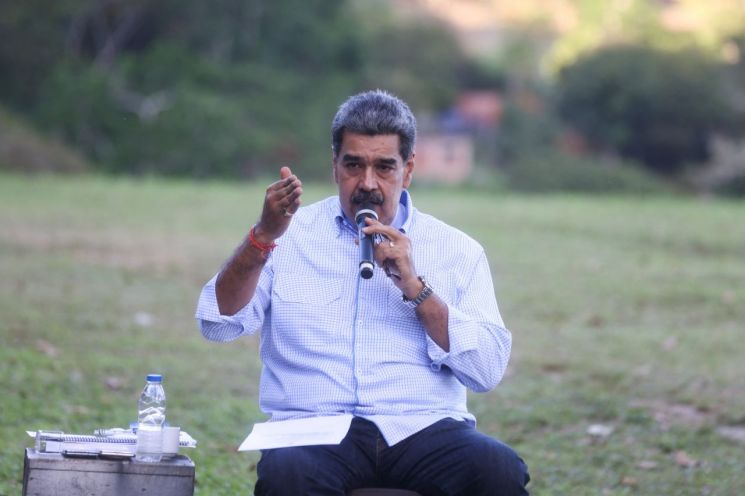
The Donald Trump administration has, since September, deployed troops to the Caribbean under the pretext of cracking down on drug trafficking vessels, blocked Venezuelan crude oil exports, and even mentioned the possibility of military operations on the mainland, thereby intensifying pressure on the Maduro regime.
President Maduro has been appealing to the international community, including the United Nations, claiming that the United States is seeking regime change to seize Venezuela's vast oil resources, while cracking down on critics of his government.
President Maduro continues to hold power, insisting that he succeeded in winning a third term despite allegations of electoral fraud in last year's presidential election.
However, the Venezuelan opposition, the U.S. government, and some neighboring governments in Central and South America believe that opposition candidate Edmundo Gonzalez overwhelmingly defeated President Maduro in the actual vote count in last year's election.
Controversy over electoral fraud sparked protests across the country, during which 28 people were killed and about 2,400 were arrested in the crackdown. Hundreds of them remain in detention.
In this context, the Venezuelan government admitted that opposition figure Alfredo Diaz, former governor of Nueva Esparta, died on December 6 after being imprisoned for about a year. Diaz's family claimed that he did not receive the necessary medical care.
Foro Penal, a Venezuelan human rights organization that provides legal support to inmates imprisoned by arbitrary decisions of the regime, pointed out that former Governor Diaz was held in solitary confinement for a year and that his daughter was allowed only a single visit.
Volker Turk, United Nations High Commissioner for Human Rights, recently stated at the UN Human Rights Council that "the repression of civic space is intensifying, suffocating the freedoms of the Venezuelan people," and pointed out that "journalists, human rights activists, opposition figures, and even humanitarian workers continue to face threats and the risk of arbitrary detention simply for doing their work."
© The Asia Business Daily(www.asiae.co.kr). All rights reserved.
![Clutching a Stolen Dior Bag, Saying "I Hate Being Poor but Real"... The Grotesque Con of a "Human Knockoff" [Slate]](https://cwcontent.asiae.co.kr/asiaresize/183/2026021902243444107_1771435474.jpg)















