Leap Forward as the “Energy Hub City of Korea”
Accelerating Growth of Energy-Based Industries Including AI Data Centers
The legal foundation has been established for Ulsan City to create a system in which electricity produced locally is also consumed locally.
The city was finally selected as a Distributed Energy Specialized Area following a re-evaluation by the Ministry of Climate and Energy’s Energy Committee.
As a result, Ulsan has laid the groundwork to accelerate the development of energy-based industries, such as the introduction of a differential electricity pricing system by region and attracting artificial intelligence (AI) data centers, paving the way for its leap as the “Energy Hub City of Korea.”
At the Energy Committee meeting held on the 5th of last month, the city’s designation was initially put on hold. Subsequently, political leaders and working-level officials in Ulsan took comprehensive action, preparing a supplementary renewable energy plan in line with central government policy and submitting it to the Ministry of Climate, among other efforts.
In particular, the city achieved final designation through thorough preparations, including: establishing a specialized area operation plan; enacting an ordinance on distributed energy; forming a task force comprising experts from industry, academia, and research; launching the nation’s first Distributed Energy Support Center; and submitting a direct proposal to the President at the Central-Local Cooperation Council.
The distributed energy special zone is designated based on the “Special Act on the Promotion of Distributed Energy,” and within the zone, regulatory exceptions for direct electricity transactions apply, enabling a local production and consumption distributed energy system.
This allows local power generation companies to participate directly in the electricity sales market, while businesses can receive electricity at more affordable rates.
The type of distributed energy special zone designated for Ulsan is the “power demand attraction type.” This approach establishes a local power production and consumption structure by attracting new power demand near existing distributed energy power plants or within industrial complexes.
Distributed energy special zones are categorized into three types: power demand attraction, power supply resource attraction, and new industry activation.
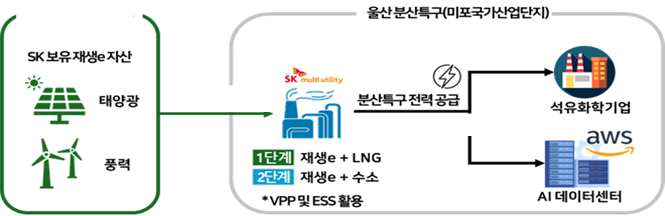
SK MU, a local power generation company, plans to supply low-cost electricity through direct power transactions to the SK-Amazon data center and petrochemical companies within the Ulsan Mipo National Industrial Complex. In line with the government’s renewable energy policy, the supply of carbon-free power based on renewable energy and eco-friendly (green) hydrogen will also be expanded in stages.
Based on the electricity cost savings from the fuel cost linkage system and carbon emission rights, Ulsan City attracted the nation’s largest SK-Amazon artificial intelligence (AI) data center in June.
Further investment is also becoming visible, including securing sites for a future 1GW-class AI data center project.
In addition, Ulsan, which has oil and natural gas storage facilities with a total capacity of 5.75 million barrels, serves as the “Northeast Asia Energy Hub.” This enables stable fuel supply for distributed energy and provides favorable conditions for large-scale industrial complexes and major corporations that require significant amounts of electricity.
In particular, focusing on Ulsan’s future key industries such as artificial intelligence (AI), semiconductors, and secondary batteries - all of which are energy-intensive - the city expects not only to reduce energy costs and enhance competitiveness, but also to positively influence the relocation and increased investment of large power-consuming companies.
Mayor Kim Doo-gyeom stated, “Ulsan City has played a leading role by continuously proposing legislation during the enactment of the Special Act on the Promotion of Distributed Energy, and after the initial postponement of designation, both political leaders and working-level officials responded with full force. If energy self-sufficiency enables the supply of reasonably priced electricity, it will lead to attracting companies, creating quality jobs, and increasing the population. By introducing a differential electricity pricing system by region, we will provide the most competitive energy environment for companies and make a leap forward as the undisputed energy hub city of Korea.”
© The Asia Business Daily(www.asiae.co.kr). All rights reserved.
![Clutching a Stolen Dior Bag, Saying "I Hate Being Poor but Real"... The Grotesque Con of a "Human Knockoff" [Slate]](https://cwcontent.asiae.co.kr/asiaresize/183/2026021902243444107_1771435474.jpg)
















