Diagnosed in the "2025 China Military Power Report"
"Capabilities to Directly Threaten U.S. Security"
Global Times: "Contradictory Content in the Report"
The U.S. Department of Defense has assessed that China's military capabilities have reached a level where they can directly threaten the U.S. mainland.
In the "2025 China Military Power Report" released on the 23rd (local time), the Department of Defense stated, "China's historic military buildup has increasingly exposed the U.S. mainland to vulnerabilities," and diagnosed that "China possesses large-scale nuclear, maritime, conventional long-range strike, cyber, and space capabilities that can directly threaten U.S. security, and these weapons are increasing."
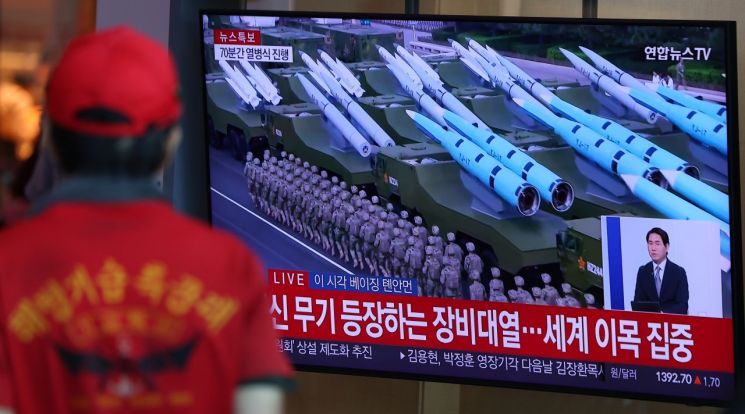
The Department of Defense evaluated that the Chinese military's objectives are to achieve a "strategic and decisive victory" against Taiwan by 2027, to "strategically offset" the United States in nuclear and other strategic domains, and to secure capabilities for "strategic deterrence and control" against other countries in the region.
The Department of Defense stated that the Chinese military continues to refine multiple military options to forcibly annex Taiwan, including amphibious operations, firepower attacks, and maritime blockades, and that in 2024, it conducted exercises to test essential elements of these options.
The Department of Defense analyzed that the Chinese military can strike targets 1,500 to 2,000 nautical miles (2,400 to 3,682 kilometers) away from China, and if such attacks are carried out in sufficient numbers, they could seriously challenge or disrupt the U.S. military presence in the Asia-Pacific region.
However, the Department of Defense noted that while China's leadership believes the Chinese military's capability to forcibly unify Taiwan is improving, it is unlikely to be confident that the Chinese military could successfully seize Taiwan if it had to confront U.S. intervention.
The Department of Defense also stated that China's nuclear warhead stockpile remained in the low 600s in 2024, indicating a slowdown in production compared to previous years. Nevertheless, it still projected that China would possess more than 1,000 nuclear warheads by 2030.
This year's report is 100 pages long, about half the length of the report released last year by the previous Biden administration. The detailed descriptions of the Chinese military's capabilities have also been reduced.
In the report, the Department of Defense repeatedly emphasized that it does not seek conflict with China. The Department stated, "Under President Trump's leadership, U.S.-China relations are stronger than in recent years, and the Department of Defense will support efforts to reinforce this progress." It added that it would expand military-to-military communication with the Chinese military and seek other ways to clearly convey America's "peaceful intentions."
Regarding the report, Chinese media outlet Global Times commented in an editorial that, as in the past, the report highlights the expansion of China's military power and stirs anxiety about the increasing vulnerability of the U.S. mainland, while also emphasizing the strength of U.S.-China relations, calling it "contradictory." The editorial further argued that this duality reflects the complexity of U.S.-China relations, and viewed President Trump's focus on stability in U.S.-China relations as a positive signal. It also claimed that China's military power is defensive in nature, not aimed at pursuing hegemony.
© The Asia Business Daily(www.asiae.co.kr). All rights reserved.
![Clutching a Stolen Dior Bag, Saying "I Hate Being Poor but Real"... The Grotesque Con of a "Human Knockoff" [Slate]](https://cwcontent.asiae.co.kr/asiaresize/183/2026021902243444107_1771435474.jpg)















