Government Issues Guidelines for Determining Employer Status
Employer Status Recognized When Principal Contractor Restricts Subcontractor Autonomy Over Working Conditions
Structural Control Considered as Basis for Employer Status
Managerial Decis
As concerns from the field continue to mount over the Yellow Envelope Act (Amendments to Articles 2 and 3 of the Labor Union and Labor Relations Adjustment Act), which will take effect in March next year, the government has issued interpretive guidelines. When determining whether the principal contractor qualifies as an employer in negotiations with subcontractors, the decision will depend on whether there is structural control over working conditions. If there are substantial and specific changes to working conditions, such as layoffs or restructuring-related job reassignments, these can become subjects of labor disputes.

The Ministry of Employment and Labor announced on the 26th that it will issue an administrative notice of the 'Draft Interpretive Guidelines for Article 2 of the Revised Labor Union Act' to enhance field predictability and support the stable implementation of the Yellow Envelope Act. The guidelines include concrete standards and examples related to the expanded definition of 'employer' (Article 2, Clause 2) and the expanded scope of labor disputes (Article 2, Clause 5) in the revised act. The administrative notice period will last until the 15th of next month.
Employer Status Recognized by 'Structural Control'
The revised Labor Union Act broadens the concept of employer to include those who must negotiate with subcontractor unions. Even if a party has not directly entered into a labor contract, the principal contractor is interpreted as an employer if it holds a position that can substantially and specifically control or determine workers' working conditions. In response to growing confusion and concerns in the field, the Ministry has presented 'structural control over working conditions' as the standard for determining employer status.
For example, if the principal contractor structurally restricts the determination of subcontractor employees' working conditions, thereby fundamentally and continuously limiting the discretion or autonomy of the subcontractor, this may constitute structural control. The Ministry explained that "even if only some working conditions are involved, structural control can be examined." Cases where principal and subcontractor work is interconnected or where work processes are mutually dependent are also applicable.
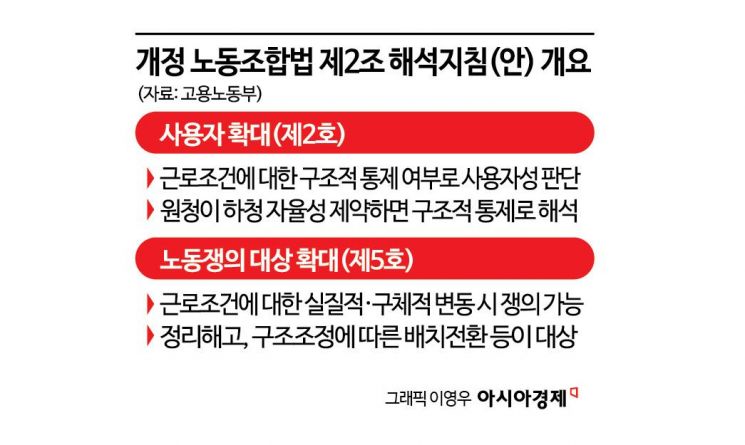
However, the mere existence of a subcontracting contract does not automatically mean there is structural control over the working conditions of employees belonging to the contracting party. In general subcontracting relationships, when the principal sets requirements or negotiates/adjusts matters such as delivery deadlines or quality standards to achieve the purpose of the contract, this may not constitute structural control.
A Ministry official stated, "In a typical subcontracting relationship where goods are produced independently and delivered, it is common for the principal to request production by a certain date or to a certain quality, but this is difficult to regard as structural control," adding, "Most delivery relationships are like this." The official continued, "(Structural control) refers to cases such as in-house subcontracting or situations where the subcontractor has little autonomy in performing core work together."
Factors such as 'integration into the principal's business' and 'economic dependence', which have been used in court decisions to determine principal employer status, will now be considered as supplementary indicators of structural control over working conditions. For example, this applies if the labor of subcontracted workers is directly integrated into the principal's business system or if the subcontractor's continued existence becomes uncertain upon termination of an exclusive contract, indicating economic dependence.
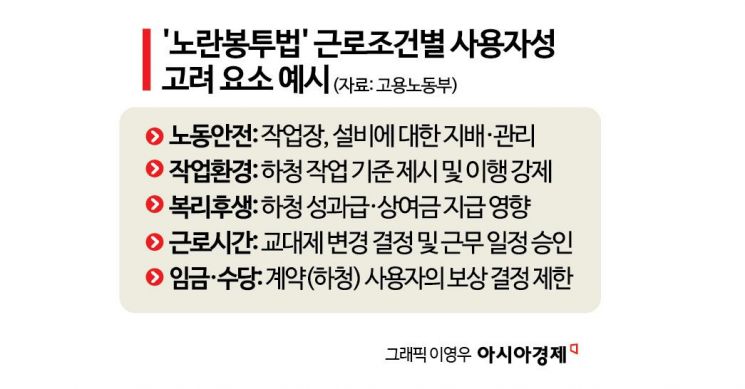
The guidelines also include examples to help determine employer status for each working condition, such as occupational safety, work environment, welfare, working hours, wages, and allowances. In the case of occupational safety, if the principal controls and manages the overall safety and health management system, including work processes and safety procedures, employer status is likely to be recognized. The exercise of decision-making authority over safety budgets and the concentration of authority regarding structural safety improvements are also included.
For wages and allowances, if the principal effectively determines labor costs based on the number of workers or working hours, or directly sets wage increase rates or allowance standards, thereby fundamentally limiting the subcontractor's discretion, employer status will be recognized. Conversely, if the principal sets the total contract amount in consideration of average wages and the subcontractor autonomously pays wages within that amount, employer status may not be recognized.
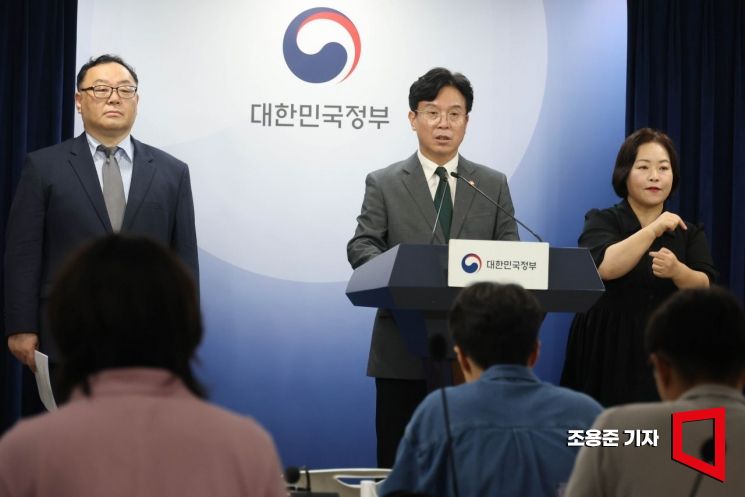 Kim Younghoon, Minister of Employment and Labor, giving a briefing on the Yellow Envelope Act (Amendments to Articles 2 and 3 of the Labor Union and Labor Relations Adjustment Act) at the Government Seoul Office in Jongno-gu, Seoul, last July.
Layoffs and Job Reassignments Also Subject to Disputes
The revised Labor Union Act newly includes as subjects of labor disputes: ▲ managerial decisions affecting working conditions ▲ disagreements over the determination of employee status, and ▲ clear violations of collective agreements by the employer. Employer organizations have also expressed concerns regarding these changes. The guidelines present standards that align with actual situations in industrial settings.
Managerial decisions can involve a series of actions, and whether these are subject to labor disputes should be determined based on whether they cause substantial and specific changes to working conditions. If the impact on employee working conditions at the time of the decision is only abstract or potential, it is difficult to regard it as a subject of labor disputes.
Managerial decisions aimed at organizational changes such as mergers, splits, transfers, or sales of businesses are not in themselves considered to have a substantial and specific impact on working conditions. However, if layoffs or job reassignments due to restructuring during the implementation process result in substantial and specific changes to employee status or working conditions, these become subjects for collective bargaining.
A Ministry official stated, "A company's decision to invest in overseas facilities does not, in itself, have a substantial and specific impact on working conditions," and "it is difficult to regard this as a subject for collective bargaining that can lead to a labor dispute." The official added, "We will consult with the Labor Relations Commission based on these guidelines," and "the government will provide legal judgment and guidance."
If employment adjustments are objectively anticipated due to decisions such as mergers, splits, transfers, or sales, labor unions may demand collective bargaining on employment security, such as 'no layoffs' or 'prior agreement with the union before implementing layoffs.' The Ministry explained that this is to ensure timely and effective bargaining for the protection of workers.
Disagreements over the determination of employee status refer to disputes between labor relations parties regarding the establishment or modification of principles, standards, or procedures related to changes in employment type, disciplinary action, or promotions. Under the revised act, disputes over conversion of non-regular to regular employment, or the establishment or modification of disciplinary or promotion standards, are included as subjects of labor disputes.
Clear violations of collective agreements by the employer refer to cases where the employer fails to comply without justifiable reason, even though the wording of the agreement leaves no room for interpretive dispute. This also applies if the employer acknowledges the violation but does not implement corrective action, or if the violation is objectively confirmed during labor dispute mediation by the Labor Relations Commission or labor-management negotiations at the local employment and labor office.
© The Asia Business Daily(www.asiae.co.kr). All rights reserved.
![Clutching a Stolen Dior Bag, Saying "I Hate Being Poor but Real"... The Grotesque Con of a "Human Knockoff" [Slate]](https://cwcontent.asiae.co.kr/asiaresize/183/2026021902243444107_1771435474.jpg)


















