Wi Sung-rak, National Security Office Director, Press Briefing on Visits to the United States, Canada, and Japan
Nuclear Submarine Cooperation Requires Workaround for U.S. Atomic Energy Act Section 91
"U.S. Working-Level Delegation to Visit Early Next Year... Nuclear Enrichment and Reprocessing Talks to Proceed Concurrently"
Discussing the Korean Peninsula Peace and Coexistence Process, Including U.S.-North Korea and Inter-Korean Dialogue
Differences Between Independents and Alliance Supporters on North Korea Policy: "It Is Not Desirable to Expose External Confusion"
60 Trillion Won Canadian Submarine Project: Actively Highlighting Korea's Strengths
South Korea and the United States have agreed to pursue a separate agreement for cooperation on nuclear-powered submarines. A working-level U.S. delegation is scheduled to visit South Korea early next year, and the South Korean government plans to use this opportunity to initiate full-scale discussions on nuclear-powered submarines, including nuclear enrichment and reprocessing. Regarding the Canadian Submarine Procurement Project (CPSP), for which South Korea is currently bidding, the government plans to actively highlight to the Canadian side the advantages of domestically produced submarines, while also emphasizing the commitment by both countries' leaders to strengthen the defense and defense industry partnership.
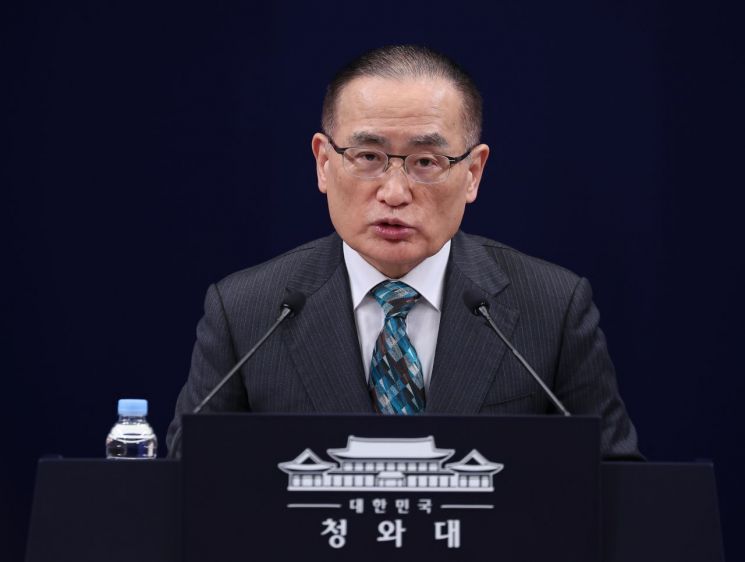
Wi Sung-rak, Director of the National Security Office at the Presidential Office, held a press briefing at the Chunchugwan in the Blue House on the 24th, where he explained the outcomes of his visits to Washington D.C. and New York in the United States, Ottawa in Canada, and Tokyo in Japan from the 16th to the 22nd. He stated, "It has been just over a month since the Korea-U.S. Joint Fact Sheet was announced on November 14, and this visit was intended to implement follow-up security measures in earnest," adding, "Both sides agreed on the need for a separate agreement regarding submarine cooperation and decided to pursue it."
Section 91 of the U.S. Atomic Energy Act prohibits the transfer of national nuclear materials. Therefore, to obtain uranium, which is used as fuel for nuclear-powered submarines, a separate agreement applying an exception to Section 91 is required. Director Wi explained, "In order to receive (uranium), an exemption or exception must be stipulated," and "The United States set an exception for Australia as well, and we need the same. We have agreed to pursue this." During his visit to the United States, Director Wi held intensive consultations with key U.S. officials, including Secretary of State and White House National Security Advisor Marco Rubio, and Secretary of Energy Wright.
He also emphasized that the uranium to be supplied from the United States under the separate agreement would be low-enriched, with an enrichment level of 20% or less. Director Wi stated, "The nuclear-powered submarines envisioned by South Korea will use low-enriched uranium," and "There are no plans to introduce highly enriched uranium."
Alongside the agreement to pursue a nuclear-powered submarine agreement during this U.S. visit, discussions on nuclear enrichment and reprocessing were also held. Director Wi said, "The President has repeatedly emphasized his commitment to non-proliferation, which I conveyed to the U.S. side, and I also stressed that South Korea's capabilities represent a strategic area of cooperation for the energy security of both countries," adding, "Both presidential offices agreed that they should lead the process to reach a summit-level agreement."
South Korea and the United States have also synchronized the 'clock' for working-level consultations to accelerate implementation. Director Wi stated, "At the earliest possible time early next year, a U.S. working-level delegation will visit South Korea to hold full-scale discussions on each security issue outlined in the Joint Fact Sheet," adding, "We agreed to set milestones at certain points, such as mid-year or the second half of next year, to review progress."
Resuming Dialogue on North Korea's Nuclear Program, UN Cooperation Discussed... Differences Between Independents and Alliance Supporters: "It Is Not Desirable to Expose External Confusion"
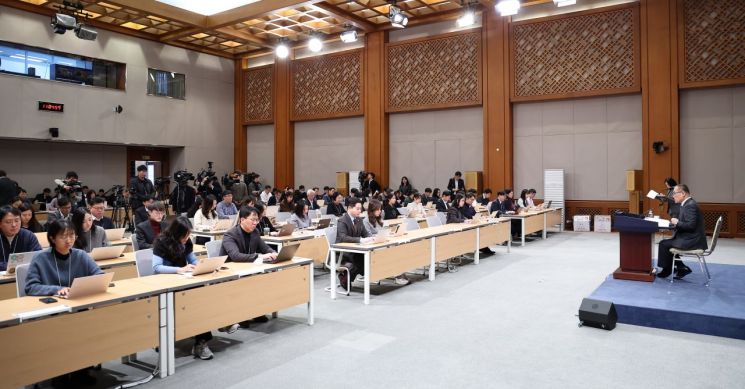
Director Wi also stated that during his visit to the United States, he discussed responses to North Korea's nuclear program and ways to resume dialogue. He said, "We shared assessments of the current situation, where dialogue with North Korea has been cut off, and discussed ways to advance U.S.-North Korea and inter-Korean dialogue," adding, "With various diplomatic events scheduled for the first half of next year in mind, we discussed ways for South Korea and the United States to coordinate their North Korea policies to resume dialogue with North Korea." He further noted that there was a "comprehensive exchange of views" on U.S.-China relations, Russia-North Korea military cooperation in the context of the Russia-Ukraine war, and the situation in Northeast Asia.
In this context, he mentioned that foreign officials have asked about the ongoing conflict between the Ministry of Foreign Affairs and the Ministry of Unification over the Korean Peninsula peace and coexistence process, which has been continuously exposed recently. He emphasized, "It is better not to show a confused appearance externally." Director Wi stated, "Differences of opinion can be part of the process of reaching a better conclusion," but also acknowledged, "The United States and Japan are aware of inter-ministerial differences. Sometimes they ask which position represents the South Korean government's stance."
He went on to say that, moving forward, opinions would be coordinated at the National Security Council (NSC) to present a 'one voice.' He said, "What is important is coordination at the NSC," adding, "It is important to proceed as coordinated, and initial controversy is not a major problem."
However, throughout the briefing, Director Wi refrained from commenting on the so-called conflict between 'independents' and 'alliance supporters.' He said, "There is always a lot of controversy, so it is difficult for me to comment, and if I do, things become more complicated. President Lee Jae-myung has settled many issues," adding, "Going forward, we will continue to coordinate and integrate the various opinions of different ministries through NSC discussions and strive to present the government's position with one voice." He further stated, "The focus is on controversy and disputes, but I do not think that is productive," emphasizing, "We need to set the direction through NSC discussions and strengthen 'one voice.' If I keep talking about differences, it will be reported, leading to endless controversy, which is not desirable."
Director Wi also stated that in New York, he met with United Nations Secretary-General Antonio Guterres and Under-Secretary-General for Political and Peacebuilding Affairs Rosemary DiCarlo to discuss "various current issues and ways to strengthen cooperation between South Korea and the United Nations, including peace and stability on the Korean Peninsula."
60 Trillion Won Canadian Submarine Project: Actively Explaining Korea's Strengths... 'Shuttle Diplomacy' Reaffirmed in Tokyo
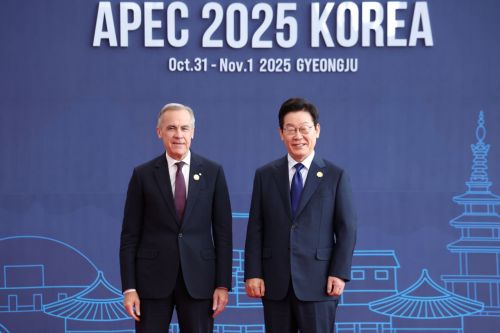 President Lee Jae-myung is welcoming Mark Carney, Prime Minister of Canada, who attended the 2025 Asia-Pacific Economic Cooperation (APEC) Summit held at Gyeongju Hwabaek Convention Center (HICO) on the 31st. Photo by Yonhap News Agency
In Ottawa, Canada, Director Wi met with Nathalie Drouin, National Security and Intelligence Advisor, and Marc-Andre Blanchard, Chief of Staff to the Prime Minister, to discuss the selection of the contractor for Canada's next-generation submarine procurement project, valued at 60 trillion won. This was a follow-up to the Korea-Canada summit held at the Asia-Pacific Economic Cooperation (APEC) Summit in Gyeongju at the end of October. The Canadian government has finalized South Korea and Germany as the final candidates for the 60 trillion won mega-project and requested proposal submissions by March next year. From South Korea, Hanwha Ocean and HD Hyundai Heavy Industries are participating in the bidding, while Thyssenkrupp Marine Systems (TKMS) from Germany is also competing.
Director Wi stated, "We mainly discussed ways to enhance security and defense industry cooperation between the two countries," adding, "We agreed to strengthen the security and defense partnership between South Korea and Canada." In particular, regarding Canada's next-generation submarine acquisition, he said, "We actively explained our strengths and emphasized that we can effectively contribute to strengthening Canada's defense capabilities."
Recently, Canada became the first non-European country to join SAFE, the EU's joint arms procurement program, creating a favorable environment for European bidders such as Germany. Therefore, continued efforts to persuade the Canadian side are needed. Director Wi explained, "Our submarines do not fall behind in terms of performance and investment, but our competitor is a NATO member, which means a deeper level of security cooperation. It is difficult to say that South Korea is superior in status as a security partner."
Director Wi also met with Chief Cabinet Secretary Minoru Kihara, Foreign Minister Toshimitsu Motegi, and National Security Secretariat Secretary General Keiichi Ichikawa in Tokyo. He stated, "We agreed on the need for joint efforts by both countries to ensure stable Korea-Japan relations, including the continuation of shuttle diplomacy, and discussed a wide range of issues between the two countries," adding, "Amid a grave international situation, we also had a frank exchange of views on the regional situation and agreed on the need to expand communication and cooperation among countries in the region."
© The Asia Business Daily(www.asiae.co.kr). All rights reserved.
![Clutching a Stolen Dior Bag, Saying "I Hate Being Poor but Real"... The Grotesque Con of a "Human Knockoff" [Slate]](https://cwcontent.asiae.co.kr/asiaresize/183/2026021902243444107_1771435474.jpg)

















