Rising Proportion of Ultra-Short-Term Workers
"Necessary to Proceed with Sufficient Discussion"
An analysis has found that the weekly holiday allowance system is increasing the number of ultra-short-term workers who fall into the blind spots of worker protection systems. Experts have evaluated that while the abolition of the weekly holiday allowance should be considered, it should be pursued cautiously over the medium to long term.
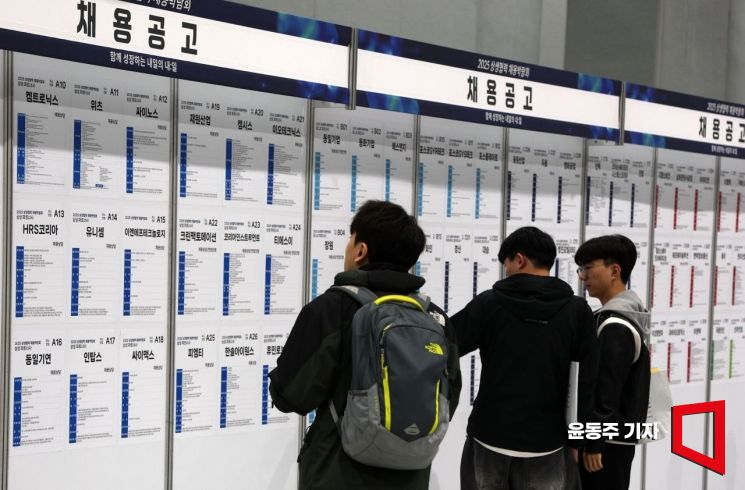 Job seekers attending the '2025 Win-Win Cooperation Job Fair' held last October at COEX Magok in Gangseo-gu, Seoul, are looking at job postings.
The Korea Development Institute (KDI) has published a KDI Focus report titled "Factors Behind the Increase in Ultra-Short-Term Work and Policy Recommendations." The report examines the background and implications of the rise in ultra-short-term workers in the labor market since the 2010s, and provides policy suggestions.
According to the Survey on Working Conditions by Type of Employment, the proportion of ultra-short-term workers (those working less than 60 hours per month) among wage workers increased from 4.7% (487,000 people) in 2012 to 8.5% (1,538,000 people) last year, more than doubling over 12 years. In particular, among new employees with less than one year of service, the proportion of ultra-short-term workers has exceeded 20% since the 2020s, accounting for a significant share.
The problem is that ultra-short-term work has a low coverage rate under basic worker protection systems, including social insurance. The report also predicts that signs of improvement are minimal. Since most worker protection systems only apply to those working at least 60 hours per month, ultra-short-term work is considered to be left in a blind spot.
Jung Suhwan, a research fellow at KDI and author of the report, pointed out, "Ultra-short-term work is a representative form of labor that exists in the blind spots of worker protection systems in the labor market." He added, "The rapid increase in ultra-short-term work means that jobs in the blind spots of worker protection systems are also increasing rapidly, so it is necessary to analyze the causes and respond with appropriate policies."
The report states that the institutional structure, in which costs and the scope of protection change at the 60-hour-per-month threshold, leads to two phenomena. First, when monthly work hours exceed 60, the change in costs is so drastic that companies are incentivized to hire ultra-short-term workers who work less than this threshold. Second, as employers seek to avoid cost changes by opting for ultra-short-term labor, efficiency is negatively impacted.
In particular, the report evaluates that since the 2010s, the improved compliance with systems protecting workers working more than 60 hours per month, as well as higher compliance with existing systems, have become factors driving the increase in ultra-short-term work. Jung noted, "There is empirical correlation between improved compliance rates and the increase in ultra-short-term work, which explains a large part of the growth in ultra-short-term workers."
Jung also advised, "The current labor market structure, in which average costs can change by more than 40% at a specific point, needs to be improved to mitigate cost disparities." He explained, "To reduce the cost gap at the 60-hour-per-month threshold, it is necessary to reconsider the weekly holiday allowance, which accounts for the largest portion of the cost difference."
The weekly holiday allowance is a system introduced in the 1950s to guarantee one paid holiday per week, ensuring a minimum income for low-wage workers. Although the minimum wage system, which serves the same purpose, was later introduced, the weekly holiday allowance has been maintained to this day. Jung stated, "While it is necessary to reconsider the weekly holiday allowance, it is desirable to set this as a medium- to long-term goal and pursue it cautiously."
Jung further explained, "A sudden change to the current structure, where costs can change by up to 40% at the 60-hour threshold, could shock the labor market. It is necessary to proceed gradually and supplement and mitigate the changes through a combination of various policies." He added, "It is important to carefully pursue these changes with sufficient discussion, considering their impact on the entire labor market."
© The Asia Business Daily(www.asiae.co.kr). All rights reserved.
![Clutching a Stolen Dior Bag, Saying "I Hate Being Poor but Real"... The Grotesque Con of a "Human Knockoff" [Slate]](https://cwcontent.asiae.co.kr/asiaresize/183/2026021902243444107_1771435474.jpg)
















