Fines for Media Outlets and YouTubers
Distributing Illegal or Fake/Manipulated Information
Ambiguity and Lawsuit Concerns
Remain Despite Ruling Party's Amendments
Opposition Labels It a "Super Gag Law"
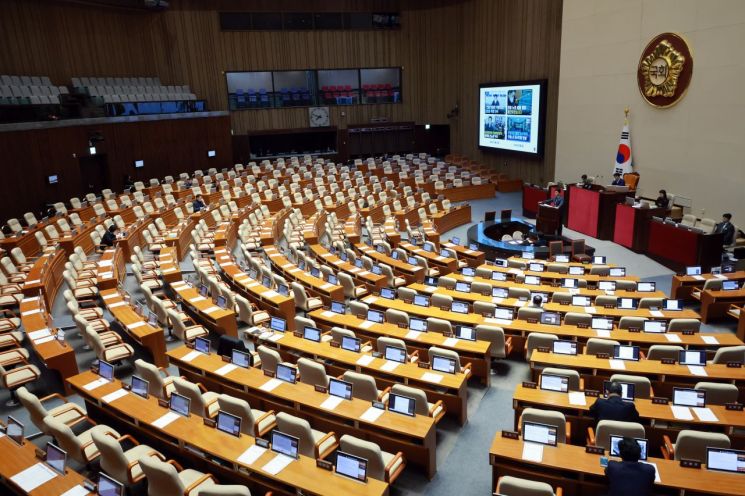
The amendment to the Information and Communications Network Act, known as the "Fake News Eradication Act," is expected to pass the National Assembly plenary session on December 24, led by the Democratic Party of Korea. As a result, the filibuster (unlimited debate) phase between the ruling and opposition parties over key bills, such as the law to establish a special court for insurrection cases that began on December 22, will come to a close for now, but controversy over the bill’s constitutionality is expected to continue.
Democratic Party leader Jung Cheongrae stated at the Supreme Council meeting that day, "We plan to process the Information and Communications Network Act," adding, "We will firmly eliminate intentional fake and manipulated information, as well as illegal information." The bill stipulates that if a media outlet or YouTuber distributes illegal or fake/manipulated information, they can be required to pay up to five times the amount of damages, and if such information is spread maliciously or repeatedly, an administrative fine of up to 1 billion won may be imposed.
The People Power Party has labeled this a "super gag law" that infringes on freedom of expression, and Assemblywoman Choi Sujin began a filibuster in protest. However, the Democratic Party and its allied parties plan to end the unlimited debate and pass the bill at around 12:19 p.m., 24 hours after the bill was introduced, through a three-fifths majority vote of all members. If the bill passes the National Assembly and is promulgated by the president, it could take effect as early as the end of June next year.
The bill has undergone repeated revisions right up to the plenary session, and controversy is expected to persist even after its passage. The Science, ICT, Broadcasting, and Communications Committee, which has jurisdiction over the bill, had set "intent to harm others" and "public interest infringement" as conditions for prohibiting the distribution of fake/manipulated information, but these were deleted during the review by the Legislation and Judiciary Committee, only to be reinstated during the process of submitting the bill to the plenary session. Conversely, the clause on defamation by stating facts, which the Science, ICT, Broadcasting, and Communications Committee had abolished, was revived by the Legislation and Judiciary Committee to allow punishment only in cases involving "personal privacy." However, the scope of punishment was expanded again in the plenary session to include "public facts." If someone publicly reveals facts that damage another person's reputation, they may be sentenced to up to three years in prison or fined up to 30 million won. To prevent excessive litigation, the clause requiring a complaint from the defamation victim for prosecution (a so-called "complaint offense") was deleted from the version submitted to the plenary session.
Despite repeated amendments, criticism persists that the scope of fake/manipulated information remains ambiguous, raising concerns that politicians or businesspeople could file excessive lawsuits to block critical reporting. The People Power Party urged a complete halt, stating, "The Democratic Party is pushing through a rushed legislation with patchwork amendments." Pro-government groups, such as the National Union of Media Workers and the People's Solidarity for Participatory Democracy, also expressed concerns about the bill’s constitutionality.
Controversy over the constitutionality of the law to establish a special court for insurrection cases, which passed the plenary session the previous day, also remains unresolved. The Democratic Party initially planned for a recommendation committee composed mainly of external figures, such as the Minister of Justice, to recommend judges for the special court. However, as controversy over constitutionality grew, the provision for judge recommendation through the committee was removed, and instead, each court’s judges’ council and case allocation committee were given responsibility for forming the special court. Leader Jung stated, "Despite many adverse conditions, the special court for insurrection cases will be established, and I hope for stern judgment." However, there are concerns that forming a court retroactively for ongoing cases may violate the principle of equality.
As a result, the power struggle between the ruling and opposition parties is expected to continue. The parties had originally planned to hold the final plenary session of the year on December 30, but at a meeting of the floor leaders the previous day, they agreed to adjust the plenary session schedule after reviewing the results of the confirmation hearing for Kim Hocheol, the candidate for chairman of the Board of Audit and Inspection, on December 29.
© The Asia Business Daily(www.asiae.co.kr). All rights reserved.
![Clutching a Stolen Dior Bag, Saying "I Hate Being Poor but Real"... The Grotesque Con of a "Human Knockoff" [Slate]](https://cwcontent.asiae.co.kr/asiaresize/183/2026021902243444107_1771435474.jpg)















