Despite Concerns Over Losing Moderates, Party Pushes Ahead With 'Strengthening Party Sentiment'
Focus on Jang Donghyeok's Decision After Calling for 'Change'
The People Power Party's Local Election General Planning Committee has maintained its original plan to raise the proportion of party member votes in next year's June 3 local election primaries from the current 50% to 70%. Amid concerns that this move goes against public sentiment, it is expected that the party leadership's final decision will not only determine next year's local election strategy, but also influence the interests of candidates and regions.
The General Planning Committee held its final full meeting the previous day and decided to recommend to the leadership a plan to change the current 50-50 ratio between party member votes and public opinion polls to a 70-30 ratio. This indicates a focus on strengthening party sentiment rather than expanding to moderates. The current plan, which reflects party sentiment and public sentiment equally, was also included as a minority opinion in the recommendation.
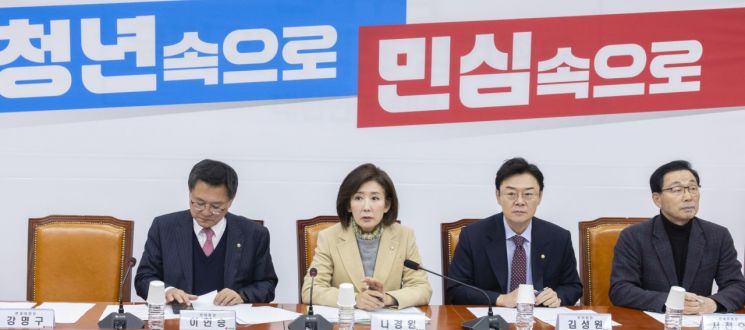 Na Kyung-won, a member of the People Power Party and chairperson of the Local Election General Planning Committee (second from the left), and committee members are starting the full meeting of the Local Election General Planning Committee at the National Assembly on the 23rd. Photo by Yonhap News
With the ball now in the leadership's court, attention is focused on the final decision of People Power Party leader Jang Donghyeok, who has hinted at expanding the party's base to secure victory in next year's local elections. Jang, who previously faced a leadership crisis due to a hardline approach that focused solely on the party's core supporters, was credited with strengthening internal unity the previous day by launching a high-stakes, up-to-24-hour filibuster.
However, as criticism over the 'expansion of party sentiment' primary rules has continued both inside and outside the party, it is expected that tensions will be inevitable during the leadership's final decision-making process. A first-term People Power Party lawmaker said, "Ultimately, the decision by Leader Jang is the most important," adding, "It would be highly risky to push forward with a strategy that appeals only to the hardline base, as recommended by the committee."
Since last month, when the General Planning Committee first proposed the 70% party sentiment plan, dissatisfaction has already been expressed publicly. Seoul Mayor Oh Sehoon objected, saying, "At a time when we should be pursuing expansion, we are instead heading toward contraction," and Seoul district party heads also issued a statement opposing the plan. Their argument is that, since local elections are held nationwide, public sentiment should be reflected as much as possible, rather than just party sentiment.
Changing the local election primary rules requires an amendment to the party regulations, which must be approved by the Supreme Council after it decides to convene the Standing National Committee, and then by the Standing National Committee itself. It is also possible for the Central Party Nomination Management Committee to decide on the selection method.
© The Asia Business Daily(www.asiae.co.kr). All rights reserved.
![Clutching a Stolen Dior Bag, Saying "I Hate Being Poor but Real"... The Grotesque Con of a "Human Knockoff" [Slate]](https://cwcontent.asiae.co.kr/asiaresize/183/2026021902243444107_1771435474.jpg)















