Accelerated Establishment Targeted by 2026
The Ministry of Agriculture, Food and Rural Affairs announced on December 24 that Sagot-ri in Hwaseong City and Hyeonmae-ri in Anseong City have been selected as pilot sites for agrivoltaic solar power projects in the Seoul metropolitan area.
On October 13 of this year, the government unveiled a plan to establish pilot agrivoltaic solar power projects in the metropolitan area, aiming to simultaneously increase farmers' incomes and strengthen food security. To ensure swift implementation, the government held briefing sessions for Gyeonggi Province and the relevant local governments in October, followed by on-site meetings and community briefings through November.
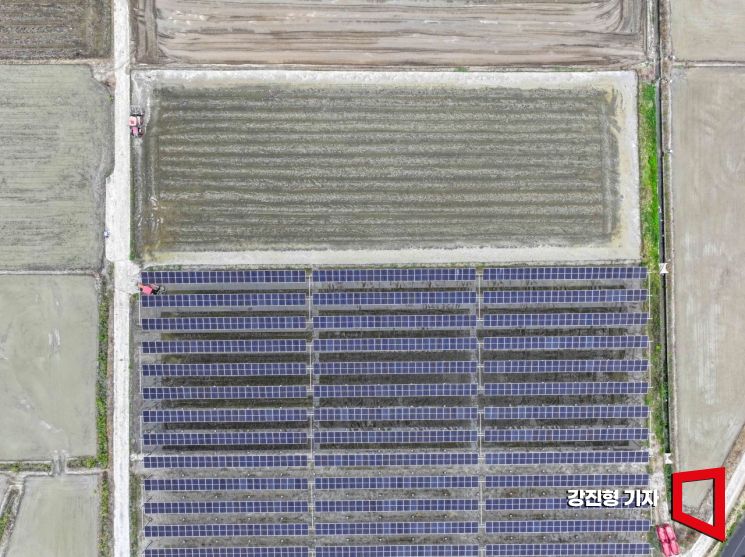 Agrivoltaic solar power plant installed in farmland in Wolpyeong-eup, Yeomsan-myeon, Yeonggwang-gun, Jeollanam-do. Photo by Kang Jin-hyung
An official from the Ministry explained, "Initially, about 20 villages expressed interest, but five villages ultimately applied, and among them, two sites with the most favorable conditions were selected." The selection process focused on evaluating community acceptance and plans for utilizing joint village funds to maximize the project's chances of success.
At the two final sites, Sagot-ri and Hyeonmae-ri, solar power facilities with capacities ranging from 1 to 1.2 megawatts will be installed on reserve farmland of at least 2 hectares owned by the Korea Rural Community Corporation. After forming village cooperatives and completing the necessary permits and construction, it is expected that these communities will begin generating revenue from power production next year.
In the coming year, the Ministry plans to provide nationwide education, promotion, site selection, funding, and comprehensive consulting support for the development of “Sunlight Income Villages.” Additionally, through the identification of additional idle land such as marginal farmland and livestock sheds, along with farmland and reservoirs owned by the Korea Rural Community Corporation and local governments, the Ministry aims to expand the number of Sunlight Income Villages beyond the initial target of 100.
Park Haecheong, Director of the Rural Carbon Neutrality Policy Division, stated, "The pilot agrivoltaic solar project in the metropolitan area and the Sunlight Income Village initiative are not government-led support programs, but community-driven projects where residents form cooperatives and directly pursue power generation businesses." He added, "Once the support and cooperation system between the government and local governments is finalized early next year, we expect the establishment of Sunlight Income Villages to gain full momentum."
© The Asia Business Daily(www.asiae.co.kr). All rights reserved.
![Clutching a Stolen Dior Bag, Saying "I Hate Being Poor but Real"... The Grotesque Con of a "Human Knockoff" [Slate]](https://cwcontent.asiae.co.kr/asiaresize/183/2026021902243444107_1771435474.jpg)















